Showing posts with label media. Show all posts

Monday, December 1, 2014

CBS 5 trashes local protester, gives pass to former Steubenville coach who started fight with protesters

Belardine (in black) attacks demonstrators in Scottsdale on Saturday (Dennis Gilman/Phoenix New Times)

CBS 5's Karla Navarrete's story on a protester, arrested at an anti-police protest, featured details on the man's family background, including naming his father and occupation. When it came to the other two men arrested that night, who were accused of attacking protesters, there was no such effort, despite one of the men's involvement in a crime which prompted international outrage.  Had Navarrete googled either of the other men who were arrested after instigating a fight with demonstrators, she might have learned that one of the two men arrested, Matthew Michael Belardine, was involved in the Steubenville rape case.

Belardine in court in Steubenville last April (AP Photo)

Matthew Belardine, while never a suspect in the rape, was at one time the volunteer coach for the Steubenville High School football team and hosted the party that the Steubenville students attended the night that the sexual assault occurred.  In April he was sentenced to 10 days in jail after he plead no contest to serving alcohol to a minor and making false statements to investigators. Belardine could have faced up to six months in jail for each of those charges, in addition he was sentenced to one year of probation, due to expire in April of 2015. Belardine was arrested after an investigation into other crimes tied to the rape of a student by Steubenville football players in 2012.  The volunteer coach was charged along with a district principal and the Steubenville superintendent for their roles in knowing or covering up the assault of the student.

WATCH AS TROY HAYDEN MAGICALLY TURNS A STORY ABOUT DPS DROWNING A MAN INTO A PRO-MCSO FLUFF PIECE

Matthew Belardine's arrest for assault and disorderly conduct on Saturday night occurred after he and a friend attacked participants in the anti-police demonstration on Saturday night, some of whom were wearing the notorious Guy Fawkes mask. His companion Samuel Lee Busic was charged with assault.  Videographer Dennis Gilman captured Belardine's pal Samuel Busic charging through the crowd screaming "Fuck Anonymous!"


Why was Busic so angry with Anonymous? Well maybe because Anonymous played a central role in driving the Steubenville story into the national media and ensuring that charges were brought by officials, who up to that point seemed more inclined to ignore the whole thing, covering up for a popular sports team and players. Specifically, Anonymous doxxed Belardine. Anonymous has also been active in the protests in Ferguson, in particular outing Klan members publicly, including dumping the data of a local KKK leader.

Why was Channel 5, which was so vigorous in digging into the life of a protester accused of a property crime, so curiously negligent when it came to a man now charged with assaulting people at that same protest? The protest on Saturday night was in opposition to police brutality, specifically in Ferguson but also in general. KPHO has been accused over the years of being too cozy with police and specifically the local police union PLEA. And apparently the tool kit of the modern KPHO reporter doesn't include the modern classic, the Google search. And do we need to mention the obvious racial difference between those arrested and the treatment they got? This latest story is another stain on their credibility.


More local media follies:

Emails reveal: New Times Reporter Took a Mulligan on Occupy Phoenix

Fox 10 Producer "Thankful" for drunk driver crashing into Phoenix home

Monday, March 10, 2014

True Detectives: Branding PPD'S Major Offenders Bureau

Thanks to the popularity of the HBO show, "True Detective," Americans are pretty familiar with the concept of the Easter Egg, the inside joke or hidden message buried within the larger story. The recent media coverage of the killing of Detective Hobbs also contains just such a buried theme: the coming out party for the Phoenix Police Department's Major Offenders Bureau (MOB) and the return of the police apparatus of political repression. But we'll get to that in a minute.

What words would you use to describe the local media's coverage of police shootings? Comprehensive? Surely not. Critical? Hardly. Dismal? Getting warmer. Ass-kissing? Yeah, that's more on the money.

Let's start with this because it's kind of a metaphor for the general failures of Valley media to critically cover police shootings. AzCentral's map of officer-involved shootings in the Valley leaves a lot to be desired. By our count Monday's two shootings by Phoenix PD brings the number of times Valley cops have opened-fire on residents to at least 12 (note, by the time of publication and on the day of Hobbs' funeral, DPS had shot another man in Tempe). Their map lists six. Absent from their map, for instance, is a man shot by Glendale PD's fugitive task force in February. Also missing is the shooting of Juan Nino by a US Marshall in front of the Food City on 48th St. and Southern. Updating the map seems to be a low priority for them.

Missing a few killings, but what's a few
shootings between friends? (Via AzCentral)

And, if following police shootings wasn't your thing, you'd be hard-pressed, given any of the coverage of the two shootings -- one of which involved the death of an officer -- to know that cops in the Greater Phoenix Area are on another one of their epic shooting sprees. In fact, just hours before the shootout involving Detective Hobbs and his partner, Detective Casados, police opened fire on alleged burglars fleeing a break in at a gun shop. In 2012, there were 47 shootings involving cops, and according to AzCentral themselves, by November 2013 the cops were already safely in record territory with 50, with a grand total of zero charges filed against any officers.

That's a heck of a record. The system works, right?

And despite what you might think based on the recent wave of effusive praise emanating from editorial boards and Twitter accounts since the most recent shooting, policing is not a terribly dangerous job. In fact, despite the assertions in a recent editorial from the Arizona Republic that plays more than a little loose with the facts (opting for an 11-year average rather than the decades-long downward trend), officers killed by gunfire nationwide is at its lowest since 1887. More officers are killed in traffic accidents.

 READ MORE ABOUT PPD'S SURVEILLANCE PROBLEMS


In fact, overall deaths on the job among law enforcement is at its lowest since 1959, and that includes the car wrecks. The fact that they work in a profession that requires a lot of driving and yet still rate a safer profession that truck driver says a great deal about the amount of risk that officers really take. So, as policing has gotten safer, and threats to officers have declined, cops have been shooting more people.


Also noticeably missing from the coverage is any kind of critical analysis. When the shooting happened, the media eagerly jumped on the pro-cop band wagon, instantly transforming into direct advocates for officers. Channel 12 made a sign for people to write their condolences on and placed it at the memorial, making sure to tweet it out for the PR points. Channel 3 organized a telethon with the 100 Club of Arizona, a group that supports law enforcement.

Meanwhile, reporters made sure to tag @PhoenixPolice in their tweets, as if seeking approval from the authorities. What other kind of news event warrants this level of unquestioning fealty to the official story as delineated by the authorities? When else is journalism suspended in a similar way? Certainly not for the victims of police violence, where reporters are always careful to get "both sides of the story." Meanwhile, the trend of rising shootings of civilians by police shows every sign of continuing. But we at Down and Drought couldn't find a single article about the Hobbs shooting that even mentioned it, something that occurs to us as crucial to contextualizing a situation like this. Certainly it would be hard to argue that it's not relevant.


Local media seem to be some kind of competition to outdo each other in heaping praise on the police, both specifically and in general. KTVK Channel 3 reporter Natalie Brand has obsessively covered the shooting death of officer, writing over 50 consecutive tweets in response to the officer's death and subsequent publicity and public relations events organized by PPD. While a clear standout, Brand's behavior is in line with that of her colleagues, who tweet photo after photo of the memorial and dutifully praise the police who, despite scandal after scandal, are immediately transformed into saints the moment one of them is shot or killed.


We here at Down and Drought understand the desire not to speak ill of the dead. But it doesn't take a deep understanding of the history of Valley police misconduct to feel betrayed as news consumers by the coverage that follows police shootings. Consider the example of the recent expose of Mesa PD's antics in their so-called "Fun House," and the department's expressed desire to purge employee records that would include complaints. We have to wonder when exactly criticism will take place if the records are purged and media are active partisans for the boys in blue when they are at their most violent. In this context of disappearing information, treating slain cops as heroes by default seems questionable at best, and certainly bad journalism.


Indeed, just a cursory Google search of Detective John Hobbs turned up several interesting tidbits. For instance, an October 2000 article in the Arizona Republic reports that Hobbs was involved in a fatal accident with a pedestrian. According to the piece, Hobbs was off duty and driving at around 10:30 at night when he ran over Burdice Monson, who was walking along an I10 entrance ramp after his car broke down. The Republic story says no alcohol test was administered to Hobbs, though police said despite this that they didn't believe drinking was involved in the accident.

A search of Maricopa Superior Court records revealed (CV1998-001445) what appears to be a lawsuit involving Hobbs in which he was defended by the city. It resulted in $6328.10 payout to the plaintiff. Unfortunately, we don't have the resources as humble bloggers to research this further but we'd sure like to know what it was about.

Further research revealed a court document detailing an encounter that resulted in the imprisonment of a man who confronted Hobbs on a stakeout. Hobbs was in plain clothes in an unmarked car. Haidar Muhsin al Bazony, eventually convicted of aggravated assault in the incident, was responding to a call from his wife who was concerned about men lingering outside her townhouse.


Bazony, armed with a handgun and backed up by a friend he recruited to aid him, approached the car, peering inside. The document in question, an appeal, disputes the timing of the encounter as described by the state. The appeal claims that Hobbs pointed his gun at Bazony first not the other way around. Each testified in court that the other had aimed their weapons first. According to the appeal, the timing was critical to the conviction. Keep in mind that Hobbs wasn't dressed in a uniform and wasn't in a marked vehicle. The request was denied and Bazony was sentenced to the absolute minimum by the court.

Meanwhile, a simple internet search on Hobbs's partner, Albert Casados, returns an excessive force complaint made in 2011 against Casados. The document further alleges denial of medial aid. Parsing the legalese, it appears that the court found sufficient cause to allow the charges to move ahead against Casados. Again, we don't have the resources to pursue this further, and we couldn't find any additional information about it on the internet. Another casual internet search turned up another instance in which Casados fired his weapon on the job, in this case killing Ricky Campillo Ramirez, who police said had a knife.

The point in bringing these cases and allegations forward is to show that there is ample reason for skepticism when considering the actions of both officers, and also to warrant holding off on the parades and beatification of the officers as automatic heroes merely because of the job they do. A March 7 Arizona Republic article on the Major Offenders Bureau (MOB), the division for which Hobbs and Casados worked, is practically a hagiography for the unit. The article, which serves as a coming out party of sorts for MOB, fails to mention that the MOB doesn't just go after the “worst of the worst.” The suspension of the media's critical role in this case, however, has rubbed off onto coverage of MOB, which has made it possible for the PPD to present this unit to the public without criticism.

But the media's reporting on MOB doesn't cover the whole story. As emails released to the Center for Media and Democracy detail, MOB was also heavily involved in the repression of Occupy Phoenix, despite the total lack of felonious or violent activity on the part of occupiers. Sgt. Saul Ayala, a member of MOB was dispatched by his superiors to infiltrate Occupy Phoenix, where he advocated violence, perhaps hoping to provoke the very actions the MOB publicly claims to police. Ayala got his orders from another MOB member, Career Criminal Squad Sgt. Tom Van Dorn.

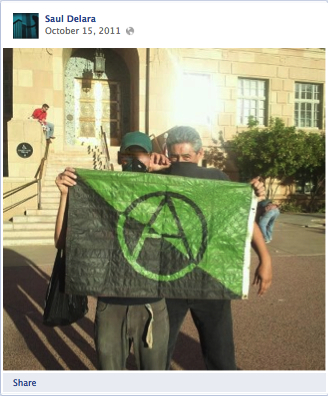
Sgt. Saul Ayala (right) poses with an occupier in a photo from his phony Facebook page

Just last month Down and Drought uncovered a Facebook post by Van Dorn joking about wanting to pull over parents selling Girl Scout cookies in his new beat, the poor and heavily Latino, Estrella Mountain Precinct. As we said, the response to the killing of Officer Hobbs is at least understandable (although not excusable), but just why such lack of critical reporting should also apply to MOB in general isn't clear. Natalie Brand tweeted that the PPD's press conference "made me cry," making us wonder, are the media being played by PPD?

We here at Down and Drought, even with our limited tools, routinely uncover examples of police racism and misconduct. Surely the media, with its vastly greater resources, can do more. Just in the last year we uncovered officers' racist tweets and Facebook posts, and we delved into the police surveillance and infiltration of Occupy Phoenix (while the media almost entirely ignored the revival of the political repressive functions of the police). And when stories about police violence have broken, we contextualize them, as we did in the case of a Phoenix Police Lieutenant accused of domestic violence (another epidemic of police violence that reporters refuse to connect). Why this is impossible for local media completely baffles us. Are local reporters too cozy with the cops?

Second chances are only for cops
It's worth noting that the media had no problem reporting on the target of the Hobbs/Casados raid that day, William Thornton. To the media, the civilian's record was fair game, but not the officers. The Republic's Lauri Roberts went so far as to declare that Thorton had been given too many second chances. This piece came on the heals of another she authored ordering us to support the boys in blue. Thornton's past is deemed sufficient justification for his shooting, but past allegations and suspicions abut the two officers is off limits. Cops get as many chances as they need. Reporters like Brand got on the internet more than 50 times to tweet praise for officers but couldn't be troubled to visit Google once and report on what she found. In the case of shootings by police, especially when an officer is wounded or killed, the past is irrelevant. Off limits, even.

The local media may be enamored of the police, seeing them as defenders of order and all things good. But many Phoenicians live in a completely different world. One in which the police act a lot differently than they do at press conferences. When reporters purge their critical faculties with regard to the police, and operate instead as the megaphone boosting and bolstering the cops' public image, they don't just do us a disservice, they discredit their own trade.  Even more so in cases of deadly force. And in this situation, the collective media suspension of disbelief has allowed PPD to pass off a unit that poses a serious threat to civil liberties instead as a thin blue line protecting civilization from violent thugs. In the era of mass protest and increasing alienation from the political system, the importance of that shouldn't be lost on anyone.

CLICK HERE FOR MORE OF DOWN AND DROUGHT'S COVERAGE OF THE OCCUPY PHOENIX FILES AND POLICE POLITICAL REPRESSION

Wednesday, February 19, 2014

Public Relations: The love affair between Valley cops and the news media


 A Symbiotic Relationship: 3TV news crew poses for a selfie with Phoenix PD's Press Information Officer (PIO) Steve Martos

It's no surprise that local news content is full of pre-packaged "video news releases" which make up much of the content that supplements the local coverage.  While some of the news is received via satellite from international news organizations such as the Associated Press, often there are stories planted by public relations firms and advertisers disguising their product in a news story.  Local television stations have relied on video news releases to keep the costs of producing a newscast low and the profits for the station's owners up, even as audiences for local newscasts have been dwindling for years. The pervasiveness of the video news release has reached such absurd proportions that even late night talk host Conan O'Brien has a regular feature on his show lampooning the frequency of local newscasts that report the same story, word for word, in markets across the country.


However, it is not just PR firms and ad agencies making the most of local news media's need for content that is cheap and easy to obtain, police departments have also become experts at using the media to boost their image by adapting the methods used by advertisers to craft a "brand identity" for consumer products. In "Branding Your Agency: Creating the Police Department's Image", a 2004 article published in Police Chief Magazine, police chiefs Gary J. Margolis of the University of Vermont and Noel C. March of the University of Maine encouraged police chiefs to seize control of their department's public image by turning to the strategies of advertising and PR firns in creating a brand identity for policing.

Margolis and March cite a 2001 "Public Image of the Police" report from George Mason University which concluded that negative perceptions of the police stem from personal experience, rather than the success of police in reducing crime or an individual's favorable interaction with a law enforcement officer.  Key to the study was the finding that people's perception of the police are often formed by their exposure to police actions in the media, that the media is the primary source for most people about crime, and in the absence of a narrative controlled by the department it may appear that police are unable to stop crime. 

Valley police departments were taking notes, as Press Information Officers (PIO) make frequent appearances on the evening newscast to share information that departments want released to the public.  In addition to the various departments' de facto anchors making regular appearances on the local news, press releases from law enforcement agencies are often reprinted with minor changes made in the arrangement of sentences to avoid plagiarism.  That these press releases are appearing on local news websites and newscasts as news items, complete with all the authenticity associated with a journalist's byline, should be prompting outrage at the local news and police agencies. 

We here at Down and Drought follow the local news pretty closely, so we thought we might have some fun comparing the press releases from law enforcement agencies with news articles from our esteemed "free and independent" fourth estate. How bad is it?  Take a look at two recent stories in the Phoenix news, compare the police press releases to the slightly altered news content and ask if it stands on its own as an independent piece of journalism.

Below is a screen capture from the January 27, 2014 press release from the Mohave County Sheriff's Office announcing the search for a suspect involved in a bank robbery in Golden Valley, Arizona.  The press release includes photos of the alleged robber as well as information specific to the person's build, their behavior during the alleged robbery, and the the appropriate contact information for the department(s) investigating, in the case a viewer might have information the cops would find useful.


The photos below are both screen captures from articles published on the website for KTVK Channel 3 and KPHO Channel 5.  Both websites ran the press release with slight modifications from the original writing and were published under the names of employees at the station.   The KPHO article, credited to Steve Stout, a longtime editor of valley news publications from the East Valley Tribune to his current gig at KPHO, is nearly identical to the press release.


Both articles come pretty close to qualifying as plagiarism, as they are nearly identical to the Mohave County press release, and yet they are not the exception.  Again, the same pattern with a Tempe police press release on the arrest of an alleged bike thief:


Followed by screen shots taken from two articles from local news websites which include large sections of the press release which are rearranged just enough to keep it from being a plagiarized article.


The local press, and as seen above KTVK and KPHO, have no qualms about reprinting police news releases and remaining completely uncritical about the information contained within.  Just like the video news releases released to stations by PR agencies, law enforcement agencies know they have an open door with the local media, forever hungry for cheap, garish stories which come to them, saving any of the employed journalists from having to do any of the actual leg work and research required for a balanced piece of journalism.

In plain terms, there's lots of advantages for the police in crafting a brand identity which portrays the police as the solution and final word to the problems of the community. Aside from that, they need the good publicity! Just last year valley cops killed over 50 people in shootings alone, a key community relations officer was arrested for sex with minors, and Phoenix officer Richard Chrisman went to prison on assault and manslaughter charges.


It was during the week that Chrisman was sentenced when the Phoenix police's PR division may have tried to deflect attention from the Chrisman verdict by planting a story about officers helping a needy family at Christmas.  The story, which appeared on KNXV ABC15, cited Phoenix police officer James Holmes, as he described Phoenix cops as having a "tough and dangerous job", and frequently coming to the aid of the citizenry, at what now sounds like potentially great peril to their well being.  Whether out of laziness or complicity, the journalist Lauren Vargas deemed it unnecessary to also include the information that James Holmes is a PIO for the Phoenix police, and the story aired on December 20, 2013 the day that one of the most notorious cops in Phoenix's history was sentenced to seven years in prison.

Writer JJ Hensley at the Arizona Republic wrote a lengthy article on the police shooting spree of 2013 and tackled a number of contributing factors which critics and defenders of the police say have contributed to so many shootings in the Valley.  Hensley cites the rate of assaults on officers and the continuing militarization of the police as two of the main reasons for the change in policing.

Hensley ends the article with a section on the public's response to trigger-happy cops, noting a lack of public outrage to the well-publicized shootings.  But he fails to consider one of the biggest factors as to why there may be a lack of outrage when officers gun someone down: that his own profession treats the local police department as an in-house bureau which provides the footage that often bleeds and leads on the local news.

While the public's passivity to police killings cannot be entirely attributed to the media's coverage and working relationship with the police, it is worthwhile to return to Margolis and March's article in Police Chief Magazine and their emphasis on manipulating the public's perception of the police. Utilizing the media is useful for police in expressing their department's brand identity, and to seize the narrative from their critics to ensure that, whether they are rescuing a cat from a tree or shooting over 50 people in a year, they must be seen as the community's only solution to their problems.

Tuesday, February 4, 2014

Fox 10 Producer "Thankful" for drunk driver crashing into Phoenix home

UPDATE: After media journalist Jim Romenesko picked up on the exclusive Down and Drought coverage of Fox 10 producer Juliana Vasquez's twitter meltdown, the story spread across the internet, largely being reposted by others in the news business.  The media blog TVSpy reported that Vazquez had been reprimanded by station management as a result of our story and the coverage it received from media outlets. In a statement to TVSpy regarding the Down and Drought story on Vazquez, KSAZ vice president and GM Mark Rodman stated that “This is unacceptable behavior and will not be tolerated.” TVSpy also reported that other sources had said that Vasquez was reprimanded by the station for her twitter posts.


Juliana Vasquez, a morning news producer at KSAZ Fox 10 Phoenix, may have been venting about the difficulty of finding content for the morning program when she tweeted that she was "thankful" that an alleged drunk driver crashed into a Phoenix home last night, but her logic in posting such a statement is questionable.  The Fox 10 producer tweeted: "Sometimes you just gotta be thankful that some drunk dude drivers [sic] into a house..no one was hurt, but I needed news #producerproblems".

The tweet was removed from Vasquez's twitter profile this afternoon after Down and Drought posted responses challenging the ethics of a news professional publicly posting such sentiment, and callously treating the real life problems of people impacted by an event as a "#producerproblem".  Fox 10's morning news coverage of the accident featured reporter Anita Roman boasting of the "first look" inside the home, describing how the van crashed mere feet away from where a resident had been sleeping.

FOX 10 News | myfoxphoenix.com
 
Had the residents of the home been aware of Vasquez's excitement over the crash, would they have granted the station "first look" access into their home to video tape the destruction?  Would the 17 year old family member who told reporters that he and his family were "lucky to be alive" be "thankful" that he was able to help a news station fill two minutes of air time?  Vasquez's tweet that she "needed news" is emblematic of the troublesome "what bleeds leads" mentality of local news, and a reminder that, despite the sympathy in the voice of the reporter, it's these stories which drive the advertising revenue and keep producers needing the next big tragedy.

Tuesday, June 4, 2013

When is "police brutality" not police brutality? When a cop says so.


Valley news outlets have given much attention to the youtube video featuring a Mesa police officer and his failed take-down arrest, and the subsequent Mesa police dog pile on Matatangi Sentituli Tai outside of a Mesa Circle K.

Coverage ranged from the Phoenix New Times blogger Matthew Hendley describing the police violence as "supposed police 'brutality' during a physical arrest in Mesa" and "more like a blooper reel", to channel 5's Elizabeth Erwin's article which reads like a press release straight from the department's PR flacks.  KPNX channel 12 brought one time Arpaio opponent, and ex-Phoenix PD "good cop" Paul Penzone onto their morning show to justify the actions of the officers, giving the excuse that the only reason this looks so bad is that "there should have been more aggression earlier on."

So there you have it, Valley media and police officers can agree on one thing: they know police brutality when they see it, and this was no police brutality.  A couple of the articles mention a car accident, which is audible in the video, which happened when an off duty Mesa cop ran a red light to jump in on the arrest.  To my knowledge there has been no follow up from any media outfit on the condition of the other driver, and many outlets failed to even refer to the accident.

In addition, a Mesa family is grieving the loss of their family member Joseph Moreno, he died after being tasered and arrested while the U.S. Marshals East Valley Fugitive Task Force were executing a search warrant for a parole violation.  The officers tasered the unarmed Moreno when an officer felt threatened.  The arrested man was placed in a patrol car for 45 minutes where his speech slurred and he sweated profusely.  Eventually Moreno was taken to a nearby hospital where he was pronounced dead.

The Moreno family has organized a vigil for their Joseph this Thursday, June 6th at Pioneer Park in Mesa at 8 PM.  The family is also in need of financial support, they have set up an account for donations to help with the costs of the funeral, the account is with Chase Bank and donations can be made to account number 2995635725.  The family is also receiving support from three fundraising car washes this Saturday at the following locations:
  • Taco Mexico Restaurant at 27th Ave and Camelback at 7 AM
  • 8607 E. Main St in Mesa between Sossaman and Ellsworth at 9 AM
  • Rudy's Restaurant near Ellsworth and Ocotillo in Queen Creek at 8 AM

Monday, June 3, 2013

Video shows Mesa cops responding to a trespassing call by beating the crap out of a confused man at Circle K


Proving yet again that there is no interaction that a cop can't escalate into a violent confrontation, a video causing waves today shows a Mesa officer responding to a trespassing call at a Circle K and winding up in an all-out brawl, including tasering, pepper-spraying and punching a man in the process of arresting him.

The victim, identified as Mantagi Tai by the police, had been inside Circle K claiming he was there for his medication.  According the cops, the officer demanded identification from Tai and ordered him to sit down.  When Tai refused the officer pulled out his taser and started making aggressive moves and swearing loudly, telling Tai "to sit the fuck down or you're gonna get tased".

From there, all hell broke loose, and after a very violent struggle the officer, with some help from an off duty cop passing by, a plain clothes office and an elderly security guard, managed to take Tai down hard to the ground, where they then proceed to pummel, knee and tase him violently.  At one point there are three officers, all of whom appear to be white, attacking one man of color, with a white security guard joining in at various points.  The officers knee Tai in the back violently and strike him repeatedly in the face while he is on the hot blacktop.  So far the news has ignored the obvious question of whether the officer would have reacted the way he did if the suspect had been white.

The discussion online and in the media has broken down along the lines of whether this was justified force or not.  People commenting on the raw video on YouTube seem to be mostly taking the side of the officer, but plenty assert that the video shows cops out of control and going too far.  The Mesa PD spokesman, Sgt. Tony Landato, makes sure to point out that the off duty officer who joined the fight (after crashing his truck into a light pole and possibly injuring someone) lost his pistol in the fight, and cites that as a reason for the viciousness of the cops.

But it seems this all misses the real point, which one YouTube user summed up like this:
So? None of that would be material if the cop stepped back, and used his radio, instead of revealing that he fights like a wuss. I'm not billy bad ass, but I did wrestle in high school. Pretty much any high school wrestler would have been on top of that cop.
Exactly.  Whereas ABC15 ended their coverage with some dimwitted anchorman remarking how "it does show how dangerous an officer's job is on a daily basis," in fact what the video shows is how dangerous it is for other people when a police officer shows up.  The officer is the one responsible for this whole situation.  It's his escalation, threats and then violent attack that transformed this from a simple case of removing someone from private property into a potentially life-threatening battle.

What we have here is a cop over-reacting and escalating an encounter when someone merely doesn't comply with an aggressive and rude demand for identification and an order to sit down.  An order that it's entirely possible that Tai doesn't even understand.  After all, extrapolating from his reference to medication and confused behavior, he may well be mentally ill.

Surely there was another solution to this problem.  But Mesa PD, as with police in the Valley generally, continue to demonstrate their aggressive and adversarial nature, as well as their dedication to violence and bullying as their preferred method of problem-solving, especially when dealing with people of color.

Thursday, May 30, 2013

Watch as Troy Hayden magically turns a story about DPS drowning a man into a pro-MCSO fluff piece

How do you take a story that ought to be about the cops killing a man who can't swim by chasing him into a canal, where he drowns, and magically turn it into a fluffy PR piece celebrating the tough guy heroism of the MCSO?  With the power of television journalism, of course!  Get ready to take notes, all you cub reporters, because Troy Hayden is going to take you to school!


First, of course, gloss over the obvious fact that the man being chased had not been convicted of any crime.  Mention it quickly and move on.  If you can, use military-style language like "go on a mission" to describe your story and make sure to let your viewers know that you've got a real scoop -- a first and only look into how the MCSO dive team works.  How exciting, right?  No, this will not be an investigation into why DPS chased him into the canal and let him drown.

So, at no point entertain the notion that DPS may have some responsibility for the fact that the man is dead, his body submerged in the canal.  That's why you're able to even do this story, but remember, this is a thing that just happened.  There is no one to blame, certainly not the cops, right?  The MCSO dive team is here now, that's the story.

Move on into the "body" of the piece now (whoops, was that in poor taste?).  Show some tough guy speeches by the sheriffs.  Make sure to get them talking about their dedication to each other and getting each other out in one piece.  Now you'll want to demonstrate the technology being used.  Isn't it cool?

TA-DAAAAAAA!!!!!!

Now, dive with the team.  Become one with the team.  Merge your goals and outlook with that of the team.  You know, the way reporters that embed themselves with soldiers do.  There's a reason they let you come along, don't let them down now.  They're counting on you.

It's time now for the emotional release.  He was just a kid.  What a tragedy, right?  A tragedy in which absolutely no one is to blame.  No one.  Except maybe the victim.  Certainly not DPS and, by the way, isn't the MCSO dive team so, like, totally brave and stuff?  Talk to the appropriate authority to give him a chance to affirm again how tough and awesome the cops are.  Let him get some silly cookie-cutter tough guy quote in at the end while you cut away to the murky depths you filmed earlier.  Is this an analogy for something?  Maybe.  Or maybe it's just muddy water.

Finally, make sure to thank the police for letting you be their vehicle for covering up in plain sight the murder by DPS of a man who was not charged with any crime.  Was he a victim of the cops?  Of economic forces beyond his control?  Who cares, right?  You got some badass underwater footage.  Anyhow, say your piece now.

"I want to thank the members of the MCSO dive team for taking me along and helping me show you a little about how they do their jobs."

That'll do.  Nice job.

The end.  Cut to a dog water-skiing or something.