Showing posts with label use of force. Show all posts

Monday, November 24, 2014

Tempe, Scottsdale arrest blacks at a higher rate than the Ferguson PD

Truly shocking numbers were released today in a USA Today report detailing the massive disparities in arrest rates for blacks compared to, well, everyone else. In the Valley, Tempe and Scottsdale police stood out for particular distinction, with starkly high figures per capita.

The USA Today analysis of arrest records for police departments across the country found that almost 1600 police agencies nationwide took blacks into custody at rates above those in Ferguson, Missouri, the city well-known now for aggressive and racist policing following the shooting of Michael Brown and the turmoil that resulted.

According the the article, blacks were "more likely than others to be arrested in almost every city for almost every type of crime. Nationwide, black people are arrested at higher rates for crimes as serious as murder and assault, and as minor as loitering and marijuana possession." If you're not black, you're more likely to escape arrest for comparable crimes. Notably, the data, which came from the FBI, does not track arrests of Latinos, which in the Southwest is a major shortcoming. That number would be very good to have.

Of particular note, two Valley police agencies, Tempe and Scottsdale, not only have arrest rates for blacks higher than Ferguson, but take blacks into custody at more than double (triple in the case of Scottsdale) that which has set the Missouri city on fire with accusations of police harassment of a black population by white police agency.

Source: USA TODAY

Tempe, this year found itself embroiled in controversy when ASU professor Dr. Ore, who is black, was stopped off campus by a white university cop. The stop, which many viewed as unnecessary, aggressive and racially-motivated, set off a media firestorm and enraged many residents of the college town, some of whom took their anger to a Tempe city council candidates forum, disrupting the event.

Tempe, which likes to brand itself as a progressive city despite its history as a Klan bastion, will have a hard time making the case that these numbers don't indicate a serious problem for a police force that many see as out of control. While Ferguson's arrest rate for blacks was 186.1 (versus 66 for whites) out of a thousand, Tempe's came in at a staggering 405.5! Anglos, on the other hand, got arrested at a rate of 120 per 1000 in Tempe, still almost twice that of Ferguson but over a third less frequently than blacks. If you're black, Tempe PD has its eyes on you.

Tempe police have come under scrutiny lately as a result of a program called "Safe and Sober", which involves upwards of 20 police agencies flooding downtown with officers, making thousands of stops of all kinds, ostensibly to battle alcohol consumption. Locals report harassment and profiling.

The city hasn't released final numbers on this years' program (which has run for two years now) -- including data on the race of those people that were stopped -- but numbers like those compiled by USA Today lend support to suspicions that racial bias is very likely at work. Back of the envelop calculations by local activists put the rate of stops during the three weeks that "Safe and Sober" runs in Tempe at per capita levels comparable to NYC's highly controversial "Stop and Frisk" program, which was ruled racially biased this year.

Source: STATE PRESS

The City of Tempe has suffered a series of public black eyes around the issue of policing in the last couple years. In 2013, during the first year of "Safe and Sober," local cops gunned down Austin Del Castillo in broad daylight in downtown Tempe, sending bullets into a nearby restaurant.  Before that, in May of the same year, Tempe police opened fire on a man who had broken into the wine cellar of a local restaurant downtown. Then there was the Dr. Ore incident. In July, Tempe police were caught on video beating a homeless man, again on Mill Avenue downtown. An internal review by the police of the police ruled the violence justified, although they admitted that proper procedure wasn't followed when officers failed to file the use of force paperwork that should accompany such incidents. Tempe has also raised concerns by failure to come clean on their possession and use of a StingRay cell phone spy device and whether and how that is being used to snoop on residents.

Critics of the Ferguson PD point to giant disparities between the percentage of cops who are white on the force compared to the general population. A recent NY Times article. "The Race Gap in America’s Police Departments", highlighted these discrepancies in several departments nationwide, including half a dozen in Arizona. The study didn't give stats for Tempe, but it did show clearly that whites were over-represented in all the Valley departments surveyed, sometimes skewing (in the case of the Phoenix Police Department) as much as 35% more white than the local population they police. The Phoenix PD, by the way, ranked in the USA TODAY study at 220.5 for blacks, and 77.6 for everyone else. Incidentally, the city with the smallest gap between population and police, demographically, was Scottsdale. But that was only because Scottsdale is 84% white. There isn't much room to go higher than that, although SPD does manage to still put 6% more whites on their force than the general population.

Changing the racial makeup of the police force won't solve the problem of police brutality and profiling, but the fact that they are so out of whack with the general population again gives cause to believe, combined with those radically skewed arrest stats, that profiling is probably going on. And a lot of it.


We asked TPD if use of force paperwork was 
filed in the above case and they never replied

This data also shows how little things have changed in the Valley. Tempe and Scottsdale, both historically "sundown towns" where nonwhites were strongly encouraged, to put it mildly, to make themselves scarce when nightfall came, obviously still put a heavy emphasis on the policing of blacks within city limits. As troubling as Tempe's outrageous data is, Scottsdale's is even more disturbing. It wasn't that long ago that scandal wracked the SPD when it came out that some officers were enforcing what they called a "no n*gger zone" in the wealthier parts of a generally very well-off city. These stats show an inexcusable gulf between the policing that blacks and everybody else gets in Scottsdale.

Either way, if you're black in Scottsdale and Tempe you have good reason to worry about the police. Just like Dr. Ore, you may very well find yourself attracting the special attention of local law enforcement, for no other reason than your skin color. Perhaps data like this is the reason why Tempe has been so reluctant to release the racial breakdown of the "Safe and Sober" stops. But that's all the more reason why they should.

Thursday, July 31, 2014

Cops say what they really think about ASU Professor Ore in online fourms and it's not pretty

Just keyboard warriors? Behold one cop's response to the arrest of Professor Ore. Here's what a bunch more had to say. Are you mad yet?

REM870 is a reference to a shotgun commonly used by police

On August first, ASU English professor Ersula Ore will be sentenced for "passively resisting an unlawful arrest" after Officer Stewart Ferrin confronted her for jaywalking and obstructing traffic in closed off a construction zone near the university.

The case sparked outrage, protest and even some drama at one of the Tempe city council candidate forums when outraged community members vocalized their frustration with local cops. As the scandal put pressure on ASU, the officer was put on leave and the two top bosses at the university cop shop were eventually replaced. Local dissident cop blog, The Integrity Report, has been documenting the internal shakeup which at least some officers seem to hope will create an opportunity to rein in a police force that they allege (with a good deal of evidence) is unaccountable and out of control.

Professor Ore (Photo via Phoenix New Times)
But since Ore took responsibility for her act of self-defense, much of the tension has dissipated from this once highly controversial and contentious case. Coverage was mixed in the media but it has mostly dropped off the radar as she moves towards sentencing.

Notable exceptions include a recent exchange of letters to the editor, one by former Mesa cop Bill Richardson defending Ferrin's character, followed by a response challenging it ("Letter: Police officer's personality doesn't matter"), both run in the State Press, ASU's east campus newspaper. Over the course of the scandal, one particular local weekly news blog/magazine left some very interesting things out of the story, but we'll come back to that at the end.

We at Down and Drought pay a lot of attention to the police, including cop online forums. So when we saw last week that New York Magazine had run a piece focusing on the comments from officers on various cop websites regarding the recent death of a cigarette vender, who appears to have died as a result of very rough treatment by the NYPD, we thought we'd give the Ore case the same treatment. We thought: let's see what cops have to say online about her case, under the cover of (what they think is ) anonymity.


As the NY Magazine article points out, in order to post on cop forums like PoliceOne.com, you have to register and be verified as an actual cop or retired law enforcement officer. PoliceOne.com boasts over 200,000 members and claims that they "confirm the status of all officers registering... by calling that officer’s department directly." Which means when you read opinions from commentators on their forums, you can be pretty sure you're getting the thoughts of a cop or former cop.

We were able to track some of these officers back to their departments ourselves through basic internet searches and confirm that they are in fact cops, but we weren't able to link any of them directly to ASU -- although some of the comments we looked at demonstrated knowledge of policing in Tempe and Arizona.


That said, it's important to note that the comments we're sharing here, while outrageous, weren't out of step with the general tenor of comments we found. No comments defended Ore and most posters thought that Ferrin had been too forgiving with her. As we've demonstrated before, Phoenix and Tempe police have notoriously bad senses of humor (see here, and here, and here). So there's no reason to think that they are any better than online cops in terms of their opinions.

So let's dig in and see what some cops had to say about the Ore arrest. To get things started, here's one officer making a joke referencing sexual assault. Remember, Ore objected vocally on the video about Ferrin's manhandling of her causing her dress to hike up. Thus an officer naturally thought this was an appropriate joke to make.

 In the same comment thread, another officer chimes in:


In a different post on the same site, user "SgtDavidWilliams" rushes to Ferrin's defense, counseling that she's lucky she didn't get the rougher treatment he thinks she deserved:


Advocating for less tolerance and a higher degree of violence was common in the online cop forums we looked at. Most officers took the position that Ferrin had been too kind in his interaction with Ore.

Officers also frequently argued for liberal use of the Taser. One user hinted in a "wink, wink, nudge, nudge" sort of way that "I did see a taser on his belt, correct?" In the comment below, the reference to "sparky" (the taser) may or may not be a double entendre also alluding to the ASU mascot, but it certainly indicates a casualness that is disturbing when it comes to the use of a weapon that has been linked to many deaths over the years.


Along similar lines was another comment boasting that the "college professor would've met the pavement far sooner had I been arresting her." Yet another joked that Ferrin should "probably work on that straight arm bar takedown." Later in the thread another member says, "She really needed to taste the color of the paint on the hood."


Another set of comments focused on Ore's race and gender, reflecting the usual tact and sophistication that one tends to expect from the reactionary right.


In an era of increasing skepticism and worry about the police, even on the traditionally law and order right, comments like those we found don't do cops any favors in the PR department. If white middle class people -- the traditional base of support for law enforcement, no matter how brutal -- are worried about their interactions with police then it's an indication of something significant going on. Police should be worried. The carte blanche they've had for, well, basically forever may be in danger.

And those curious omissions I mentioned at the beginning? One of the curious features of the Ore coverage was the oddly reactionary treatment from the Phoenix New Times, spearheaded by Ray Stern. Stern went pretty hard against Ore. He conceded Ferrin's approach appeared "mildly thuggish," but when Ore pleaded guilty he pronounced somewhat smugly that, "it looks like Ore's done fighting the good fight. We're not expecting her to follow up on the threat she made in the video to sue the (bleep) out of the officer or ASU."


In one article, Stern in passing gives us a brief history of Stewart Ferrin, who it was revealed early on hails from a law enforcement family and had long harbored aspirations of continuing that legacy. But what legacy? Strangely, Stern fails to mention another little bit of Ferrin law enforcement family history -- one detailed in the very archives of the Phoenix New Times itself!

In a September 1998 article entitled "Thrust and Parry," the New Times detailed in a feature article the story of Alvin Yellowhair, a Native American student at ASU who alleged that Stewart Ferrin's father, John Ferrin, then an officer with the Tempe PD, had beaten and sodomized him with a nightstick after arresting him at a party.

"Advocating for less tolerance and a higher degree of violence was common in the online cop forums we looked at." 

The case, which involved missing evidence and allegations of obstructionism from city officials, was eventually ruled in Ferrin's favor, and he came out the winner in a lawsuit by Yellowhair, too, which was finally resolved by jury in 2005. But the case led to allegations of an out of control police force without proper supervision and the revelation that the senior Ferrin, at that point, had had four citizen complaints against him which the city didn't want to reveal. Does any of this sound familiar? White cop, civilian person of color, ASU, use of force, out of control police force, potential cover up and lack of investigation? Quite an omission, if you ask me!

But Stern's probably right when he says that "ASU's very sensitive to the pubic perception, especially given President Michael Crow's goal to attract 100,000 students to lucrative online-degree programs." Indeed, the University should be concerned about how they will be viewed by prospective or returning students and their parents. Especially if those students aren't white.

Nothing to see here!

As Professor Ore faces sentencing, with a shakeup going on at ASU PD, and with residents in the surrounding neighborhoods increasingly fed up with both the actions of local cops and the complete failure of the politicians to do anything about it, the university and the city would each be well-advised to consider taking immediate public steps to address these concerns with concrete actions.

Locals have put forward several options, from repealing the loud party ordinances that so quickly can escalate under heavy handed policing, to canceling the upcoming "safe & sober" campaign (in which cops invade the neighborhoods and detain residents at rates higher than NYC's "stop & frisk" program), or selling off controversial spy equipment like the Stingray mass cell phone monitoring device.

How about a program of de-militarizing TPD in general? In an era of mass corporate tax giveaways downtown, why not raise some cash by selling off that useless cop clutter? On a related note, does the Tempe Citizens’ Panel for Review of Police Complaints and Use of Force even meet? Down and Drought has been following the public page for this supposed oversight board for a year now and have yet to see a single posting for a public meeting nor any updates on what they're up to.

Meanwhile candidates for city council have to be forced by angry crowds to discuss the police, and the only solutions they seem to have is lavishing them with even more expensive toys which residents can be assured they will abuse. Increasingly, Tempe government looks completely out of step with a public that is asking themselves just what the hell is going on with the cops that patrol their neighborhoods. Does the city have any answers for them? It appears that answer is, no.

Monday, March 10, 2014

True Detectives: Branding PPD'S Major Offenders Bureau

Thanks to the popularity of the HBO show, "True Detective," Americans are pretty familiar with the concept of the Easter Egg, the inside joke or hidden message buried within the larger story. The recent media coverage of the killing of Detective Hobbs also contains just such a buried theme: the coming out party for the Phoenix Police Department's Major Offenders Bureau (MOB) and the return of the police apparatus of political repression. But we'll get to that in a minute.

What words would you use to describe the local media's coverage of police shootings? Comprehensive? Surely not. Critical? Hardly. Dismal? Getting warmer. Ass-kissing? Yeah, that's more on the money.

Let's start with this because it's kind of a metaphor for the general failures of Valley media to critically cover police shootings. AzCentral's map of officer-involved shootings in the Valley leaves a lot to be desired. By our count Monday's two shootings by Phoenix PD brings the number of times Valley cops have opened-fire on residents to at least 12 (note, by the time of publication and on the day of Hobbs' funeral, DPS had shot another man in Tempe). Their map lists six. Absent from their map, for instance, is a man shot by Glendale PD's fugitive task force in February. Also missing is the shooting of Juan Nino by a US Marshall in front of the Food City on 48th St. and Southern. Updating the map seems to be a low priority for them.

Missing a few killings, but what's a few
shootings between friends? (Via AzCentral)

And, if following police shootings wasn't your thing, you'd be hard-pressed, given any of the coverage of the two shootings -- one of which involved the death of an officer -- to know that cops in the Greater Phoenix Area are on another one of their epic shooting sprees. In fact, just hours before the shootout involving Detective Hobbs and his partner, Detective Casados, police opened fire on alleged burglars fleeing a break in at a gun shop. In 2012, there were 47 shootings involving cops, and according to AzCentral themselves, by November 2013 the cops were already safely in record territory with 50, with a grand total of zero charges filed against any officers.

That's a heck of a record. The system works, right?

And despite what you might think based on the recent wave of effusive praise emanating from editorial boards and Twitter accounts since the most recent shooting, policing is not a terribly dangerous job. In fact, despite the assertions in a recent editorial from the Arizona Republic that plays more than a little loose with the facts (opting for an 11-year average rather than the decades-long downward trend), officers killed by gunfire nationwide is at its lowest since 1887. More officers are killed in traffic accidents.

 READ MORE ABOUT PPD'S SURVEILLANCE PROBLEMS


In fact, overall deaths on the job among law enforcement is at its lowest since 1959, and that includes the car wrecks. The fact that they work in a profession that requires a lot of driving and yet still rate a safer profession that truck driver says a great deal about the amount of risk that officers really take. So, as policing has gotten safer, and threats to officers have declined, cops have been shooting more people.


Also noticeably missing from the coverage is any kind of critical analysis. When the shooting happened, the media eagerly jumped on the pro-cop band wagon, instantly transforming into direct advocates for officers. Channel 12 made a sign for people to write their condolences on and placed it at the memorial, making sure to tweet it out for the PR points. Channel 3 organized a telethon with the 100 Club of Arizona, a group that supports law enforcement.

Meanwhile, reporters made sure to tag @PhoenixPolice in their tweets, as if seeking approval from the authorities. What other kind of news event warrants this level of unquestioning fealty to the official story as delineated by the authorities? When else is journalism suspended in a similar way? Certainly not for the victims of police violence, where reporters are always careful to get "both sides of the story." Meanwhile, the trend of rising shootings of civilians by police shows every sign of continuing. But we at Down and Drought couldn't find a single article about the Hobbs shooting that even mentioned it, something that occurs to us as crucial to contextualizing a situation like this. Certainly it would be hard to argue that it's not relevant.


Local media seem to be some kind of competition to outdo each other in heaping praise on the police, both specifically and in general. KTVK Channel 3 reporter Natalie Brand has obsessively covered the shooting death of officer, writing over 50 consecutive tweets in response to the officer's death and subsequent publicity and public relations events organized by PPD. While a clear standout, Brand's behavior is in line with that of her colleagues, who tweet photo after photo of the memorial and dutifully praise the police who, despite scandal after scandal, are immediately transformed into saints the moment one of them is shot or killed.


We here at Down and Drought understand the desire not to speak ill of the dead. But it doesn't take a deep understanding of the history of Valley police misconduct to feel betrayed as news consumers by the coverage that follows police shootings. Consider the example of the recent expose of Mesa PD's antics in their so-called "Fun House," and the department's expressed desire to purge employee records that would include complaints. We have to wonder when exactly criticism will take place if the records are purged and media are active partisans for the boys in blue when they are at their most violent. In this context of disappearing information, treating slain cops as heroes by default seems questionable at best, and certainly bad journalism.


Indeed, just a cursory Google search of Detective John Hobbs turned up several interesting tidbits. For instance, an October 2000 article in the Arizona Republic reports that Hobbs was involved in a fatal accident with a pedestrian. According to the piece, Hobbs was off duty and driving at around 10:30 at night when he ran over Burdice Monson, who was walking along an I10 entrance ramp after his car broke down. The Republic story says no alcohol test was administered to Hobbs, though police said despite this that they didn't believe drinking was involved in the accident.

A search of Maricopa Superior Court records revealed (CV1998-001445) what appears to be a lawsuit involving Hobbs in which he was defended by the city. It resulted in $6328.10 payout to the plaintiff. Unfortunately, we don't have the resources as humble bloggers to research this further but we'd sure like to know what it was about.

Further research revealed a court document detailing an encounter that resulted in the imprisonment of a man who confronted Hobbs on a stakeout. Hobbs was in plain clothes in an unmarked car. Haidar Muhsin al Bazony, eventually convicted of aggravated assault in the incident, was responding to a call from his wife who was concerned about men lingering outside her townhouse.


Bazony, armed with a handgun and backed up by a friend he recruited to aid him, approached the car, peering inside. The document in question, an appeal, disputes the timing of the encounter as described by the state. The appeal claims that Hobbs pointed his gun at Bazony first not the other way around. Each testified in court that the other had aimed their weapons first. According to the appeal, the timing was critical to the conviction. Keep in mind that Hobbs wasn't dressed in a uniform and wasn't in a marked vehicle. The request was denied and Bazony was sentenced to the absolute minimum by the court.

Meanwhile, a simple internet search on Hobbs's partner, Albert Casados, returns an excessive force complaint made in 2011 against Casados. The document further alleges denial of medial aid. Parsing the legalese, it appears that the court found sufficient cause to allow the charges to move ahead against Casados. Again, we don't have the resources to pursue this further, and we couldn't find any additional information about it on the internet. Another casual internet search turned up another instance in which Casados fired his weapon on the job, in this case killing Ricky Campillo Ramirez, who police said had a knife.

The point in bringing these cases and allegations forward is to show that there is ample reason for skepticism when considering the actions of both officers, and also to warrant holding off on the parades and beatification of the officers as automatic heroes merely because of the job they do. A March 7 Arizona Republic article on the Major Offenders Bureau (MOB), the division for which Hobbs and Casados worked, is practically a hagiography for the unit. The article, which serves as a coming out party of sorts for MOB, fails to mention that the MOB doesn't just go after the “worst of the worst.” The suspension of the media's critical role in this case, however, has rubbed off onto coverage of MOB, which has made it possible for the PPD to present this unit to the public without criticism.

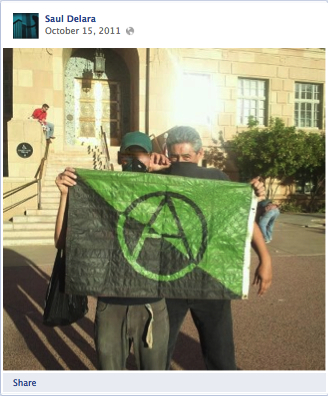
But the media's reporting on MOB doesn't cover the whole story. As emails released to the Center for Media and Democracy detail, MOB was also heavily involved in the repression of Occupy Phoenix, despite the total lack of felonious or violent activity on the part of occupiers. Sgt. Saul Ayala, a member of MOB was dispatched by his superiors to infiltrate Occupy Phoenix, where he advocated violence, perhaps hoping to provoke the very actions the MOB publicly claims to police. Ayala got his orders from another MOB member, Career Criminal Squad Sgt. Tom Van Dorn.

Sgt. Saul Ayala (right) poses with an occupier in a photo from his phony Facebook page

Just last month Down and Drought uncovered a Facebook post by Van Dorn joking about wanting to pull over parents selling Girl Scout cookies in his new beat, the poor and heavily Latino, Estrella Mountain Precinct. As we said, the response to the killing of Officer Hobbs is at least understandable (although not excusable), but just why such lack of critical reporting should also apply to MOB in general isn't clear. Natalie Brand tweeted that the PPD's press conference "made me cry," making us wonder, are the media being played by PPD?

We here at Down and Drought, even with our limited tools, routinely uncover examples of police racism and misconduct. Surely the media, with its vastly greater resources, can do more. Just in the last year we uncovered officers' racist tweets and Facebook posts, and we delved into the police surveillance and infiltration of Occupy Phoenix (while the media almost entirely ignored the revival of the political repressive functions of the police). And when stories about police violence have broken, we contextualize them, as we did in the case of a Phoenix Police Lieutenant accused of domestic violence (another epidemic of police violence that reporters refuse to connect). Why this is impossible for local media completely baffles us. Are local reporters too cozy with the cops?

Second chances are only for cops
It's worth noting that the media had no problem reporting on the target of the Hobbs/Casados raid that day, William Thornton. To the media, the civilian's record was fair game, but not the officers. The Republic's Lauri Roberts went so far as to declare that Thorton had been given too many second chances. This piece came on the heals of another she authored ordering us to support the boys in blue. Thornton's past is deemed sufficient justification for his shooting, but past allegations and suspicions abut the two officers is off limits. Cops get as many chances as they need. Reporters like Brand got on the internet more than 50 times to tweet praise for officers but couldn't be troubled to visit Google once and report on what she found. In the case of shootings by police, especially when an officer is wounded or killed, the past is irrelevant. Off limits, even.

The local media may be enamored of the police, seeing them as defenders of order and all things good. But many Phoenicians live in a completely different world. One in which the police act a lot differently than they do at press conferences. When reporters purge their critical faculties with regard to the police, and operate instead as the megaphone boosting and bolstering the cops' public image, they don't just do us a disservice, they discredit their own trade.  Even more so in cases of deadly force. And in this situation, the collective media suspension of disbelief has allowed PPD to pass off a unit that poses a serious threat to civil liberties instead as a thin blue line protecting civilization from violent thugs. In the era of mass protest and increasing alienation from the political system, the importance of that shouldn't be lost on anyone.

CLICK HERE FOR MORE OF DOWN AND DROUGHT'S COVERAGE OF THE OCCUPY PHOENIX FILES AND POLICE POLITICAL REPRESSION