Showing posts with label OPHXFILES. Show all posts

Tuesday, August 6, 2013

Emails reveal: New Times Reporter Took a Mulligan on Occupy Phoenix

A special for Down and Drought by Erik Blare

In golf, a mulligan is when a player gets to cheat for making a bad stroke. In serious competition, the practice leads to the player being disqualified.

Former New Times reporter James King appears to have taken a mulligan by calling on the cops to do his work for him. According to e-mails uncovered as a result of a FOIA request and released Monday by D.B.A. Press, King was playing golf with New Times editor Paul Rubin instead of covering Occupy Phoenix. He calls on top cop Trent Crump to give him the rumpus on what went down because he “can’t stand hippies” and “protesting with no cause is stupid.”  His poorly written e-mails may be a symptom of golf elbow.  Here is the e-mail in full:


From: James King <james.king@newtimes.com>
To: "Martos, Steve" <Steve.Martos@phoenix.gov>, "Thompson, Tommy" <Tommy.Thompson@phoenix.gov>,
"Crump, Trent" <Trent.Crump@phoenix.gov>
Sent: Sat, Oct 15, 2011 04:01:35 GMT+00:00

Subject: occupy phoenix

hello, sirs. was hoping for any info you have on the occupy phoenix march today. any arrests? any mayhem? anyone other than dirty hippies pretending it's 1968? here's my dilemma: i was supposed to go down there and cover it. instead, i went and played golf with paul rubin because i think protesting with no cause is stupid and I can't stand hippies. that said, i'm still expected to write something about it tonight. any help you could offer would be greatly appreciated.
thanks
JK

Someone whose profession is protected by the First Amendment should have some respect for the right of citizens to protest. The fact that King thinks there is no cause worth protesting is because he is short-sighted and single-minded. The Occupy Movement protested the fallout of one of the worst financial crises in the country’s history and the government’s unprecedented bailout. There were multiple causes to protest, which confused many journalists like King and irked others by the fact that they would have to do some work to cover the story.

It may be that King’s snarky and sarcastic tone is a ruse to cover up his rag’s “liberal” reputation amongst pols and cops, but his attitude is in full effect in his coverage of Occupy Phoenix. His October 15th, 2011 story 'Occupy Phoenix: Banks Are Evil, the Government's Evil, and Jan Brewer's a "Lying Whore" With Alzheimer's' show that he reported the story with extreme bias. King goes for the low-hanging fruit of finding the wackiest protestors to give him a complete action plan of how to overhaul capitalism. When he doesn’t get it, he dismisses the protestors whole-handedly.  He writes, “Apparently, blowing bubbles is the key to redistributing wealth. Who knew?”

Apparently, King was hoping for a riot because in King’s mind a protest looks the documentaries about the ‘60s that he saw in his high school civics class. When he doesn’t get one, he leaves disappointed and abrogates his duty to the police. “Tomorrow, Phoenix police will update us about any mayhem that went down after we left the demonstration.” After quickly surveying the scene and finding the wackiest protestors to photograph and mock, King presumably went to the links to get some face time with his golf buddy boss and to figure out how many Bud Lights it takes to get a decent enough buzz to kill 18 holes of boredom.  King was not connected to the community. He had no contacts in Occupy Phoenix, so he relied on the police for his reporting. His lackadaisical reporting led to his shoddy story.

As a reporter for a publication started by a counter-culture college drop out who protested the Vietnam War, King calling protestors "dirty hippies" would be ironic if New Times was still true to its original muckraking spirit.  New Times has a history of dismissing community activists with sarcasm. One of the most egregious cases was the fake pro-yuppie protest they sponsored in response to San Francisco’s late ‘90s anti-gentrification movement called the Mission Yuppie Eradication Project.


SF Weekly, a New Times publication, contacted a Project member named Nestor Makhno. The paper covered the story and Makhno wrote a well-researched report on the issues facing the Mission district because of internet-bubble-fueled rapid gentrification of a neighborhood of immigrants, artists and activists. Makhno even refused payment because he wouldn't have his real name printed on the check.

SF Weekly relied on a community activist to cover a burning issue that it couldn’t or wouldn’t. It was a wise move on their part because the then upstart alt-weekly faced stiff competition from long-standing and respected San Francisco Bay Guardian.  True to its snarky, pseudo-libertarian colors, the Weekly turned on Makhno and staged the fake pro-yuppie protest and mocked the counter-demonstrators.

What does a long ago beef between activists and a New Times publication in San Francisco have to do with Phoenix New Times’ reporting on Occupy Phoenix? It demonstrates that New Times has long strayed from its image as an alternative to the mainstream press.  As it became an alt behemoth, it bought out local publications and homogenized content, all of which is covered in a bitter sauce of sarcasm dripped from on high by reporters without connections to the community.

King, a New Yorker, is emblematic of this. He failed to see that a national protest had real roots in Phoenix, which had one of the highest home foreclosure rates in the nation. He didn’t take the time to find real people affected by a growing national disaster. For King, a protest is nothing more than spectacle. He brought his dismissive attitude and biases to Occupy Phoenix and left without the tear gas and batons he wanted for his pre-scripted story. It’s clear from his e-mails to Phoenix police what he wanted:   “tucson police have made 351 arrests so far during their ‘occupation.’ if phoenix police have arrested any fewer than 1,000 hippies, i'll be thoroughly disappointed.”

Occupy Phoenix was nothing but a joke to Phoenix New Times. Despite the real pain and sacrifice of Phoenix residents, King took it as nothing but a laugh at the expense of others, which is not comedy but a mark of arrogant contempt. King’s reporting never let on that he thought Occupy Phoenix was a joke form the onset. That joke was shared only between him and the police. Phoenix police chief responded to King’s written request for information by getting in on the joke. Crump wrote, 

James, I don't know if I believe anything you are saying, first of all rubin [couldn't] swing a golf club if [his]  life depended on it and I don't know what golf course would allow you two liberals to be out on it at the same time. But, in the spirit of helping you keep your job, the demonstration today was very peaceful.  They marched to the variety of locations in the downtown area and were dispersed by 6 pm. We had no arrest or problem to report. I know that does not make for a good story but, I can make something up if you really need it.

While King didn’t make anything up, he clearly had a story in mind before he actually did any reporting. His e-mails and reporting reflect the biases he had prior to covering the story. He prefers playing golf and joking with the police to doing his job. The joke is on New Times because it is a thoroughly discredited source amongst activists. (See Stephen Lemons' press conviction of the Arpaio 5, for example). King has had his last laugh. He disappeared from Phoenix to work for another community newspaper destroyed by New Times’ greed and guile, the historic and venerated Village Voice. Shortly thereafter, King was fired or left that paper and is now in journalism purgatory as a freelancer.

The lesson from this is that the community needs to do the reporting itself, which is why Down and Drought is the perfect forum for activists to tell the story as they see it and feel it. Despite some infrequent good reporting, Phoenix New Times can not be trusted to do the job they claim to do: “Afflict the comfortable and comfort the afflicted.” If any more evidence of this is needed, just remember that those “dirty hippies” who started the alternative newspaper have sold out to become pimps at Backpage.com. After all, advertising erotic services is far more profitable than serious business of reporting the truth.

James King was contacted for this story but did not reply as of press time. His e-mails can be read in full here.


This is part 7 in our ongoing series analyzing recently released police and Federal documents detailing their surveillance and infiltration of Occupy Phoenix and anarchists in the Valley. 

Tuesday, July 2, 2013

ARIZONA COUNTER-TERROR COPS USED FACIAL RECOGNITION ON FACEBOOK PHOTOS IN OCCUPY PHOENIX OPERATION


Last week the Electronic Frontier Foundation sued the FBI for access to their records regarding the function of the forthcoming federal facial recognition program and the potential for a combined civilian and criminal database. The lawsuit came on the heels of a report by the Washington Post on a facial recognition software manufactured by MorphoTrust USA, used in criminal investigations by local and state law enforcement agencies in 26 states.  The software accesses a database of over 120 million photos gathered from police booking photos, and, in some states, driver's licenses and identification cards. In the same article, Arizona is identified as one of 13 states with no facial recognition systems for driver's license photos.

Yet, in journalist Beau Hodai's report "Dissent or Terror", it is revealed that the Arizona Counter Terrorism Information Center (ACTIC) is using facial recognition software to identify persons of interest through a database composed of millions of photos, and that they have used this system to identify at least one participant in Occupy Phoenix by using a photo taken from Facebook.  The ACTIC Facial Recognition Unit is a division of the Maricopa County Sheriff's Office (MCSO) which acts in partnership with ACTIC and participating agencies,  the Arizona Governor's office, Arizona Office of Homeland Security, county and city police agencies, and the Arizona Department of Transportation.

Incidentally, the purchase of the software by MCSO briefly became the subject of controversy in 2008, when it was revealed that $200,000 in seized RICO money, in addition to federal grant funds, had been used in relation to MCSO officers and trips taken to Honduras.  Channel 12 reporter Joe Dana and Phoenix New Times blogger Stephen Lemons documented back in 2008 that the Sheriff's Office used the software as an excuse to built a "Honduras Unit" along with a database of photos from Honduras that related to the gang MS-13. As Lemons pointed out, Arizona was not considered a state with a high number of MS-13 members, and Dana drew out connections between Hendershott and the facial recognition software contractor Hummingbird Defense Systems that may have helped the company financially profit.


According to a 2007 presentation by Norm Beasley of MCSO on "Fusion Centers & their Role in Information Sharing" the Facial Recognition Unit was capable of operating "field deployable for special events and onsite identification" and that the ACTIC Facial Recognition Unit, under the direction of MCSO, was in the process of coordinating a national network of counter-terrorism fusion centers, and obtaining all "criminal images" from participating agencies to buffer the MCSO's own facial recognition database.


While it's unknown if the MCSO was able to achieve the goals outlined in Beasley's presentation, the  information obtained by Hodai from an Arizona Department of Homeland Security record shows that the ACTIC Facial Recognition Unit could access a database of 24.7 million photos from their photographic databases to identify an individual:
"The ACTIC Facial Recognition Unit has the ability to match biometric data contained in photographs -- such as those found on Facebook -- with biometric data contained in roughly 18 million Arizona Driver's License photos, 4.7 million Arizona county/municipal jail 'booking' photos, 12,000 photos contained in the 'Arizona Sex Offender Database,' and 2 million photos available through the Federal Joint Automated Booking System."
According to the MCSO's Counter-Terrorism website, the ACTIC Facial Recognition Unit "contributes to all criminal and counterterrorism investigations by potentially identifying unknown subjects, or locating known subjects, through a comparison of their photographic images to millions of stored booking, driver's license, and other related data bases."

The ACTIC Facial Recognition Unit has been used by Phoenix Terrorism Liaison All-Hazards Analyst Brenda Dowhan, an intelligence analyst for ACTIC, in at least one attempt to identify a person believed to have been involved with Occupy Phoenix. As documented below, in an email obtained by Hodai, Dowhan responds to Phoenix police detective CJ Wren who had asked for help identifying this woman by her facebook photo. 


The facial recognition search was unable to identify the person in the photo amongst the database of nearly 25 million photos.

If the use of facial recognition technology is about furthering the ability of police to catch "bad guys", then why is it that just about anyone who challenges the rich and powerful can end up in an ACTIC database search?  Beau Hodai, the author of the report on the Arizona counter-terrorism fusion centers, was driven to undertake the research after he was ejected from the 2011 ALEC conference in Scottsdale by security as a "persona non grata."

Rather than his removal being a misunderstanding, or the actions of a rogue cop, it was the hidden collaboration between the Phoenix police department and the ALEC planners in identifying and removing unwanted individuals.  In addition to journalists, Hodai's report and police documents disclosed the level of attention paid to Occupy Phoenix, anarchists, and Indigenous activists who seem to be singled out for no other reason than their motivation to take action against the interests of the rich and powerful.

This raises even more questions in what already looks like at the very least to be a case of police abuse of authority.  Already, we have documented on this blog that the PPD and FBI were almost certainly sharing information on protests and protesters with perennial activist target and accused abuser of workers, Freeport-McMoran.  This sharing was direct through emails, but may as well have happened through the FBI Fusion Center, where private security firm Infragard was allowed to participate in information sharing.  Likewise, we have also revealed how Tempe PD anti-terror cops treated local activists as terrorists.

The Washington Post article does not list Arizona as one of the states that uses facial recognition technology to access drivers license databases, but the documents released surrounding Occupy Phoenix and anti-ALEC protests clearly do contain photos taken from drivers licenses.  Are there databases of Valley activists?  Down and Drought has documents that suggest that there are, at least in the case of the Tempe Police Department.  Further, is this activity legal?   Especially when it is being used to target and identify activists.  Many states have laws regulating this kind of activity, or preventing it to be used for political purposes.  What is the case in Arizona?  More and more it appears that regardless of its original intent, the growing police and surveillance apparatus in Arizona, under the cover of anti-terrorism, has increasingly become a weapon for police to target activists and, in so doing, to protect corporations.  While the US is gripped by the NSA spying story, we seem to have our own mini-version right here in the Copper State.


This is part 6 in our ongoing series analyzing recently released police and Federal documents detailing their surveillance and infiltration of Occupy Phoenix and anarchists in the Valley.

Wednesday, June 5, 2013

Did Phoenix Police and FBI fusion center information-sharing on protesters extend to Freeport-McMoran, too?

Good news!  Arizona's richest CEOs are doing fine.  Because I know you were worried.  So, just so you can sleep at night, know that although there was a slight dip in pay for the state's top CEO's and chairpersons (there's a woman or two in the mix, after all!), Arizona's capitalists and managers-in-chief are still making out pretty damn well.  Granted the average did drop from $1.33 million the year before to $1.31 million last year, but what's twenty grand between friends, right?  Hey, we're all tightening our belts these days!

And standing on the top of the heap for a second year in a row is Freeport-McMoran CEO Richard Adkerson.  While the average worker in Arizona took around $44,000 last year, the mining boss took in just shy of $20 million, which actually was quite a bit less than the year before, when Adkerson cashed out some stock and took home a cool $82 million.

Which should come as some consolation to mine workers in


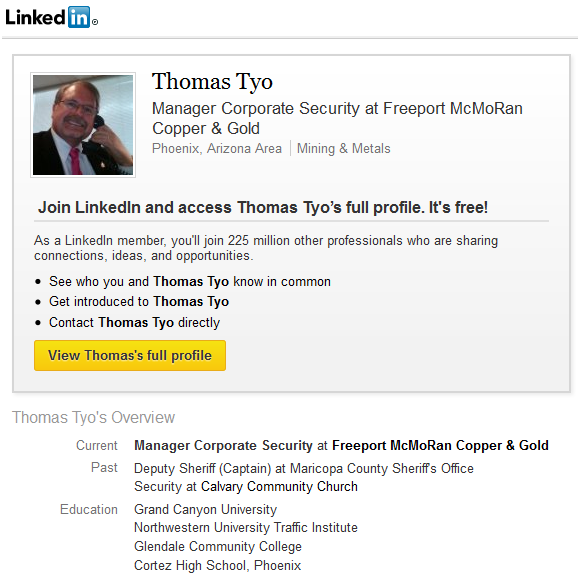
The short version?  The Feds let Infragard sit in on FBI fusion center discussions about Occupy protests in Phoenix that targeted Freeport-McMoran, and the head of security for Freeport-McMoran in Phoenix is a member of Infragard.


Wednesday, May 29, 2013

Emails raise more questions about PPD, the red squad, homeland security and the repression of Occupy Phoenix

As we continue to go through the emails released by the Center for Media and Democracy detailing Phoenix Police, Tempe Police and FBI collusion in spying and disrupting Occupy Phoenix, many troubling questions arise.

For instance, who was in the driver's seat during the police response to the ALEC protests of 2011?  It seems clear from the emails that at least some PPD officers were serving as off-duty private security for ALEC while others were working on-duty.  They were coordinating, perhaps as one might expect, but this cooperation raises real questions about the role of a police force that likes to claim that its presence at protests is to facilitate the exercise of constitutional rights.  Clearly PPD doesn't look like an unbiased actor given these facts, a conclusion that no seasoned activist would dispute.

These records also show clearly that PPD was working with banks and, through the FBI fusion center, private security firms like Infragard.  Many questions about these relationships will surely be answered as we dig deeper into these thousands of emails.  But as of now, the answers don't look good for PPD and other police agencies.

Still other emails raise questions about not just the independence of the PPD, but also of whether there was appropriate oversight of such police protest staples as the community relations unit (affectionately known by local activists as the "red squad"), just what it's actual role is in the era of anti-terrorism and even whether it ought to exist at all.

This team plays a central role in the released messages which show it several times to be very important on the ground links for funneling information to police anti-terrorism officials and the FBI fusion center, and for carrying out their plans.  Such a relationship validates the "red squad" monicker that activists have given the unit.  Time and again the community relations unit proves itself to be an integrated part of the overall spying apparatus.


One recurring source of serious concern centers around the role played by Detective Chris Wilson, at the time assigned to the Phoenix PD community relations unit.  As we have previously reported, Detective Wilson, now revealed to have been using his contacts and authority as liaison to the Phoenix LGBTQ community to target and sexually abuse underage boys, is frequently cited in these documents as a source of information and as someone who can use his community contacts to get details on protesters and their plans.  

In the documents features above and below, Brenda Dowhan of the PPD and an alphabet soup of various other anti-terrorism related units responds to a February 2nd request by Tracey Woods of the Glendale PD for "a list of Occupy Phx members with pics".   Woods email in turn was in response to an initial message from Dowhan warning that underage occupiers, known to "openly consume drugs and alcohol" and "create a riotous atmosphere", might attend a fundraiser for a gay pride scholarship at the Mighty Cup & Spoon in Glendale. Incidentally, among Dowhan's other duties was to monitor Facebook and other social media.


Dowhan refers Woods to Wilson, who she says "has contacts with the LGBT and can obtain more information on their plans for the night".  Here we not only see the direct relationship between the community relations unit and the homeland security behemoth, but also how Det. Wilson's directives from above to spy on and interface with elements within the LGBTQ community put him directly in contact with the community he was later to admit victimizing.  This is of course particularly disturbing given the November memo from Det. Wilson's direct supervisor on the community relations unit, Sgt. Mark Schweikert, alleging that Wilson had protection from powerful individuals in the police and city government, and that Wilson was as a result difficult to manage.

But we must resist the tendency to chalk this up to a single bad apple.  In fact, what these emails reveal is that the "red squad" was key in the repression, surveillance, and disruption Occupy Phoenix, not to mention the role it played in creating the opportunity and authority necessary for Wilson to abuse his young victims.  Further, it suggests strongly that it has become a key element of the larger anti-terror infrastructure, a vital part of the information funnel and repressive machinery of homeland security that increasingly targets domestic activists as part of its ever-expanding mandate.

As the saying goes, if all you have is a hammer, every problem looks like a nail.  And this is precisely the model on which anti-terrorism operates, a form of policing to which community relations has become wedded.  Assets unused for fighting terrorism instead must be justified by hyping threats.  Likewise, resistance must be framed as terrorism.  And the red squad was situated at a crucial juncture in that system.  Such a relationship creates a chilling effect with regard to the exercise of the very rights it claims to protect and makes a very good case for the total dismantlement of the unit.


This is part 4 in our ongoing series analyzing recently released police and Federal documents detailing their surveillance and infiltration of Occupy Phoenix and anarchists in the Valley.

Thursday, May 23, 2013

Tempe anti-terror cops sent undercovers to infiltrate a local bar to spy on anarchists planning a community garden

According to documents released by the Center for Media and Democracy this week, while investigating Occupy Phoenix organizers and anarchists in Phoenix, Sgt. Ken Renwick (of Tempe's Homeland Defense Unit) directed plain clothes officers to "visit Casey Moore's and see if we can get any intel".  Casey Moore's is a bar in downtown Tempe where police suspected anarchists gathered and hatched their plans.  It's affectionately called "Casey's" by regulars.

The problem?  May Day was approaching and while it seemed Occupy Phoenix had wound down in many respects, it was known that Tempe anarchists were planning something, probably in Tempe, maybe in Scottsdale.  But finding out what hadn't proved an easy task.

At the beginning of Occupy Phoenix Sgt. Tom Van Dorn, head of the Major Offenders Bureau and Career Criminals Squad was forced to admit that "finding out how the anarchists are organizing and what they are up to is still difficult".  Sending police infiltrators like Saul DeLara (quickly unmasked by veteran activists) hadn't helped.  By May the cops were still complaining about the lack of information, and Brenda Dowhan worried about the "complete silence from May Day organizers".

Incidentally, Dowhan is a perfect example of the explosion of anti-terrorism positions since September 11th, signing off her emails as "Terrorism Liaison All Hazards Expert, Phoenix Police Department Homeland Defense Bureau, Arizona Counter-Terrorism Information Center".  An online search reveals her as an alumni.of Kaplan University, an online college.  In one email, Dowhan shared at least one link to an article posted to AnarchistNews.org entitled "Spain: New wave of incendiary attacks and sabotages by Nihilist Anarchists".  There were no attributed anarchist incendiary attacks in Phoenix during the period covered by these documents.

The cops are heading to Casey's
This wasn't the first time anarchists in Tempe had been singled out by anti-terrorism authorities to fit their demands for a local terrorist bogeyman.  In 2004, Dan Elting, a Phoenix cop and counter-terrorism trainer, organized a community forum at the Tempe library in which anarchists were described as terrorist threats equivalent to Al-Qaeda and the Klan.  Printouts of the Phoenix Anarchist Coalition's webpage were distributed as reference materials to a very conservative, elderly and scared audience.  It was the only local organization so featured.

Around the time Tempe plain clothes officers appear to have been directed in the name of homeland defense to brave the cool Spring patio weather and cold beers at Casey's to spy on anarchists, Casey's had been informally the site of a regular Thursday night anarchist drinking night known as "Anarchy Thursdays".  This is almost certainly the reason why cops were sent there.

Anarchists had been living and organizing in Tempe for well over a decade, and downtown Tempe had seen two previous May Day marches in 2002 and 2003.  The former had gotten a bit out of hand from the perspective of the cops.  In addition, police reacted clumsily and pepper sprayed journalists.  But by 2003 the bike unit had received training by the Eugene Police Department in crowd control (Eugene being another national hotbed of anarchist organizing at the time) and the march was more easily contained.

Over the years anarchists have become well-established in downtown Tempe neighborhoods and the community there, and had proved it most recently (pre-Occupy) during the 2010 resistance to SB1070.  Anarchists had initiated and been central organizers in building Tempe neighborhood resistance to the application of the law in Tempe, doing door to door organizing, printing yard signs denouncing the law that proliferated through the neighborhood, putting on well-attended neighborhood general assemblies and one very large march through the neighborhood that attracted a wide range of Tempe residents.  Police were not able to contain that march to the sidewalks and residents marched cheerfully in the streets as their neighbors frequently came out to wave in support or join in.

What the cops did know was that the Tempe May Day action involved taking over a public space ("reclaim the commons", as it was called in anarchist parlance) in order to plant a community garden.  An occupation.  This much was clear from the posters that went up around town.

The chosen spot was a long vacant lot downtown.  For two decades it had been the location of Tempe's largely beloved "Gentle Strength Co-op" (although not so much with the developers and city council).  Anarchists had held weekly meetings for years there as the Phoenix Anarchist Coalition, and had run an infoshop on the premises for about six months at one point (until some yuppie members complained about "bad vibes").  Still, anarchists worked there and were prominent members.  But the co-op had closed now and, after a failed attempt to develop the land into a Whole Foods/condoplex, it had lain fallow and unused for years.  What's more, the empty lot was now owned by the very same Canadian corporation that owned Zuccotti Park, the site of the original Occupy Wall Street encampment.

Officer Derek Pittam, by May Day 2012 serving as a Tempe Police Department Homeland Defense Unit Detective, had come up on the bike squad and had experience dealing with Tempe anarchists.  He'd had many run ins with them during protests and their routine cop watch patrols in the downtown.  Like many cops post-9/11, he had moved into one of the myriad anti-terrorism-related jobs that had proliferated across police departments nationwide thanks to increased Federal funding, a kind of grade inflation that led to the ridiculous number of titles accumulated à la Dowhan by many of the officers appearing in the documents released by PR Watch.  Those documents reveal Pittam was determined to deny anarchists a victory in their May Day plans.


Anti-terror cops defend empty lot from gardeners
In order to execute those plans, and to make sure that the vacant lot stayed empty and unused by the neighborhood, Pittam engaged in a series of pre-emptive actions (of questionable legality), such as sending police to visit local businesses warning of anarchist activity (including, according to one business owner, a claim that anarchists planned to run "really long hoses" across the street to water the lot).  Oh, the horror! 


He also wrote a letter to local businesses and prominent non-anarchist neighborhood residents.  In it, he linked the May Day action to anarchist violence. Pittam clearly saw this as a battle for the hearts and minds of Tempe.  He wrote: "I am very concerned that the organizers of this event have not disclosed important information in their quest to gain support from local residents and businesses." Unfortunately for Pittam, the letter was leaked by residents sympathetic to Tempe anarchists, who then published it the day before the garden planting, causing some embarrassment.

A riot cop is confused as a child is detained for vandalism
On the day in question about seventy people showed up with the intent of building a community garden, a great many of them local residents.  They gathered at the Farmer's Market across the street, with the permission of the owner.  What they found was a line of riot cops positioned in the lot.  Police threatened any trespassers with arrest.  Still loaded up with supplies (and with the cops baking in the hot sun), the group decided to take over a strip of city land right next to the lot.  Police did not act and a garden was built.  Several news outlets sent out reporters and cameras to
report on it, capturing the excitement and enthusiasm of participants.  A concrete planter was poured and filled with a variety of plants and vegetables.  At one point police, watching from the park, thought they saw some small children vandalizing a sign, so they stormed in and detained the kids and their parents.  It turned out the paint was water-soluble, so only warnings were given.  The impromptu community garden was maintained for three days until city workers came early in the morning and destroyed it.

In an email tooting his own horn about police activities that day (designed, as Sgt. Renwick had said, to make neighborhood residents and anarchists "go home saddened", denied victory), Pittam wrote, 'Our local actions, for better or worse, did appear to have an impact.  We did not have "Black Bloc" emerge...'  Why anyone would imagine a black bloc to be a useful tactic for building a garden wasn't clear, but it must certainly have been related to the general hyping of the potential for violence that these cops regularly engaged in.  Indeed, most likely a black bloc wasn't deterred at all, but none was ever planned.  After all, aside from its uselessness in that situation, it was also 100 degrees that day.  Only cops hang around in all black in those conditions.  They were the only black bloc that day.

Justifying their jobs in the face of what was in fact was a bit uncooperative but nevertheless standard fare protest must have been both frustrating and difficult to understand from an anti-terror framework.  It's telling that no where in these documents does it appear that police called each other out on their fantastic imaginings.  Instead, like Pittam post-garden defense, it's pats on the back, self-congratulation and attaboys. 

Interestingly, people who participated in the action didn't view it as a defeat.  A plot was taken over, the contradiction of cops defending an empty lot with significant local meaning was on full display, and a garden was planted.  And it was destroyed because the city couldn't tolerate it.  It would seem the organizers actually came out on top that day, not the TPD.

Nevertheless, when we read these police documents what we get is the odd juxtaposition of anti-terror rhetoric and gravity on one hand, and then the broad interpretation of results in the face of the actual run of the mill nature of the "threat".  As in the case of a local homeland defense officer, organizing with Phoenix anti-terror cops to send undercovers to spy on drunk anarchists and to deploy riot police in downtown Tempe to stop the planting of a community garden.  Oh yeah, and to detain children for painting.


This is part 3 in our ongoing series analyzing recently released police and Federal documents detailing their surveillance and infiltration of Occupy Phoenix and anarchists in the Valley.

Tuesday, May 21, 2013

BOOK-LOVERS CRY "HYPOCRISY!": EMAILS REVEAL CHANGING HANDS OWNER REPORTED OCCUPY PHX TO THE COPS

Would it be hypocritical for someone who makes their living off the First Amendment (like, say, a book seller, for instance) to report other people who are exercising their First Amendment rights (like, say, activists, for instance) to the police for their political activities?

If you haven't had a chance yet to read the Center for Media and Democracy's recent massive dump of emails and documents detailing the police surveillance and crackdown on Occupy Phoenix, you're really missing out.  The files reveal a year of police targeting of activists, infiltration of political groups, a witch-hunt for anarchists and outright collaboration with the right wing, pro-corporate American Legislative Council (ALEC), which came to Arizona in November 2011 for its annual meeting.

For activists and anarchists active during that year of protest that shook the country and yet seems already to have faded from public memory, these documents come as both vindication and confirmation of what everyone knew was going on at the time.  Unfortunately, the media wasn't interested in telling the story at the time.  Their cozy relationship with the authorities, inability to empathize with protesters expressing their anger at the ongoing crisis, and maybe a little bit of denial that the security state that had expanded so massively since 9/11 might be used to police dissent in a democracy, all conspired to keep this story off the airwaves and out of the newspapers.

Since the release of the documents Monday, people have pored through them.  One of the first revelations to start making waves involves Cindy Dach, co-owner and GM at the favorite local book store Changing Hands, and proprietor at MADE Art Boutique in downtown Phoenix.  The downtown arts neighborhoods has been an ongoing point of conflict for some time between the more rebellious, free (and less profit-oriented) elements and those who sought to build a commercial arts hub as part of the larger development project in the area.  As a result of this conflict, ongoing communication was established between the more business-minded folks and the cops.  The objective was to bring the often ruckus First Friday art night to heel, to domesticate it with the aim of making it more amenable to families and business.

According to documents, on October 7, 2011 Dach got wind of a gathering of Occupy Phoenix activists at the now-defunct Conspire coffehouse (a regular hang out for anarchists, activists and anticapitalist-oriented artists).  The purpose of the gathering was to flyer and raise awareness of the coming October 15th occupation.  Dach typed up an email and sent the warning to Sgt. Chas Clements, reporting the meeting.  As we know from other documents, the PPD was already focused on Occupy Phoenix and making plans to stop it.  

As PR Watch reports:

“Not sure how this differs from their regular - come to Conspire on First Friday activity, but I thought I should share,” wrote Dach to Clements (Appendix, p.148-149).  The email contained links to two Facebook event notices detailing the event...

According to records obtained by DBA/CMD, Clements forwarded this advisory on to PPD South Mountain Precinct Resource Lt. Sean Connolly. In his response to the Clements email, Connolly wrote, “Yes this is connected to the Occupy Phx / Day of Rage protest next week on the 14th and 15th. For intel purposes, I would like to obtain a few copies of any flyers handed out tonight at FF [First Friday] reference the protests next week [sic].”

This struck many in the arts community as well as long-time Changing Hands customers as a rather glaring bit of hypocrisy, considering the nature of her business. dependent as it is on the First Amendment, but also given that the store is generally well-stocked with lefty books.  Readers tend to be quite fervent defenders of freedom of speech and assembly.  What else is a book club, after all?  Or a book store for that matter?   Especially one that so frequently hosts speaking engagements for popular authors.

Disgruntled customers and artists took to Changing Hands' Facebook page to express their outrage, demanding answers.  Changing Hands posted a reply from Dach.  In it, she describes the family-friendly nature of the event and her spin on their decision to work with the police generally, adding that "it saddens me that a small but vocal minority has somehow conflated event management and crowd safety with the squelching of free speech."  That language eerily parallels the Orwellian administrative and de-politicized doublespeak of the cops as they cracked down on Occupy all over the country, citing camping ordinances, trash collection and other banal civil regulations as justification.

However, whatever their opinion on the taming of First Friday, many people are stunned that Dach couldn't see the distinction between political activity and other behavior she might consider anti-social, disruptive or bad for business.  Whether First Friday and art deserves to be sanitized for family consumption, like so many parts of this child-centered culture, is one question.  But opinion seems to solidifying at this time around a genuine sense of outrage and consternation that a trusted bookseller so easily turned on core book-lovers' values and took up the role of police adjunct in a fight in which free speech played so central a part.  After all, her report didn't just go into the ether.  Records strongly suggest that police used that intelligence to take repressive action, sending undercover officers to infiltrate the movement and gather intelligence.  One of those officers was overheard advocating violence on more than one occasion before being outed by activists.

Dach may see this as a neutral act, but many people do not.  And, as further records revealed, the Phoenix PD was in active collaboration not only with the banks but also with far right wing, pro-corporate groups like ALEC.  That adds an extra bite for customers who pride themselves on shopping locally and independently.  The old labor slogan comes to mind: "Which side are you on?"  Maybe quickly followed by some advice from the late Howard Zinn, who would remind us that "you can't be neutral on a moving train."