Showing posts with label social media. Show all posts

Wednesday, February 19, 2014

Public Relations: The love affair between Valley cops and the news media


 A Symbiotic Relationship: 3TV news crew poses for a selfie with Phoenix PD's Press Information Officer (PIO) Steve Martos

It's no surprise that local news content is full of pre-packaged "video news releases" which make up much of the content that supplements the local coverage.  While some of the news is received via satellite from international news organizations such as the Associated Press, often there are stories planted by public relations firms and advertisers disguising their product in a news story.  Local television stations have relied on video news releases to keep the costs of producing a newscast low and the profits for the station's owners up, even as audiences for local newscasts have been dwindling for years. The pervasiveness of the video news release has reached such absurd proportions that even late night talk host Conan O'Brien has a regular feature on his show lampooning the frequency of local newscasts that report the same story, word for word, in markets across the country.


However, it is not just PR firms and ad agencies making the most of local news media's need for content that is cheap and easy to obtain, police departments have also become experts at using the media to boost their image by adapting the methods used by advertisers to craft a "brand identity" for consumer products. In "Branding Your Agency: Creating the Police Department's Image", a 2004 article published in Police Chief Magazine, police chiefs Gary J. Margolis of the University of Vermont and Noel C. March of the University of Maine encouraged police chiefs to seize control of their department's public image by turning to the strategies of advertising and PR firns in creating a brand identity for policing.

Margolis and March cite a 2001 "Public Image of the Police" report from George Mason University which concluded that negative perceptions of the police stem from personal experience, rather than the success of police in reducing crime or an individual's favorable interaction with a law enforcement officer.  Key to the study was the finding that people's perception of the police are often formed by their exposure to police actions in the media, that the media is the primary source for most people about crime, and in the absence of a narrative controlled by the department it may appear that police are unable to stop crime. 

Valley police departments were taking notes, as Press Information Officers (PIO) make frequent appearances on the evening newscast to share information that departments want released to the public.  In addition to the various departments' de facto anchors making regular appearances on the local news, press releases from law enforcement agencies are often reprinted with minor changes made in the arrangement of sentences to avoid plagiarism.  That these press releases are appearing on local news websites and newscasts as news items, complete with all the authenticity associated with a journalist's byline, should be prompting outrage at the local news and police agencies. 

We here at Down and Drought follow the local news pretty closely, so we thought we might have some fun comparing the press releases from law enforcement agencies with news articles from our esteemed "free and independent" fourth estate. How bad is it?  Take a look at two recent stories in the Phoenix news, compare the police press releases to the slightly altered news content and ask if it stands on its own as an independent piece of journalism.

Below is a screen capture from the January 27, 2014 press release from the Mohave County Sheriff's Office announcing the search for a suspect involved in a bank robbery in Golden Valley, Arizona.  The press release includes photos of the alleged robber as well as information specific to the person's build, their behavior during the alleged robbery, and the the appropriate contact information for the department(s) investigating, in the case a viewer might have information the cops would find useful.


The photos below are both screen captures from articles published on the website for KTVK Channel 3 and KPHO Channel 5.  Both websites ran the press release with slight modifications from the original writing and were published under the names of employees at the station.   The KPHO article, credited to Steve Stout, a longtime editor of valley news publications from the East Valley Tribune to his current gig at KPHO, is nearly identical to the press release.


Both articles come pretty close to qualifying as plagiarism, as they are nearly identical to the Mohave County press release, and yet they are not the exception.  Again, the same pattern with a Tempe police press release on the arrest of an alleged bike thief:


Followed by screen shots taken from two articles from local news websites which include large sections of the press release which are rearranged just enough to keep it from being a plagiarized article.


The local press, and as seen above KTVK and KPHO, have no qualms about reprinting police news releases and remaining completely uncritical about the information contained within.  Just like the video news releases released to stations by PR agencies, law enforcement agencies know they have an open door with the local media, forever hungry for cheap, garish stories which come to them, saving any of the employed journalists from having to do any of the actual leg work and research required for a balanced piece of journalism.

In plain terms, there's lots of advantages for the police in crafting a brand identity which portrays the police as the solution and final word to the problems of the community. Aside from that, they need the good publicity! Just last year valley cops killed over 50 people in shootings alone, a key community relations officer was arrested for sex with minors, and Phoenix officer Richard Chrisman went to prison on assault and manslaughter charges.


It was during the week that Chrisman was sentenced when the Phoenix police's PR division may have tried to deflect attention from the Chrisman verdict by planting a story about officers helping a needy family at Christmas.  The story, which appeared on KNXV ABC15, cited Phoenix police officer James Holmes, as he described Phoenix cops as having a "tough and dangerous job", and frequently coming to the aid of the citizenry, at what now sounds like potentially great peril to their well being.  Whether out of laziness or complicity, the journalist Lauren Vargas deemed it unnecessary to also include the information that James Holmes is a PIO for the Phoenix police, and the story aired on December 20, 2013 the day that one of the most notorious cops in Phoenix's history was sentenced to seven years in prison.

Writer JJ Hensley at the Arizona Republic wrote a lengthy article on the police shooting spree of 2013 and tackled a number of contributing factors which critics and defenders of the police say have contributed to so many shootings in the Valley.  Hensley cites the rate of assaults on officers and the continuing militarization of the police as two of the main reasons for the change in policing.

Hensley ends the article with a section on the public's response to trigger-happy cops, noting a lack of public outrage to the well-publicized shootings.  But he fails to consider one of the biggest factors as to why there may be a lack of outrage when officers gun someone down: that his own profession treats the local police department as an in-house bureau which provides the footage that often bleeds and leads on the local news.

While the public's passivity to police killings cannot be entirely attributed to the media's coverage and working relationship with the police, it is worthwhile to return to Margolis and March's article in Police Chief Magazine and their emphasis on manipulating the public's perception of the police. Utilizing the media is useful for police in expressing their department's brand identity, and to seize the narrative from their critics to ensure that, whether they are rescuing a cat from a tree or shooting over 50 people in a year, they must be seen as the community's only solution to their problems.

Tuesday, February 4, 2014

Fox 10 Producer "Thankful" for drunk driver crashing into Phoenix home

UPDATE: After media journalist Jim Romenesko picked up on the exclusive Down and Drought coverage of Fox 10 producer Juliana Vasquez's twitter meltdown, the story spread across the internet, largely being reposted by others in the news business.  The media blog TVSpy reported that Vazquez had been reprimanded by station management as a result of our story and the coverage it received from media outlets. In a statement to TVSpy regarding the Down and Drought story on Vazquez, KSAZ vice president and GM Mark Rodman stated that “This is unacceptable behavior and will not be tolerated.” TVSpy also reported that other sources had said that Vasquez was reprimanded by the station for her twitter posts.


Juliana Vasquez, a morning news producer at KSAZ Fox 10 Phoenix, may have been venting about the difficulty of finding content for the morning program when she tweeted that she was "thankful" that an alleged drunk driver crashed into a Phoenix home last night, but her logic in posting such a statement is questionable.  The Fox 10 producer tweeted: "Sometimes you just gotta be thankful that some drunk dude drivers [sic] into a house..no one was hurt, but I needed news #producerproblems".

The tweet was removed from Vasquez's twitter profile this afternoon after Down and Drought posted responses challenging the ethics of a news professional publicly posting such sentiment, and callously treating the real life problems of people impacted by an event as a "#producerproblem".  Fox 10's morning news coverage of the accident featured reporter Anita Roman boasting of the "first look" inside the home, describing how the van crashed mere feet away from where a resident had been sleeping.

FOX 10 News | myfoxphoenix.com
 
Had the residents of the home been aware of Vasquez's excitement over the crash, would they have granted the station "first look" access into their home to video tape the destruction?  Would the 17 year old family member who told reporters that he and his family were "lucky to be alive" be "thankful" that he was able to help a news station fill two minutes of air time?  Vasquez's tweet that she "needed news" is emblematic of the troublesome "what bleeds leads" mentality of local news, and a reminder that, despite the sympathy in the voice of the reporter, it's these stories which drive the advertising revenue and keep producers needing the next big tragedy.

Tuesday, June 11, 2013

Mesa PD will violate copyright and your rights, too, while they're at it

In what wouldn't be the first Twitter-related cop blunder we've cataloged, the Mesa PD -- fresh from the debut of its crime reporting app that might just spy on its users -- may have made another social media boo-boo.

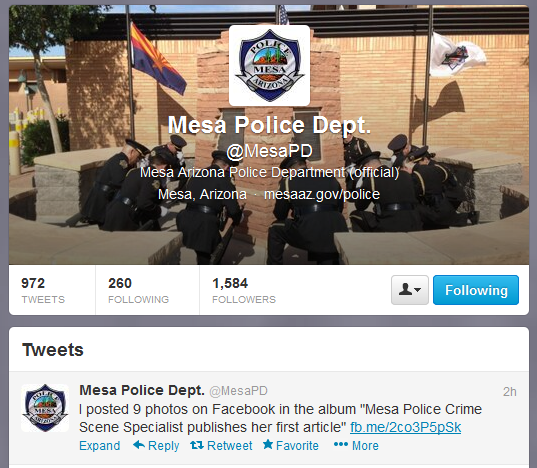
Early Sunday morning, the Mesa PD posted an update to its Twitter feed announcing an addition to the MPD's facebook photo section.

.

Clicking on the link in the tweet delivers you to the Mesa PD's photo album, specifically a folder designated "Mesa Police Crime Scene Specialist published her first article".  In this album, Mesa cops have uploaded scans of Christine Lowenhagen entire article, including the front page of the journal.


Is this posting legal?  Is it a copyright violation?  The International Association for Identification is the organization that publishes the JFI.  A search of the IAI website brings up a pdf of official "Publication Guidelines" which mostly deals with style for writers.  However, one part does seem relevant.  It reads, "The JFI is liberal in allowing the noncommercial reprinting of articles from the JFI, especially to the IAI divisions."

While the Mesa PD may be noncommercial, Facebook certainly is not, and that's where the post was made.  Further, the "divisions" cited are regional or state associations of the IAI, so the instructions appear to be granting permission for these sub-groups that run their own independent pages to post articles.  The IAI's website itself has a list of costs for access, which line up comparably with the typically outrageous figures scholarly journals commonly charge for reading to their publications. Subscriptions for institutions, for example, are just over 200 dollars.

We emailed Alan McRoberts, the editor of the Journal of Forensic Identification, and he responded to our request for more specifics on their policy, writing, "All requests to reprint must be specific (i.e., naming the paper to be reprinted) and specify where it is to be reprinted. Each request will be considered individually."

The question then becomes whether this permission was granted.  The posting of scans suggests not.  We followed up, asking if the organization had specifically received a request for permission to post from either the Mesa PD or Christine Lowenhagen.

Mr. McRoberts replied this afternoon and provided this clarification:
Two years ago, our board of directors approved a policy regarding reprinting material from the JFI. Part of that policy indicates that "Only JFI articles that are at least six months old at the time permission is requested will be considered." The recent publication (May/June 2013) of the article from Ms. Lowenhagen is not eligible to be considered for reprinting until the end of the year. At that time, I would have to evaluate the venue (e.g., IAI division newsletter, webpage, blog, or facebook) for reprinting before making a decision regarding permission.

Going by this response, it certainly seems reasonable to conclude that the MPD did not get permission and if they had, such wouldn't have been granted for at least six months. 

When you think about it, the Mesa PD appears to be violating copyright law in the same exact way that an information activist like Jason Swartz did, activism that led the police and Feds to crack down on him quite harshly.  In fact, it was these kinds of high charges and artificially limited access common for professional journals that drove Swartz to download for online release thousands of JSTOR documents in 2011. 

This act of protest in turn led the US government to charge him with several serious crimes, levying the threat of many decades in prison against him.  His supporters cite this overly-vigorous prosecution as what drove him to suicide.  One might even go further, and invoke the arrest and imprisonment of Jeremy Hammond, the Antisec militant recently sentenced for releasing Arizona police documents in protest of racist policing.  Police in Arizona were not too keen on forgiving his internet breeches of legality.

This selective enforcement of the law, where the Mesa PD gets to decide just which laws it will enforce as well as which laws it will obey, is a problem that can't be ignored.  Just as we see it in their online activities, we see it likewise reflected in the very real world recent arrest and brutal beating of Matatangi Tai (see also: here, here).  Mesa cops have a lot of leeway when it comes to enforcement of law, but in the case of Tai, the cops were not interested in being forgiving, and so what amounted to a trespassing call, thanks to needlessly aggressive policing, turned into a violent attack on a someone who very-likely was mentally ill and unable to understand even that he was violating the law.  Tai, after all, was in a convenience store claiming he was there for his medication.  Police, however, know exactly what they are doing.  Or they should. 

Mesa police were also not in a very forgiving mood when they stunned Joseph Moreno with a taser for taking too long to surrender.  After they put him in the back of a patrol car for 45 minutes, he began slurring his speech and sweating.  When the Fire Department showed up, he was taken to the hospital, where he died.

Moreno's sister put it this way:
"I feel there was other ways of doing it... I understand, from the police point of view. But, if there was more than 40 of them, or however many, and he was in a car. He wasn't running. He wasn't in the front seat of a car trying to run off. Their way of resisting (interpreting resisting) was that he wasn't responding."
In other words, the Mesa PD has two standards: one for itself and one for the rest of us.  The law is for us to obey and for them to interpret, and that can mean a death sentence for anyone who crosses their path.  It seems copyright isn't the only thing they'll violate.