Saturday, June 14, 2014

Scottsdale Police join ranks of Valley cops using "Stingray" device to spy on cell phones


As we revealed in a recent post, the Tempe Police Department has made at least two purchases of the Stingray device from the Harris Corporation, both shrouded in secrecy due to a non-disclosure agreement.  We can now reveal that another valley police department is in possession of a Stingray device. Down & Drought has learned that the Scottsdale Police Department used the controversial Stingray surveillance device on 29 "missions" in 2010, citing a Scottsdale police report which identifies the device by name in a section on the department's Technical Operations Unit.

The 2010 annual report appears to be the only public admission of Scottsdale's use of a Stingray, no other web searches by Down & Drought could find any other reference of the device by the City of Scottsdale or Scottsdale Police Department.  In the 2010 City of Scottsdale Annual Report, the Stingray is mentioned briefly in the section on the Scottsdale Police Department's Special Investigations Section Technical Operations.  According to the report, the Technical Operations Unit is "responsible for the installation and maintenance of technical surveillance equipment and systems. The Tech Ops Unit assists other work groups within the police department, including Patrol, with special technical investigative assistance." 

Police departments across the valley, and through out Arizona, are increasingly utilizing electronic surveillance devices to eavesdrop and record information with very little public knowledge about the techniques being used in the mass gathering of private and confidential information of individuals.  In an article published in March on Down & Drought, we raised concerns over the civil rights implications of the Tempe Police Department's use of an electronic surveillance device called the Stingray by citing the secrecy surrounding the devices as a result of a contractual confidentiality agreement between the City of Tempe and the manufacturer of the Stingray, the Harris Corporation.

It has been confirmed, through articles from the Arizona Republic and statements from the Arizona branch of the ACLU, that police departments in the valley, and across Arizona have purchased Stingray technology.  The AZCLU's Alessandra Meetze identified the Maricopa County Sheriff's Office, the Gilbert PD, and Glendale PD as valley departments in use of the Stingray device, and the Pinal County Sheriff's Department and Flagstaff PD as agencies outside the valley with Stingrays. A subsequent Arizona Republic article from December 2013 identified the Mesa PD and Phoenix PD as departments using the Stingray, with Phoenix having one in use since 2001.

The Stingray is a surveillance technology used by police to imitate a cell phone tower causing every cell phone and wireless device within range to connect with the police tower and unwittingly sharing data.  As of now, there is no way for an individual to know if their cell phone or wireless device is currently having its communications and data intercepted by police.

Scrutiny from media outlets over the Stingray technology has intensified in recent weeks after US Marshals intervened in a public records request regarding a Florida police department's use of the device.  Wired writer Kim Zetter has followed the legal battles over the non-disclosure agreements which protect police departments from releasing any information on their purchases from the Harris Corporation.  In her most recent piece on the Stingray, she covered the eyebrow raising actions of the  US Marshals seizing records requested by the ACLU regarding the Stingray's use by detectives from the Sarasota Police Department. While this brazen intervention by federal authorities has shocked civil libertarians, such efforts to thwart a public records request are common. The FBI routinely has its agents working to obscure the price, function, and uses of the Stingray device by testifying in courtroom hearings that the secrecy is necessary to stop criminal targets from learning how police may be monitoring their activities.


Most troubling is the revelation, which came from the Associated Press, that the Obama administration is actively advising local law enforcement agencies to not disclose the details of their agreements with the Harris Corporation, or the applications of the secret surveillance technology used for the Stingray device.  Whereas the FBI's public defense of the non-disclosure agreements concerned "criminals" evading the device's detection, the Obama administration is defending the secrecy surrounding the device on the grounds that to reveal any information could constitute a threat to national security. As Washington Post columnist Radley Balko remarked this week, if revealing the particulars of this device is such a threat to national security, then why is it being widely used by local police departments across the country?

Since it seems likely that these devices will continue to be used in greater number across the country, and not seized as Balko jests, then it is imperative that the core questions regarding these devices be answered.  How do they work, how many are they, how many people are going to prison due to their use, and how can an individual prevent such a device from accessing their personal information on a wireless device.  Until that occurs, it's safe to presume that the Stingray, and similar devices, can do a lot more than log call information and triangulate an individuals location, and the public deserves to know how they're being spied on this time

Thursday, May 22, 2014

Phoenix Police threaten wave of terror, plan to murder their way towards pay raises

Are Valley police threatening to murder their way to a pay raise? Are they gunning to take food off the plates of poor children? All indications point to "affirmative."

With Phoenix cops threatening to go to the ballot to protect their bloated pay packages and fast lane pay increases -- raises that have gone far beyond that of other city workers -- the fight over police pay may not be over just because the City of Phoenix passed a budget.

STRANGE BEDFELLOWS

The surprise moment of political clarity that threatens to finally cut back on the bloated pay of Phoenix Police officers has led to some odd political moments already, such as local civil rights advocate Jarett Maupin rushing to the defense of the boys in blue, who so often dish out the black and blue -- and worse -- in Valley neighborhoods, especially poor neighborhoods of color.

Sal Diccicio, generally a right wing opponent of unions, voted with the union thugs this time. Will Buividas, the cops' bargainer-in-chief on this one, had this to say:  "It's weird, of course. And politics makes these strange bedfellows. The people supporting us last night were some of the same people who support The Goldwater Institute and got Goldwater to sue us on release time. It's a very interesting blender we find ourselves in."

SOCIALISTS IN BLUE

Local libertarian activist Jason Shelton, however, showed up to the city council debate as a lone dissenter, speaking after a long line of cops and police-advocates had their chance. Known for his past organizing against the hated freeway cameras and border checkpoints, Shelton denounced the police union and Phoenix officers as "socialists" and "pirates." It's nice to see the libertarian hatred of government and unions aimed in a direction that doesn't first and foremost screw over the poor for once.

Watch Shelton's comments in the the video below. Start it at 4:55 if it doesn't queue up automatically.


Shelton rightfully goes after several police myths, including the alleged dangerousness of the job and the nature of most police deaths on the job. In his remarks, Shelton mentions the leading cause of death for police: being hit by oncoming traffic.

Nevertheless, policing is universally revered in media and government. The death of any officer, for any reason, gets treated as a tragedy for the whole community, leading to civic responses quite out of proportion not only to the cause of death, but also the notice given to any other worker.

This city would be nothing without air conditioning repair technicians, for instance, and yet when is the last time we witnessed a public funeral for one of them? And yet on May 20th, the City of Phoenix placed a historical marker to commemorate the death of Officer Daryl Raetz, who was hit and killed by a vehicle while heroically making a DUI stop.

STEALING BREAD FROM THE POOR

Shelton also raises the issue of the regressive food tax, putting his finger on a crucial element of this debate that isn't getting much play: the salaries of Phoenix cops have depended in no small measure on a direct tax on the city's poorest residents.

Indeed, the Phoenix food tax was passed in 2010 specifically to preserve police jobs, among others. It's a real case of the poor paying not just more -- but twice! -- because, as a recent NPR study showed, it's the poor who are the overwhelming targets of police harassment and violence, including the fees and fines that keep the police in business.

In an April 30th position paper filed with Phoenix City Council (.pdf), PLEA (Phoenix Law Enforcement Association), one of the unions that represents Phoenix cops in the pay dispute, specifically blamed the repeal of the food tax as the cause of the pay cuts.


Police unions, used to the never-ending gravy train of raises, high tech toys, tax transfers, and Homeland Security grants, reacted with shock at the sudden reversal. Advocating for denying food to the poor is disturbing indeed. Taking it and putting it on your own plate even more so, which is essentially what the cops are advocating.

KILLING FOR A RAISE

The debate over the pay cuts come at a time of great concern over real and perceived increases in the use of lethal force by local cops (euphemistically referred to in the media with the passive voice term "officer-involved shootings"). Thus it was only natural that the two issues would become entwined in the debate over pay.

Returning to PLEA's position paper, the union itself draws the connection between increasing violence and cuts. While championing the reduction in crime by 40%, the union laments that the same hasn't been true for cop violence (.pdf) "Unfortunately, the same trend cannot be said for violence involving Phoenix police officers. In 2013 Phoenix police officers were involved in 31 officer involved shootings. Already in 2014, Phoenix police officers have been involved in 15 officer involved shootings, on pace for 60 officer involved shootings this year, almost double the amount from 2013."

As a side note, consider that both the cops and the media are happy with that tidy little bit of obfuscatory grandiloquence, the "officer-involved shooting," a politically useful bit of Newspeak that removes all blame, situating the violence in a space detached from time, space and, importantly, causality. As if the armed officer's presence were mere unfortunate happenstance.

Police bosses had already been on the defensive about shootings by cops thanks to some local coverage in the media, although local news hasn't exactly done a stellar job in covering it, as we have highlighted here at Down and Drought.

Beyond PLEA, prominent cops have linked cuts to staff and budgets to a rise in shootings, too. Jeff Hynes, a former Phoenix cop and current professor at ASU in the School of Criminology and Criminal Justice, said in a March interview with Channel 5 that rising police violence ought to be blamed on "the reduction of police forces" and cut budgets.


Speaking to Channel 5, Hynes made the connection between current and future police violence and budget cuts clear: "You're going to see more assaults, more shootings. You're going to see more violence." He continued, "I truly believe it's a connection with the reduction of police forces around the country and taking your officers out of the community interaction area and putting them back into a patrol function."

Channel 5 neglected to tell its readers, however, that Hynes, a former member of the PPD's Professional Standards Bureau, which is responsible for internal investigations of use of force, was himself placed on the infamous Brady List, a federally-required database of officers identified, as the New Times reports, as having done something that "calls into question their honesty." Many of these officers are on the list for use of force complaints and violations.


PLEA has made officers available for media interviews, in which they plead their case. One of them, Officer Mike "Britt" London, spoke to ABC15, complaining (with a very spacious and modern kitchen in the background) about tight budgets at home as a result of tight budgets at City Hall. ABC15's interview ended with an ominous comment from London: "I would like to know why it came to this, why they have to take from those of us who protect them."

London ran successfully for a position of trustee in the union in 2011. While campaigning for that position, London opened his candidate statement in the association's newsletter with a quote: "Speak softly and carry a big stick; you will go far”. He declared, "I have always liked this expression and I think it can be applied to many areas of life." London prides himself on his status as a "street cop" where, presumably, he puts his philosophy into practice. Later, London described policing (he is based out of the perpetually scandal-plagued Maryvale Precinct) as "a job that sometimes feels isolating and thankless."


Meanwhile, Mesa PD Chief Frank Milstead claimed in a May 2 interview with Channel 3 that he didn't really believe that shootings by officers were on the rise. "I don't know that there's a real spike in violence as some of these pieces of violence as these events have been close in proximity timewise, which makes it very apparent to us that it happens," Mistead said.


Interestingly, Milstead, who started the controversial and scandal-plagued Major Offenders Bureau, was speaking to the news in order to mark the addition of the name of Detective Hobbs (also from MOB), recently killed in a gun fight on duty, to the Phoenix Police Museum's fallen officer display.

We've written about the Hobbs case already, but since that article ran, we have come into possession of a new document regarding Hobbs' past history with use of force. As we disclosed last time, previous public records searches had raised some questions about Hobbs' career.

From our previous article:
Further research revealed a court document detailing an encounter that resulted in the imprisonment of a man who confronted Hobbs on a stakeout. Hobbs was in plain clothes in an unmarked car. Haidar Muhsin al Bazony, eventually convicted of aggravated assault in the incident, was responding to a call from his wife who was concerned about men lingering outside her townhouse.

Bazony, armed with a handgun and backed up by a friend he recruited to aid him, approached the car, peering inside. The document in question, an appeal, disputes the timing of the encounter as described by the state. The appeal claims that Hobbs pointed his gun at Bazony first not the other way around. Each testified in court that the other had aimed their weapons first. According to the appeal, the timing was critical to the conviction. Keep in mind that Hobbs wasn't dressed in a uniform and wasn't in a marked vehicle. The request was denied and Bazony was sentenced to the absolute minimum by the court.

This new document is a version of the previously-cited court filing, but this one includes the court's footnotes. These notes include one very important fact which was not included in the previous version that we had. The case rested on a very simple but hard to determine fact: which of the two men, Hobbs or Bazony, had drawn their weapon first.

As noted above, the previous version of this document, lacking the court's comments, had indicated a "he said, she said" kind of situation, as both men testified that the other had pulled his weapon first. However, the court notes reveal something else. Footnote number 5 states, "Hobbs denied taking out his sidearm at this time. Another member of the surveillance team reported that Hobbs admitted to taking his sidearm out when he lay down, but this statement was not introduced as evidence."


This is important because, according to the document, while Hobbs was warned of Bazony's approach, the surveillance team had not seen the weapon. Hobbs himself, again, according to the court record, claims he did not draw his weapon until he saw Bazony's weapon. This excluded testimony changes the nature of this case substantially, especially given that Bazony went to prison as a result. It also casts further doubt on Hobbs in general, beyond that which we already managed to discover through cursory Google searches (a technique apparently unknown to local reporters, or at least conveniently forgotten when police shootings occur).

These questionable incidents included a case where Hobbs ran over and killed a pedestrian at night and yet was not administered a DUI test. Court record searches revealed at least one lawsuit that led to a payout by Hobbs to the plaintiff in the amount of $6328.10. Hobbs was defended by the city in that case, leaving the impression that this was work-related.

But since the media has found itself incapable of challenging the myth of policing, or the powerful police unions that perpetuate it, it frees the cops up to trot out their fallen comrades when politically expedient to do so. Long time regular columnist for the Republic, EJ Montini ran an anonymous letter from a cop in his March 27th column. The officer denounced city officials playing politics with officers' lives.
When an officer is killed in the line of duty you have a congregation of politicians lined up saying how sad they are. A week later it is business as usual -- attacking public safety. What a bunch of hypocrites. I would rather them stay away. Every cop knows they don't mean it.
Nevertheless, PLEA itself is quick to drag out the corpses of cops like Hobbs when they think it will score them points.  In an editorial on its own website entitled, "City wants Cuts While Violence Increases" (sic), the union invokes his name while warning of the consequences of a "dangerously understaffed and demoralized police force."  PLEA's position paper itself trots out Hobbs' corpse in its conclusion, a paragraph that uses the word "sacrifice" three times in the last two sentences.

While Valley cops may be confused about when it's appropriate to use a dead cop for political purposes, one thing they're sure of is that the residents of Greater Phoenix had better watch out. Take warning. The cops are looking out for number one this time around. Even your dinner isn't safe, and if they have to kill you in order to prove their point -- that they deserve a raise despite the fact that wages over all in Arizona for workers are still down since the recession -- then they will.

Maybe now's a good time to listen to Mesa Chief Milstead. Continuing his comments about policing, violence and risk in another interview, he put it this way: "We worry about putting people in the line of fire and in danger, but it is what we signed up for." Enough with the pity party, PPD. Stop complaining and take your hits like the tough, duty-bound toughies you claim to be. And most of all, stop killing us.


Read more Down and Drought coverage of Phoenix Police and the Major Offenders Bureau.

Friday, March 14, 2014

Is Tempe PD planning to use cell phone data to identify participants at an anti-racist rally?


According to local media, the Tempe Police Department are preparing for a potential clash between a group of white supremacists who have announced a "White Man March" on Mill Avenue on Saturday, and a counter-demonstration organized by local anarchists and anti-racists, including residents of the surrounding neighborhood.

The TPD has a less than stellar history when it comes to dealing with protests. With that in mind, we want to put a spotlight on a secretive tool in the arsenal of the Tempe cops, one that can easily be used for spying on demonstrators in real time by using something almost everyone carries with them these days: a cell phone. The question is, will the TPD use it -- and what will be the implications for civil liberties if they do?

The Tempe Police Department's history of political repression through intimidation, electronic tracking, and surveilling of activists, radicals, anarchists, and participants in Occupy Phoenix, has been documented here at Down & Drought (and also quite extensively by journalist Beau Hodai, and by the anarchists themselves (1,2)), and includes using anti-terror cops to spy on gardeners and deploying mobile surveillance to gawk at tailgaters.

Knowing this historical context, and considering statements from TPD about their preparation for Saturday's protests,  we decided to do a little to research on the use of technology for the purpose of remote electronic surveillance. This led us to the Stingray, a device being discreetly used by law enforcement agencies across the United States to covertly collect data.

The Stingray is known as an “IMSI catcher”, meaning that the device records the International Mobile Subscriber Identity of a particular wireless device, such as a cell phone.  According to documents obtained by The Wall Street Journal,  the "Stingray works by mimicking a cellphone tower, getting a phone to connect to it and measuring signals from the phone. It lets the stingray operator 'ping,' or send a signal to, a phone and locate it as long as it is powered on."


The Stingray has the ability to connect to all cell phones within a mile of the device, without police having to contact a wireless service provider, by collecting data on the identification and location of all phone communications within range, and then forwarding the signal on to the nearest cell phone tower.  Among the data collected by the Stingray include all outgoing numbers dialed for phone calls and text messages, and the identification for a phone which can be used to obtain call and text history.  As the Stingray is usually mounted in a police vehicle, it can stay mobile and, due to the lack of familiarity the public has with the device, would be difficult to identify.

A handful of valley police departments admitted that they use the device in an Arizona Republic article, among them Phoenix, Mesa, and Gilbert departments. These devices are generally purchased with grant funds made available by the Department of Homeland Security.  According to the Republic, a number of valley police departments refused to acknowledge the use of the Stingray device, including the Maricopa County Sheriff's Office, which denied any knowledge of the Stingray device. 

In a similar instance, journalists in Sacramento researching the use of the Stingray in the region were told by the the Sacramento County Sheriff's Office that the department had no knowledge of owning or using the Stingray.  When confronted with documents from other departments, including a purchase order from Sacramento County, which confirmed that the Sacramento County Sheriff's Office did own a Stingray and related technology, the department never fessed up to owning a Stingray, instead telling the journalists that their "legal counsel is coordinating a response" to the inquiry.

The Stingray is a product of the Harris Corporation, a company which specializes in high tech surveillance technology, and made the Stingray a sought after device for law enforcement after years of developing the technology for the US military. Harris Corporation refuses to answer reporters' questions about the Stingray and related products, telling them to ask the police agencies about the device, which would be great if Harris Corporation wasn't also requiring departments to sign non-disclosure agreements upon purchase. This is the case with one of the notable local departments absent from the Republic's article, the Tempe Police Department, who paid Harris Corporation $60,321.75 for a Stingray package in October 2012.


The contract, which the Public Intelligence project downloaded and hosts on their site, was removed from the City of Tempe's website in the weeks after the purchase.  The removal of the contract, between the Harris Corporation and the City of Tempe, was likely due to the non-disclosure agreement that Tempe probably violated by posting the document to the city's website. A subsequent request for an additional purchase from Harris Corporation to not exceed $123,497.50 was approved by the Tempe City Council at their August 22, 2013 meeting.  Naturally, the details of the recent purchase by the Tempe Police Department from Harris Corporation are not available to the public.


The use of nondisclosure agreements between the government and private industry to hide the acquisition of spy equipment with very serious civil liberties implications is troubling, to say the least! Why doesn't the city want its residents to know about this technology?  As noted in the USA Today expose on the Stingray, there is a concern that the device could be used to identify the participants of a rally or protest for a political cause.  

As we have previously noted in our article on the Facial Recognition Unit of the Arizona Counter Terrorism Information Center (ACTIC), local law enforcement have repeatedly used tools that were purchased under the pretext of "fighting crime", but were actually used to spy on the participants in protests and activist events, many of whom had never been accused or convicted of a crime.

So what does this mean for the future of protest in Tempe, or any town where the cops have a Stingray?  It likely means that anyone carrying a cell phone could have their identity placed at the scene by police, despite any other precautions (such as wearing a mask to conceal the face).  With the lengthy history of the Tempe PD's Homeland Defense Unit's efforts to stifle free speech and assembly, and the coordination between valley Terrorism Liason Officers (TLO) to identify radicals and anarchists in the valley, it seems quite likely that the Stingray could be discreetly deployed at this weekend's anti-fascist counter-protest to the "White Man March."

And if you think the Tempe Police Department using the Stingray on Saturday to collect the identities of people protesting a white supremacist march (or just anyone on Mill Ave who may get lumped in) is without precedent, think again.  In 2003, the Miami-Dade Police Department purchased a Stingray in anticipation of protests aimed at the Free Trade Area of the Americas (FTAA) conference.  The department claimed the device was needed to monitor protests, and the "anticipated criminal activities" which they claimed would be organized by cell phone. Following the FTAA protests, the City of Miami, the Miami Police Department, and its officers, faced a number of lawsuits concerning the level of violence and brutality used by police against demonstrators, as well as complaints over the use of surveillance to target journalists for arrest.

With concerns over the use of the Stingray, and the Tempe PD's history of repression towards protest groups, we reached out to Sgt Michael Pooley, the Press Information Officer at Tempe.  We asked Sgt Pooley for comment on the use of the Stringray by the Tempe Police in regards to the possible "White Man March" and counter-demonstration this weekend. We also asked about any past use of the Stingray by police at protests, and if the department has any concerns over the privacy concerns of anyone ensnared in the department's data collection.  As of the time this article was published, there has been no response from Sgt Pooley, continuing the silence from Tempe on what appears to be a serious attack on civil liberty.

Monday, March 10, 2014

True Detectives: Branding PPD'S Major Offenders Bureau

Thanks to the popularity of the HBO show, "True Detective," Americans are pretty familiar with the concept of the Easter Egg, the inside joke or hidden message buried within the larger story. The recent media coverage of the killing of Detective Hobbs also contains just such a buried theme: the coming out party for the Phoenix Police Department's Major Offenders Bureau (MOB) and the return of the police apparatus of political repression. But we'll get to that in a minute.

What words would you use to describe the local media's coverage of police shootings? Comprehensive? Surely not. Critical? Hardly. Dismal? Getting warmer. Ass-kissing? Yeah, that's more on the money.

Let's start with this because it's kind of a metaphor for the general failures of Valley media to critically cover police shootings. AzCentral's map of officer-involved shootings in the Valley leaves a lot to be desired. By our count Monday's two shootings by Phoenix PD brings the number of times Valley cops have opened-fire on residents to at least 12 (note, by the time of publication and on the day of Hobbs' funeral, DPS had shot another man in Tempe). Their map lists six. Absent from their map, for instance, is a man shot by Glendale PD's fugitive task force in February. Also missing is the shooting of Juan Nino by a US Marshall in front of the Food City on 48th St. and Southern. Updating the map seems to be a low priority for them.

Missing a few killings, but what's a few
shootings between friends? (Via AzCentral)

And, if following police shootings wasn't your thing, you'd be hard-pressed, given any of the coverage of the two shootings -- one of which involved the death of an officer -- to know that cops in the Greater Phoenix Area are on another one of their epic shooting sprees. In fact, just hours before the shootout involving Detective Hobbs and his partner, Detective Casados, police opened fire on alleged burglars fleeing a break in at a gun shop. In 2012, there were 47 shootings involving cops, and according to AzCentral themselves, by November 2013 the cops were already safely in record territory with 50, with a grand total of zero charges filed against any officers.

That's a heck of a record. The system works, right?

And despite what you might think based on the recent wave of effusive praise emanating from editorial boards and Twitter accounts since the most recent shooting, policing is not a terribly dangerous job. In fact, despite the assertions in a recent editorial from the Arizona Republic that plays more than a little loose with the facts (opting for an 11-year average rather than the decades-long downward trend), officers killed by gunfire nationwide is at its lowest since 1887. More officers are killed in traffic accidents.

 READ MORE ABOUT PPD'S SURVEILLANCE PROBLEMS


In fact, overall deaths on the job among law enforcement is at its lowest since 1959, and that includes the car wrecks. The fact that they work in a profession that requires a lot of driving and yet still rate a safer profession that truck driver says a great deal about the amount of risk that officers really take. So, as policing has gotten safer, and threats to officers have declined, cops have been shooting more people.


Also noticeably missing from the coverage is any kind of critical analysis. When the shooting happened, the media eagerly jumped on the pro-cop band wagon, instantly transforming into direct advocates for officers. Channel 12 made a sign for people to write their condolences on and placed it at the memorial, making sure to tweet it out for the PR points. Channel 3 organized a telethon with the 100 Club of Arizona, a group that supports law enforcement.

Meanwhile, reporters made sure to tag @PhoenixPolice in their tweets, as if seeking approval from the authorities. What other kind of news event warrants this level of unquestioning fealty to the official story as delineated by the authorities? When else is journalism suspended in a similar way? Certainly not for the victims of police violence, where reporters are always careful to get "both sides of the story." Meanwhile, the trend of rising shootings of civilians by police shows every sign of continuing. But we at Down and Drought couldn't find a single article about the Hobbs shooting that even mentioned it, something that occurs to us as crucial to contextualizing a situation like this. Certainly it would be hard to argue that it's not relevant.


Local media seem to be some kind of competition to outdo each other in heaping praise on the police, both specifically and in general. KTVK Channel 3 reporter Natalie Brand has obsessively covered the shooting death of officer, writing over 50 consecutive tweets in response to the officer's death and subsequent publicity and public relations events organized by PPD. While a clear standout, Brand's behavior is in line with that of her colleagues, who tweet photo after photo of the memorial and dutifully praise the police who, despite scandal after scandal, are immediately transformed into saints the moment one of them is shot or killed.


We here at Down and Drought understand the desire not to speak ill of the dead. But it doesn't take a deep understanding of the history of Valley police misconduct to feel betrayed as news consumers by the coverage that follows police shootings. Consider the example of the recent expose of Mesa PD's antics in their so-called "Fun House," and the department's expressed desire to purge employee records that would include complaints. We have to wonder when exactly criticism will take place if the records are purged and media are active partisans for the boys in blue when they are at their most violent. In this context of disappearing information, treating slain cops as heroes by default seems questionable at best, and certainly bad journalism.


Indeed, just a cursory Google search of Detective John Hobbs turned up several interesting tidbits. For instance, an October 2000 article in the Arizona Republic reports that Hobbs was involved in a fatal accident with a pedestrian. According to the piece, Hobbs was off duty and driving at around 10:30 at night when he ran over Burdice Monson, who was walking along an I10 entrance ramp after his car broke down. The Republic story says no alcohol test was administered to Hobbs, though police said despite this that they didn't believe drinking was involved in the accident.

A search of Maricopa Superior Court records revealed (CV1998-001445) what appears to be a lawsuit involving Hobbs in which he was defended by the city. It resulted in $6328.10 payout to the plaintiff. Unfortunately, we don't have the resources as humble bloggers to research this further but we'd sure like to know what it was about.

Further research revealed a court document detailing an encounter that resulted in the imprisonment of a man who confronted Hobbs on a stakeout. Hobbs was in plain clothes in an unmarked car. Haidar Muhsin al Bazony, eventually convicted of aggravated assault in the incident, was responding to a call from his wife who was concerned about men lingering outside her townhouse.


Bazony, armed with a handgun and backed up by a friend he recruited to aid him, approached the car, peering inside. The document in question, an appeal, disputes the timing of the encounter as described by the state. The appeal claims that Hobbs pointed his gun at Bazony first not the other way around. Each testified in court that the other had aimed their weapons first. According to the appeal, the timing was critical to the conviction. Keep in mind that Hobbs wasn't dressed in a uniform and wasn't in a marked vehicle. The request was denied and Bazony was sentenced to the absolute minimum by the court.

Meanwhile, a simple internet search on Hobbs's partner, Albert Casados, returns an excessive force complaint made in 2011 against Casados. The document further alleges denial of medial aid. Parsing the legalese, it appears that the court found sufficient cause to allow the charges to move ahead against Casados. Again, we don't have the resources to pursue this further, and we couldn't find any additional information about it on the internet. Another casual internet search turned up another instance in which Casados fired his weapon on the job, in this case killing Ricky Campillo Ramirez, who police said had a knife.

The point in bringing these cases and allegations forward is to show that there is ample reason for skepticism when considering the actions of both officers, and also to warrant holding off on the parades and beatification of the officers as automatic heroes merely because of the job they do. A March 7 Arizona Republic article on the Major Offenders Bureau (MOB), the division for which Hobbs and Casados worked, is practically a hagiography for the unit. The article, which serves as a coming out party of sorts for MOB, fails to mention that the MOB doesn't just go after the “worst of the worst.” The suspension of the media's critical role in this case, however, has rubbed off onto coverage of MOB, which has made it possible for the PPD to present this unit to the public without criticism.

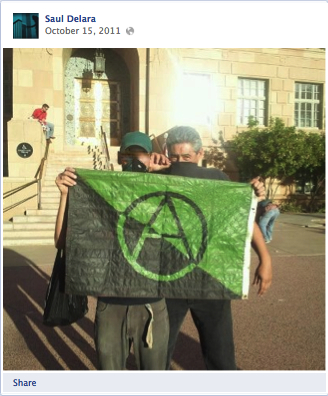
But the media's reporting on MOB doesn't cover the whole story. As emails released to the Center for Media and Democracy detail, MOB was also heavily involved in the repression of Occupy Phoenix, despite the total lack of felonious or violent activity on the part of occupiers. Sgt. Saul Ayala, a member of MOB was dispatched by his superiors to infiltrate Occupy Phoenix, where he advocated violence, perhaps hoping to provoke the very actions the MOB publicly claims to police. Ayala got his orders from another MOB member, Career Criminal Squad Sgt. Tom Van Dorn.

Sgt. Saul Ayala (right) poses with an occupier in a photo from his phony Facebook page

Just last month Down and Drought uncovered a Facebook post by Van Dorn joking about wanting to pull over parents selling Girl Scout cookies in his new beat, the poor and heavily Latino, Estrella Mountain Precinct. As we said, the response to the killing of Officer Hobbs is at least understandable (although not excusable), but just why such lack of critical reporting should also apply to MOB in general isn't clear. Natalie Brand tweeted that the PPD's press conference "made me cry," making us wonder, are the media being played by PPD?

We here at Down and Drought, even with our limited tools, routinely uncover examples of police racism and misconduct. Surely the media, with its vastly greater resources, can do more. Just in the last year we uncovered officers' racist tweets and Facebook posts, and we delved into the police surveillance and infiltration of Occupy Phoenix (while the media almost entirely ignored the revival of the political repressive functions of the police). And when stories about police violence have broken, we contextualize them, as we did in the case of a Phoenix Police Lieutenant accused of domestic violence (another epidemic of police violence that reporters refuse to connect). Why this is impossible for local media completely baffles us. Are local reporters too cozy with the cops?

Second chances are only for cops
It's worth noting that the media had no problem reporting on the target of the Hobbs/Casados raid that day, William Thornton. To the media, the civilian's record was fair game, but not the officers. The Republic's Lauri Roberts went so far as to declare that Thorton had been given too many second chances. This piece came on the heals of another she authored ordering us to support the boys in blue. Thornton's past is deemed sufficient justification for his shooting, but past allegations and suspicions abut the two officers is off limits. Cops get as many chances as they need. Reporters like Brand got on the internet more than 50 times to tweet praise for officers but couldn't be troubled to visit Google once and report on what she found. In the case of shootings by police, especially when an officer is wounded or killed, the past is irrelevant. Off limits, even.

The local media may be enamored of the police, seeing them as defenders of order and all things good. But many Phoenicians live in a completely different world. One in which the police act a lot differently than they do at press conferences. When reporters purge their critical faculties with regard to the police, and operate instead as the megaphone boosting and bolstering the cops' public image, they don't just do us a disservice, they discredit their own trade.  Even more so in cases of deadly force. And in this situation, the collective media suspension of disbelief has allowed PPD to pass off a unit that poses a serious threat to civil liberties instead as a thin blue line protecting civilization from violent thugs. In the era of mass protest and increasing alienation from the political system, the importance of that shouldn't be lost on anyone.

CLICK HERE FOR MORE OF DOWN AND DROUGHT'S COVERAGE OF THE OCCUPY PHOENIX FILES AND POLICE POLITICAL REPRESSION

Monday, February 24, 2014

Why does a Phoenix Cop want to see West Phoenix Girl Scouts profiled by police?

Eight year old Girl Scout Lexi Carney made national news this week after she and her family set up a table selling Girl Scout cookies outside of the TruMed medical marijuana dispensary in East Phoenix. Her mother Heidi had been inspired after hearing the news that a Girl Scout in San Francisco had sold out of her entire stock of cookies in a single day after setting up her table outside a pot shop. 

For its part, the local Girl Scouts chapter said that the medical marijuana dispensary would not have been approved because it would not be considered a "kid friendly" location. But the reality is that, in 2014, a family can set up a table at an East Valley medical marijuana dispensary and face no threat from law enforcement, even if Girl Scout leaders frown on the practice.  However, it's a different story in the Southwest Valley, if the Facebook post of a Phoenix Police lieutenant is to be believed.

In a February 6th posting on the public wall of his face book page, Lt. Tom Van Dorn posted a status update describing how he is a "cynical cop" because of his reaction when he saw a black Chevy Tahoe advertising the sale of Girl Scout cookies.  Below is a screen shot of Van Dorn's original post:


In other words, Lt. Van Dorn has a message for anyone driving a black Chevy Tahoe in the southwest valley: he is profiling your vehicle and is especially suspicious of anyone advertising their kid's Girl Scouts cookies from their vehicle in that part of town. When he sees your truck his first thought is, "WHO DID YOU ROB FOR THOSE COOKIES? [sic]" And, "I should pull you over."

According to the Girl Scouts of America's Girl Scout cookies FAQ, "parents and Girl Scout adults may assist, [but] it is the girl who makes the sale, sets learning and sales goals, and learns the entrepreneurial skills that are part of the program."  By these definitions the driver of the Tahoe is most likely following the rules, not that the police are empowered to enforce the Girl Scout handbook. 

Furthermore there's any number of scenarios which could explain why a parent would advertise that they have Girl Scout cookies for sale, for the suggested retail price of four dollars, as stated on the Arizona Cactus-Pine Council's FAQ. And the driver in the West Valley who advertises they have Girl Scout cookies for sale is not alone in this tactic, as the Duncan Banner reported over the weekend. 


 Tyler Boydson/Duncan Banner

The Watson family of Duncan, Oklahoma said that the painted message on their vehicle has helped them sell more cookies than they expected.  Luckily for the Watsons, they don't live in Southwest Phoenix where their support for their daughter's Girl Scout group would be interpreted by a Valley police officer as suspicious, and the cookies as likely stolen goods.

What's interesting is that you'd be hard-pressed to come up with a more wholesome, American middle class activity than selling Girl Scout cookies. In other parts of town, parents who participate in such activities are viewed as engaged and responsible parents. But not if you live in Lt. Van Dorn's beat. To him, you're just a thief.

This sets up a lose-lose situation in which parents are damned if they do and damned if they don't. Violating traditional middle class parenting values invites police intervention, but emulating them draws police suspicion. 


According to his public Facebook wall, Lt. Van Dorn was transferred to the Estrella Mountain Precinct in early January, working the 33 Area which encompasses Estrella and Laveen in Southwest Phoenix, both heavily minority parts of the city.

Before his transfer to the Estrella Mountain Precinct, Tom Van Dorn worked in the Career Criminal Squad, a division of the Phoenix Police Department's Major Offenders Bureau.  Van Dorn was referenced in journalist Beau Hodai's "Dissent or Terror" investigation into various local law enforcement agencies' surveillance of Occupy Phoenix participants, as well as individuals associated with anarchist protests and events.

According to emails released in that investigation, it was Lt. Van Dorn, then a sergeant, who was responsible for sending undercover officer "Saul DeLara" to spy on protesters, and he encouraged his colleagues at the Arizona Counter Terror Information Center (ACTIC) to broaden the scope of their internet spying on protest groups. Several people who interacted with officer "DeLara" reported that he advocated violence and claimed to have connections to Mexican anarchists. He was quickly outed by Occupiers and was further revealed in the "Dissent or Terror" investigation to be Detective Saul Ayala.

Interestingly, a search of the the Global Intelligence Files, five million emails from global intelligence firm Stratfor and leaked thanks to the work of Jeremy Hammond (who also hacked Arizona law enforcement as a part of the Antisec group), reveals that Saul Ayala contacted Stratfor at least twice offering advice on alleged radical jihadists in Mexico, a common far right wing talking point, but something that seems a bit out of the jurisdiction of your average undercover cop. There's quite a bit in these files about local police and unfortunately the media has largely ignored it.

Nevertheless, the connections between local police and private national security firms like Stratfor (and Infragard, as we have previously reported) raise serious questions, just like Van Dorn's thinly-veiled profiling operating under the guise of cynicism. Last year Down and Drought revealed a racist tweet from Phoenix officer Yuliana Sobarzo, out of the South Mountain Precinct mocking the mentally ill.  Social media posts, like those from Sobarzo and Van Dorn, reveal the casualness with which officers feel they can display their racism and bias on social media and raise questions about general attitudes among the force.

As we covered in a previous piece, the Phoenix police department has had ongoing problems with racism and their heavy handed approach to policing, so it is no surprise that the police consider the residents of Southwest Phoenix to be always under suspicion, just like how anyone outraged enough by the looting of the economy to join popular protests was a potential target of police surveillance and infiltration. And, of course, when a police officer like Van Dorn, who ordered the infiltration of a popular protest movement, jokes about profiling, it's not a far leap to believing he may in fact do it.

Further reading: Phoenix cop mocks Olympic athlete, the mentally ill, and wins gold medal in anti-black racism

Thursday, February 20, 2014

Scumbag Tempe creates free public transit, criminalizes using it

Let's hearken back to 2007, shall we? Tempe was dreaming big.  Centerpoint Towers, now reborn as W6 after temporarily pooping out mid-development, was still in progress.  The twin towers steadily rose to unprecedented heights, along with the city's prospects, it was hoped.

So can this can be used arbitrarily? Yes.

And Tempe Mayor Hugh Hallman was championing the transformation of the city's public transit system to reflect its New Urbanist vision -- a city of easy transport and just as easy-to-get-to entertainment and work. Easy money, you might call it. The city envisioned an expansion of the existing free transit system, the Flash Forward and Back, into a neighborhood system. Small free buses would snake through the areas surrounding the university, delivering students and shoppers to various city destinations.
 
Quoted in an official city press release at the time, Mayor Hallman described the purpose of the free Orbit system in broad, inclusive terms.  Not only was the system meant to be a simple, green means of getting to work, it was also supposed to serve the old and disabled.  "Many residents — young, old, disabled or those simply desiring to reduce vehicle emissions — are in need of alternative transportation," he said.


So it might be surprising to know that a few weeks ago Tempe essentially made taking the city's neighborhood buses a crime for elderly and disabled people.  And probably poor people, too. And probably just about anybody that doesn't fit into the city's yuppie vision for the future. And not only that, the may have turned taking the bus into a potential Fourth Amendment nightmare.

On January 24, 2014, the city council passed a troubling expansion of the city's sidewalk sitting ordinance into the surrounding neighborhoods, effectively criminalizing sitting on the ground while waiting for the free bus. Given that the system utilizes a “flag” stop arrangement, meaning that residents and visitors can essentially wait for and wave down the bus anywhere along the circuitous route where it is reasonably safe for the bus to pick them up, this change in the law represents a dangerous expansion of the ability of police to harass and criminalize people using the system, or just hanging out in front of their own homes minding their own business.


The only no vote came from Councilman Kolby Granville, who questioned the broad language and potential arbitrary enforcement of the ordinance.

Before the vote, Granville questioned legal counsel, asking, "So if I was sitting on the sidewalk in front of my own house, conceivably, could I be violating this rule?" To which counsel responded in the affirmative.  Cops would use their discretion, came the reassuring response.  And when it comes to the police, we know what that means: it will be open season on the poor, people of color and mentally ill and other perceived undesirables.

The passage of the original Tempe sidewalk sitting ban was controversial at the time.  Starting in 1999, community members engaged in a series of protests against the law, and then local ASU graduate student (now a professor at Prescott College) Randall Amster challenged it in court. In an unusual move, the 9th Circuit Court, based out of San Francisco, took up the case and heard the case in Tempe, in a public forum at ASU. Sadly, the court upheld the law. Ironically, it went into effect on Martin Luther King Day.

Down and Drought contacted several city officials for comments on the new ordinance, including Councilman Corey Woods. As the only African-American council member, we were curious if he would have any concerns about potential profiling that may result from the law. In his response to us via Twitter, Woods said the city had considered the effect of similar laws in Phoenix and Mesa, and that their "analysis didn't show profiling happening in those cities."


We requested that data and followed up with Woods via email, who then put us in contact with Bill Amato, police legal advisor to the city. Amato didn't include any data in his response but reiterated the claim that the city had run a "best practices analysis with other jurisdictions that had similar language," and found no reason to suspect increased "4th Amendment or racial profiling claims."

The term Fourth Amendment claims refers to cops using the pretext of police contact made via enforcement of the sidewalk sitting ordinance as cause for a search, which otherwise wouldn't happen.  This troubles Granville, who told us via email that while he's not a legal expert on the question, 'I do not know if violation of the city code is considered to be "an arrest" subject to a search, or if it is something different.  However, my concern is that it may be.'


But after those initial comments, things get a little tricky. In his response, Amato reminds us that racial profiling and police harassment are not "ordinance specific," meaning that a police force that generally profiles is just as capable of profiling with any law at its disposal. Neither Phoenix nor Mesa have stellar records in this regard.

Readers may recall in 2010 when police assaulted and handcuffed Phoenix City Councilman Michael Johnson as he was checking on a neighbor whose house was on fire. Indeed, we here at Down and Drought broke a story last year involving a racist tweet from a Phoenix police officer. In 2012 a community group accused PPD of racial profiling during traffic stops. And a statewide review of traffic stops by DPS in 2008 by the ACLU revealed widespread bias in police stops in Arizona. And of course, many Tempe residents remember the Sgt. Schoville affair. And just recently we saw allegations that Tempe police offered protection to a frat that threw a racist party. So there is certainly cause for concern.

Criminals up to no good in Tempe?

So essentially Amato's message to us is that we should just trust the police, despite ample cause for skepticism. However, it seems even the city is having some second thoughts. Amato tells us, 'As one final note, staff will be bringing this ordinance back to Council to add some additional language. The proposed language will add additional safeguards by requiring the conduct to “unreasonably impede the right of way or cause a safety risk”.'


So, if there's no reason for concern, why the need for additional language to prevent the abuses they claim won't happen in the first place? It certainly begs the question as to why the ordinance is needed at all. Is this a solution looking for a problem? Or is this push for increased policing related to other standardization measures in North Tempe, such as increased enforcement of noise ordinances and yard codes?

To us, it looks like a part of a broader attempt by the city to domesticate the valuable downtown area, to make it safe for development and high end condo owners, and to enclose all social life in Tempe in one of three places: in city sanctioned mega events and the bars of Mill Avenue (where they can be taxed and policed), or quietly and meekly inside residents' homes. Our guess is that's exactly what this is, and that's another big reason all residents should oppose it.

To the sidewalks!

Wednesday, February 19, 2014

Public Relations: The love affair between Valley cops and the news media


 A Symbiotic Relationship: 3TV news crew poses for a selfie with Phoenix PD's Press Information Officer (PIO) Steve Martos

It's no surprise that local news content is full of pre-packaged "video news releases" which make up much of the content that supplements the local coverage.  While some of the news is received via satellite from international news organizations such as the Associated Press, often there are stories planted by public relations firms and advertisers disguising their product in a news story.  Local television stations have relied on video news releases to keep the costs of producing a newscast low and the profits for the station's owners up, even as audiences for local newscasts have been dwindling for years. The pervasiveness of the video news release has reached such absurd proportions that even late night talk host Conan O'Brien has a regular feature on his show lampooning the frequency of local newscasts that report the same story, word for word, in markets across the country.


However, it is not just PR firms and ad agencies making the most of local news media's need for content that is cheap and easy to obtain, police departments have also become experts at using the media to boost their image by adapting the methods used by advertisers to craft a "brand identity" for consumer products. In "Branding Your Agency: Creating the Police Department's Image", a 2004 article published in Police Chief Magazine, police chiefs Gary J. Margolis of the University of Vermont and Noel C. March of the University of Maine encouraged police chiefs to seize control of their department's public image by turning to the strategies of advertising and PR firns in creating a brand identity for policing.

Margolis and March cite a 2001 "Public Image of the Police" report from George Mason University which concluded that negative perceptions of the police stem from personal experience, rather than the success of police in reducing crime or an individual's favorable interaction with a law enforcement officer.  Key to the study was the finding that people's perception of the police are often formed by their exposure to police actions in the media, that the media is the primary source for most people about crime, and in the absence of a narrative controlled by the department it may appear that police are unable to stop crime. 

Valley police departments were taking notes, as Press Information Officers (PIO) make frequent appearances on the evening newscast to share information that departments want released to the public.  In addition to the various departments' de facto anchors making regular appearances on the local news, press releases from law enforcement agencies are often reprinted with minor changes made in the arrangement of sentences to avoid plagiarism.  That these press releases are appearing on local news websites and newscasts as news items, complete with all the authenticity associated with a journalist's byline, should be prompting outrage at the local news and police agencies. 

We here at Down and Drought follow the local news pretty closely, so we thought we might have some fun comparing the press releases from law enforcement agencies with news articles from our esteemed "free and independent" fourth estate. How bad is it?  Take a look at two recent stories in the Phoenix news, compare the police press releases to the slightly altered news content and ask if it stands on its own as an independent piece of journalism.

Below is a screen capture from the January 27, 2014 press release from the Mohave County Sheriff's Office announcing the search for a suspect involved in a bank robbery in Golden Valley, Arizona.  The press release includes photos of the alleged robber as well as information specific to the person's build, their behavior during the alleged robbery, and the the appropriate contact information for the department(s) investigating, in the case a viewer might have information the cops would find useful.


The photos below are both screen captures from articles published on the website for KTVK Channel 3 and KPHO Channel 5.  Both websites ran the press release with slight modifications from the original writing and were published under the names of employees at the station.   The KPHO article, credited to Steve Stout, a longtime editor of valley news publications from the East Valley Tribune to his current gig at KPHO, is nearly identical to the press release.


Both articles come pretty close to qualifying as plagiarism, as they are nearly identical to the Mohave County press release, and yet they are not the exception.  Again, the same pattern with a Tempe police press release on the arrest of an alleged bike thief:


Followed by screen shots taken from two articles from local news websites which include large sections of the press release which are rearranged just enough to keep it from being a plagiarized article.


The local press, and as seen above KTVK and KPHO, have no qualms about reprinting police news releases and remaining completely uncritical about the information contained within.  Just like the video news releases released to stations by PR agencies, law enforcement agencies know they have an open door with the local media, forever hungry for cheap, garish stories which come to them, saving any of the employed journalists from having to do any of the actual leg work and research required for a balanced piece of journalism.

In plain terms, there's lots of advantages for the police in crafting a brand identity which portrays the police as the solution and final word to the problems of the community. Aside from that, they need the good publicity! Just last year valley cops killed over 50 people in shootings alone, a key community relations officer was arrested for sex with minors, and Phoenix officer Richard Chrisman went to prison on assault and manslaughter charges.


It was during the week that Chrisman was sentenced when the Phoenix police's PR division may have tried to deflect attention from the Chrisman verdict by planting a story about officers helping a needy family at Christmas.  The story, which appeared on KNXV ABC15, cited Phoenix police officer James Holmes, as he described Phoenix cops as having a "tough and dangerous job", and frequently coming to the aid of the citizenry, at what now sounds like potentially great peril to their well being.  Whether out of laziness or complicity, the journalist Lauren Vargas deemed it unnecessary to also include the information that James Holmes is a PIO for the Phoenix police, and the story aired on December 20, 2013 the day that one of the most notorious cops in Phoenix's history was sentenced to seven years in prison.

Writer JJ Hensley at the Arizona Republic wrote a lengthy article on the police shooting spree of 2013 and tackled a number of contributing factors which critics and defenders of the police say have contributed to so many shootings in the Valley.  Hensley cites the rate of assaults on officers and the continuing militarization of the police as two of the main reasons for the change in policing.

Hensley ends the article with a section on the public's response to trigger-happy cops, noting a lack of public outrage to the well-publicized shootings.  But he fails to consider one of the biggest factors as to why there may be a lack of outrage when officers gun someone down: that his own profession treats the local police department as an in-house bureau which provides the footage that often bleeds and leads on the local news.

While the public's passivity to police killings cannot be entirely attributed to the media's coverage and working relationship with the police, it is worthwhile to return to Margolis and March's article in Police Chief Magazine and their emphasis on manipulating the public's perception of the police. Utilizing the media is useful for police in expressing their department's brand identity, and to seize the narrative from their critics to ensure that, whether they are rescuing a cat from a tree or shooting over 50 people in a year, they must be seen as the community's only solution to their problems.