Saturday, October 19, 2013

DID THE FORMER PHOENIX COP UNION BOSS JUST CALL THE PPD RACIST?


Did former Phoenix Law Enforcement Association President Mark Spencer just call the Phoenix Police Department racist?  It sounds like he did.

In an interview with Channel 12 on Friday, Spencer offered his comments on what might be described as a quota-system-in-everything-but-name being developed by Chief Garcia.  In the same report, Garcia described his new system, a disturbing cross between pre-crime and the NYPD's famously racist (and recently struck down as such) "Stop and Frisk" policies, this way:
“When [officers are] not responding to calls, when they're not actually in the process of writing a report, what are they doing? Are they in those areas that are areas that are going to be – that have a history, or that we think are areas that we want to go into to stop burglaries, auto thefts, aggravated assaults. We want to be productive. We want to stop crime before it happens. Before your home gets burglarized we want to catch the burglars. Before the aggravated assaults occur, how can we stop those?”
Chief Garcia swears this is not a quota system -- merely a vision for a more "pro-active" and more productive PPD -- and that despite asking for more civilian contacts from his officers there are no hard and fast numbers that he is requiring.  Just more.

In an statement released Friday night and tagged on verbatim to the end of a story posted at Channel 5's website (like good stenographers), Garcia tried to clarify his philosophy, saying "We will continue to proactively direct our efforts towards persons committing crimes, places where crimes are committed and behaviors that lead to crime."
 
The chief gives us no indication how he expects officers to know which neighborhoods are the right ones to target for increased harassment, or which people are the right ones to stop arbitrarily.  Nor does he explain how officers are supposed to stop crime before it happens.  After all, our criminal system, at least on paper, is based on people being accused of committing crimes and then having evidence brought against them, not precognition. 

So there's good reason for skepticism.  Valley residents should consider the experience of NY City with Stop and Frisk when they hear this kind of talk.  For over a year New York police officer Adrian Schoolcraft secretly recorded his bosses as they twisted themselves into contortions to say without explicitly stating that NYPD expected officers to create contacts, stops and arrests in order to meet productivity expectations under Stop and Frisk.  Quotas, essentially, though no one would speak the offending word.  This led to the obvious: manipulated stops, searches and arrests that naturally fell disproportionately on young people of color.  Because it turns out that cops are racist.  I know this news will shock some of you.
In fact, Tempe got a preview of what these kinds of policies might look like in the Valley during the city's short-lived and ill-fated "Safe & Sober" campaign.  Thousands of police flooded neighborhoods surrounding the university and made thousands of contacts over several weekends.  Per capita those stops rivaled those of Stop and Frisk.  After four weekends the city abruptly cancelled the effort after facing student and neighborhood resistance, and the "zero tolerance" shooting of Austin Del Castillo in broad daylight on Mill Avenue on the first morning of phase two of the operation.  Tempe hasn't released the racial breakdown of their stops, but it wouldn't be surprising at all if these numbers also skewed, just like Stop and Frisk, disproportionately against youth of color.

It wouldn't be a surprise, namely, because of the history of local police forces.  People may remember the infamous "no n***er zone" that Scottsdale cops enforced up by McCormick Ranch.  Or the racial profiling by DPS as documented by the ACLU, in which the state cops stopped and searched people of color more frequently than whites -- even though whites were more likely to have contraband on them!  Or the more recent ruling against Sheriff Joe for racial profiling.  

Indeed, here at Down and Drought we ourselves have recently documented racist behavior by Phoenix police.  And, of course, there's the entire history of policing to go by.  So it wouldn't be outlandish at all to suspect that a rise in quotas à la Stop and Frisk, such as Chief Garcia seems to be proposing with his increase in officer productivity, would disproportionately target blacks, Latinos and indigenous people, especially youth.

Which brings us back to Mark Spencer.  Make no mistake, Spencer is a former union boss for the cops, so his main concern is the speed-up that Chief Garcia is trying to impose on officers, not the defense of civil rights.  Forcing cops to do more stops and document their activity in terms of productivity means more work for them, and it's the union's job to push back on that.  He'll use whatever excuses he has available towards that end.

But Spencer did say something very important that should be remembered.  He called the Phoenix Police Department and its officers racist.
“When you remove discretion from an officer and you mandate enforcement action our minority community partners seem to pay a higher price for that."
Spencer seems to be saying that if his former buddies are bored and forced to make busy work, that they're going to go pick on minorities to make their numbers.  As they say, even a broken clock is right twice a day.

Wednesday, October 16, 2013

PHOENIX COP ARRESTED FOR PUNCHING WIFE USED STEROIDS, ADVOCATED FOR OFFICER STEROID USE

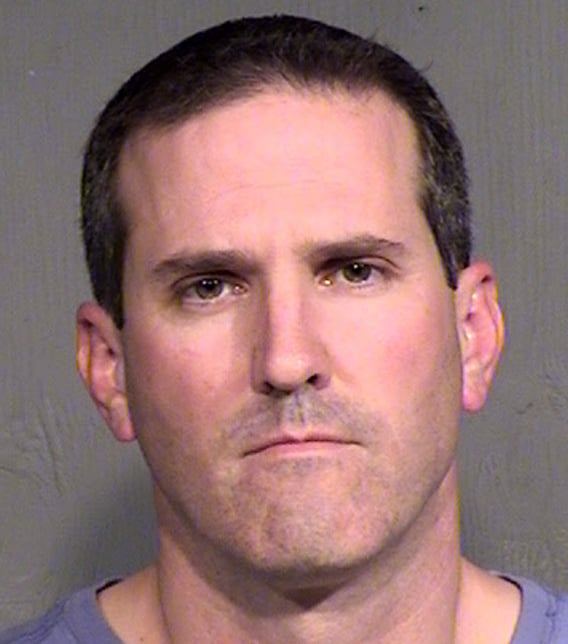
Phoenix police officer Albert Smith's mugshot

A Phoenix police officer arrested for domestic violence last week was suspended in 2007 for his use of illegal steroids during a department crackdown on the artificial male hormone.  In an interview with KTAR at the time, Officer Albert Smith defended the use of the drug by police officers and fire fighters, and suggested that steroids were widely accepted amongst officers.

Speaking to KTAR, Smith said "There's tons of guys out there, tons of guys, on the fire department, on the police department, that are using. My honest opinion? I don't believe they should be illegal, I think it's a personal decision. I'm not hurting anybody." A 2007 investigation by CBS 5 found that, despite Smith's claims that steroid use is harmless, the drug was linked to allegations against more than a dozen Phoenix police officers and firefighters involving suicidal threats, rage, restraining orders, and domestic abuse.

Smith may not have been honest about his own behavior prior to the interview with KTAR. Court documents from a lawsuit filed against Smith and the City of Phoenix in 2005 reveal that the officer was accused of extreme brutality during an arrest. The suit alleged that Smith had "punched Plaintiff behind his head with a gun, slammed Plaintiff's face on the sidewalk, put his knee in Plaintiff's head, and then kicked Plaintiff. Other unidentified officers arrived and joined Smith in kicking Plaintiff. They did not stop until they heard over their radios that civilians were watching. Plaintiff also alleges that the officers were deliberately indifferent to his medical needs. He suffered various physical injuries, including fractured ribs and a bump on his head."
__________________________
 Considering the violent outburst which led to Smith assaulting his wife, his past statements in defense of officers using strength enhancing steroids, and the past accusations of brutality would seem to qualify Smith for a full substance abuse testing by investigators of this case to determine if the officer is still using steroids.  
___________________________ 


While the outcome of the lawsuit is not found in court documents available online, it is probable that the suit did not go forward once the plaintiff was found guilty in his criminal trial. However, the behavior described in the lawsuit would not be considered irregular for an individual who has used an anabolic steroid drug. The widespread abuse of steroid by police officers, and the potential for an increase in on the job violence, was noted in an article published in Police Chief, the magazine of the International Association of Chiefs of Police, and authored by law enforcement officers and medical professionals in law enforcement.

Among the list of symptoms to watch for in cases of anabolic steroids use are "Mood swings, particularly if aggressive", "Unreasonable emotional responses to situations", and "Multiple incidents of 'use of force' or complaints of improper outbursts and attitude." Considering the violent outburst which led to Smith assaulting his wife, his past statements in defense of officers using strength enhancing steroids, and the past accusations of brutality would seem to qualify Smith for a full substance abuse testing by investigators of this case to determine if the officer is still using steroids. 


Smith is not the only Phoenix officer who has made the news in recent months after an arrest for domestic violence. In late August Phoenix police lieutenant Dalin Webb was arrested and charged with aggravated assault and disorderly conduct after he allegedly shoved his wife and choked his son. As reported in Down and Drought at the time, Lt. Webb was a school resource officer and served as an adviser to the anti-bullying group Not My Kid. It appears that Webb is still employed by the department and on duty, a check of the Phoenix police department's website lists him as an area lieutenant at the Mountain View precinct. Webb had plead not guilty to the two misdemeanor counts of disorderly conduct and one felony count of aggravated assault, his charges have been dismissed while a grand jury decides whether he should face new charges and move to trial. 

Smith and Webb's arrests illustrate that the culture of police violence extends from the city streets to the homes of the officers.  The Center for Women and Policing's research found that as many as 40 percent of law enforcement families experience domestic violence, while the number stands at 10 percent for the rest of the population.  In addition to these startling numbers, the victims of abuse from police are especially vulnerable because their abuser is armed, knows the locations of women's shelters, and has knowledge of how to use the system escape the consequences and shift blame to their victims.

As October is National Domestic Violence Awareness Month, the Phoenix police department have made a video, patrol cars have purple awareness month ribbon magnets placed on them as well. It is doubtful they will use their own officers' arrests to illustrate why domestic violence is never acceptable.

Thursday, October 3, 2013

TAILGATE: PHOENIX'S SURVEILLANCE SCANDAL SPIRALS OUT OF CONTROL

ASU FOOTBALL FANS, CITY COUNCILMEN, ACTIVISTS AND ANARCHISTS ALL BECOME TARGETS OF THE WIDENING AND SUSPICIOUS GAZE OF BIG BROTHER


Is this a photo of the "War of the Worlds" spy camera that provoked Phoenix City Councilman Sal DiCiccio into action against the encroaching Big Brother state this week?


In various Facebook posts and media interviews, the councilman for the upscale Phoenix neighborhoods Ahwatukee and Arcadia says he was just enjoying a good time tailgating at the ASU-USC game at Sun Devil Stadium when he and his friends noticed a curious white truck from the Phoenix Police Department patrolling the parking lot.   Protruding out of the bed of the truck was "a tall adjustable spire" with a sci-fi look to it and a camera, scanning the assembled fans and their hot dogs.

“I was just frustrated, and I wasn’t happy about it,” the councilman told the Arizona Republic  “Why does Phoenix police send out a truck with a camera videotaping tailgaters? ... It’s just one more level of intrusion by the government looking into our personal lives.”

DiCiccio made several inquiries and after ASU and Tempe initially denied involvement Phoenix stepped forward to claim credit, in a way, and to tell us all to relax: the spying was for our own good and they didn't really feel like explaining much more about it.  So there.  If you're not satisfied with that then you're supporting the terrorists.

Mayor Stanton put it this way:
“The suggestion is that we shouldn’t provide homeland security support to another jurisdiction unless it rises to the level where we’re ready to arrest somebody,” Stanton said as he stood in front of Chase Field in downtown Phoenix.

“I think most people, both in the law enforcement world and then families who are attending this game, would probably disagree. ... Rather, what is in the best interest of keeping tens of thousands of people attending a game safe.”
What size hot dog is that in your hand, citizen?  The state needs to know to keep you safe.  From terrorists.  Or maybe just protesters.

Because, dear reader, you may find it interesting to know that the photo above of the PPD's spy cam didn't come from the ASU-USC game.   That photo was taken at a protest in 2012, when thousands of Unitarian Universalists bused themselves into town from around the country for their national conference and held a highly regulated and peaceful protest against SB1070 in front of Arpaio's tent city gulag.

Unitarians protest fucked up shit, get played by Big Brother -- via State Press

The PPD positioned the surveillance device by the entrance to the rally, presumably recording everyone coming in and out of the protest zone.  Indeed, this caused quite a bit of controversy because police, perhaps tipped off by the towering eye in the sky, singled out several local protesters, anarchists mostly, and then proceeded to exclude them from the protest with the cooperation of out of state UU organizers (who may not have understood that they were being manipulated by PPD's red squad).

Cops wait for anarcho-Qaeda among the Unitarians -- via AzCentral

In the emails below, PPD terror cop Brenda Dowhan (who was PPD's main internet spy during Occupy Phoenix) is discussing putting together a "face sheet" so that cops can identify specific activists at the Unitarian protest, and expressing her concerns about anarchists and which of them ought to go on the sheet.

In one case she's reaching out to Tempe terror cop Derek Pittam for his input. Pittam himself is famous recently for having massively over-reacted to community gardeners, deploying undercovers and riot cops to stop the planting of of veggies in an empty lot in downtown Tempe.

This face sheet is to be used to pick out undesirables, despite no criminal allegations against them, and eliminate them from the protest.  She also references a previous face sheet that was created in collaboration with various private and federal intelligence agencies for the anti-ALEC protests that took place the previous April.  Of course, this raises the question of whether the Phoenix cops' spy toy has facial recognition technology.


Again, no one made any allegation that these protesters had committed any crime.  The basis for the special attention seems to have been their participation in Occupy Phoenix, according to emails released by the PPD to investigator Beau Hodai.  And, as we've cataloged here at Down and Drought, the PPD was involved in a long and detailed surveillance operation against local anarchists and Occupy Phoenix activists, which included information sharing with private and corporate security companies, as well as the Feds via the local fusion center.

One indication, that we're looking at the same spy device, aside from the striking similarity to DiCiccio's description, is the fact that the PPD's own explanation of their ASU operation matches up with the way it was used in 2012.  Responding to the Republic, the PPD reported the device was "part of a multi-jurisdictional operation to monitor entry and exit points from the stadium area from a homeland security perspective.”

The cops describe their ASU surveillance operation as part of Urban Areas Security Initiative, a federal grant that funds the equipment.  And of course homeland security is big business.  The chart above, taken from DHS's report "The State of Arizona’s Management of Urban Areas Security Initiative Grants Awarded During Fiscal Years 2007 through 2009," shows the many millions of dollars that flowed into Arizona via homeland security grants in just a few years -- millions that bought equipment just like that spying on local activists and football fans.

And, of course, it's not just a bounty for local law enforcement agencies.  As an upcoming Greater Phoenix Chamber of Commerce event indicates, local companies are keen to strap on the federal feedbag as well.  Innocuously entitled "Doing Business with the Federal Government," check out the teaser:
The federal budget is more than $1 trillion, with the Departments of Defense and Homeland Security spending a combined $20 billion in Arizona alone in 2012. Through this highly-interactive presentation, you will learn how to get started on earning some of that business for your company, find out about available assistance, gain insight into future trends and share your successes and challenges of doing business with the federal government.
Twenty billion dollars is a lot of dough.  And it buys a lot of equipment.  Although their website claims the GPCC "pursues and promotes a free market," they don't hesitate to line up for the government slop when its feeding time.  Even when it comes at the expense of our freedom.  Isn't that interesting?

And, of course, the other part of the equation in Tempe is the city's recent crackdown on what they call "rowdyism."  Essentially a counter-insurgency crackdown on fun with the aim of pacifying the area around ASU for developers, the city flooded the downtown neighborhoods with overwhelming police force for three weekends in a row, including enlisting the help of the notoriously racist MCSO, making thousands of arrests with contact rates rivaling NYPD's racist "stop and frisk."  All in an alleged effort to stop college drinking.  Sound familiar?  In his response to DiCiccio, Mayor Stanton claimed that ASU requested the surveillance, which was confirmed by the ASU PD.

Clearly this has to viewed in the larger context of the crackdown in Tempe.  Perhaps, surprised at the level of resistance their "Safe and Sober" campaign received, ASU and the city have turned to other means.  Or maybe this is just a case of mission creep.  After all, despite local terror cops assertions, not much in the way of terrorism is happening in the Valley.  But once you got the tools, you gotta use them for something.

It's worth pointing out that these police activities aren't just problems of Big Brother, personal data and privacy.  They can be about life and death.  The militarization of the police has consequences, sometimes deadly. They certainly were on the first day of phase two of Tempe's "zero tolerance" crackdown on "rowdyism", when Tempe police responding to a call about a man with a box cutter gunned down Austin Del Castillo in plain daylight at the intersection of Mill and University.

In that case police claimed they "feared for their lives".  But doesn't the deployment of spy cameras against activists and football fans indicate the same level of fear, this time of the population at large -- a general criminalization of society in which we are all assumed to be guilty rather than innocent, each of us a potential threat.  And, as we see, when we accept this augment for increased police power in one case, it quickly gets turned to broader use.  What was bought under the excuse of fighting terrorism first becomes a tool for tracking activists and disrupting their activism, and then the next thing you know there's an embarrassing photo of your drunk-ass puking your brains out in a DHS database.

With cities facing an alleged budget crunch, and politicians like DiCiccio calling for union busting under the argument that we can't afford them, maybe it's time to look to a fire sale of police hardware to get us out of the red.  How about we de-certify the police union as punishment for their over-reaching.  The cops clearly can't use either their power or their toys responsibly.  Plus, it could do far more than save other innocent public workers from needless cuts to pensions and salaries.  Think of the payoff in terms of freedom!  Can you put a price tag on that?

Tuesday, September 10, 2013

EVERYTHING TO G.A.I.N.: TEMPE'S TWO-PRONGED COUNTER-INSURGENCY STRATEGY IN DOWNTOWN


Guest contributor M.Arginal analyzes the ongoing and intensifying crackdown on downtown Tempe and how it fits into Tempe's overall development objectives.


File under: things that only happen in a room full of scared middle class white people.  Local cops struck their best gang member/rapper poses Monday night, complete with crossed arms and fake gang signs, at a "community" meeting boosting the city's G.A.I.N. block parties.  Meanwhile, about a hundred Tempe residents, members of local crime watches and various neighborhood groups hooted, hollered and foamed at the mouth hoping to win high profile visits to their hyper-local hootenannies by heavily-militarized local gang units and SWAT teams.  You know, fun for the whole family?

The Tempe PD raffled them off to lucky winners -- locals who have announced their plans to host local police-worshiping "get to know your neighbors" parties on October 26th.  This is the essence of the G.A.I.N. initiative, one prong of the city's counter-insurgency attack on the neighborhoods surrounding Tempe.  Masquerading as a "get to know your neighbor" block party, these function instead as propaganda ops for the cops and snitch farms to build support for the rapidly increasing development transforming Tempe.

This happens at the same time that the TPD Chief Ryff and notorious racial profiler Joe Arpaio announced MCSO participation in the fourth week of the other prong of the counter-insurgency strategy -- the boots on the ground swarming of the downtown Tempe with hundreds of cops enforcing petty alcohol crimes and setting up DUI sweeps.  Dubbed "Operation Safe and Sober", residents reported intersections blocked off by patrol cars and officers toting AR15s down neighborhood streets


The record-setting invasion, which Tempe officials claim is a response to "rowdyism", resulted over the last three weeks in almost 6000 police contacts and nearly 1400 arrests.  Police also broke up 129 parties, which they describe as "loud", although from what we're hearing from locals, the definition of "loud" and "party" has been stretched almost to the breaking point.  On a local neighborhood forum, one resident reported being raided by police exercising their new anti-party powers, although she asserted that her "party" consisted of only half a dozen people listening to music.  Other residents reported being hassled walking to the convenience store and home from the bar.

Tempe over the last year has been dealing with some high profile frat violence and fraternity-related partying.  In what some residents are now calling the "frat wars," frats and frat members have engaged in a series of assaults, general intimidation and reckless behavior in the neighborhood.  On April 28, a frat party descended into violence as shots were fired by an armed crew trying to settle a score following a fight earlier in the night.  In March two women were seriously burned at a frat party after a frat member threw alcohol in a fire pit.  Just two weekends ago, despite the Tempe police crackdown, two rival frats battled it out at the new District Apartment complex, leaving one fratboy beaten severely in a elevator.  This comes on the heels of a variety of other frat insanity, including alcohol related incidents that left one person dead and another nearly so.

ASU kicked the frats off campus last year, forcing them out into the neighborhoods, where they now rent homes and take over entire apartment complexes.  And this, in fact is the source of the problem.  A bunch of spoiled brat white kids, with powerful alumni parents, have colonized the neighborhoods surrounding the university, sowing entitled chaos wherever they go.  Interestingly, the frats meet every criteria for being a gang, and yet Tempe has not labeled them such, preferring instead to heap repression on the broader community, sending an invading force into neighborhoods long known for hosting non-frat house parties and dissident culture.  Are they too white and middle class to be considered a gang?


The scope of the Tempe's police response really comes into focus when taken in the context of Tempe's population of 160,000 people.  Six thousand contacts -- which could each involve more than one person --  means a significant portion of the population came into contact with the police, with 25% of them getting arrested as a result.  The sheer scale of the operation, and it's reliance on police contact, evokes comparisons to New York City's notoriously racist Stop & Frisk policy.  Although no numbers have been released detailing the racial breakdown of these stops, the TPD's uneven history in this regard and the newly announced participation of Joe's posse set off alarm bells.

It's worth remembering that in 2005 the Tempe Police were singled out by the city itself after years of criticism for its lack of diversity and for reflecting a culture of the "good ol' boy network."  Now throw on top of that the ongoing activities of the MCSO, recently found guilty by the Feds of racial profiling Latinos and you get the distinct feeling that walking down the street next weekend in Tempe is going to be a potentially dangerous experience if you happen to be a youth of color.


Indeed, things took a surreal "back to the future" turn Monday night when Tempe officers at the front of the room began mimicking rappers and gang members, tossing up mock gang signs, gesticulating wildly and striking exaggerated poses -- to the wild applause of the overwhelmingly white audience -- while announcing the winners of the G.A.I.N. gang unit raffle. It seemed buried in the ancient past as far as the G.A.I.N.-wannabes are concerned, but readers may remember the infamous "rap ticket" scandal, in which Chief Ryff was forced to apologize after Tempe Sgt. Chuck Schoville made two black men rap about littering on camera in order to get out of a ticket. 

Monday's meeting featured three main parts.  A couple "crime prevention" officers (begging the question of what the rest of TPD does) did an awkward presentation on how to keep from getting robbed.  Locking your doors and having small dogs featured prominently, but aside from the bizarre raffle, the meat and potatoes was a presentation about Tempe's new 311 snitch app.  Like Mesa's recently-debuted app, this downloadable program allows residents to anonymously (make sure to turn on the GPS location feature, though!) rat on neighbors and other anti-social elements.  Upload pictures of offenders and unsightly street art straight from your phone.  You, too can become part of the corporatization and blandification process in Tempe!  Every resident a gentrifying and a cop!


Which gets us to the heart of what is happening in Tempe: counter-insurgency.  As an American strategy, counter-insurgency has its roots in Vietnam and the period following the social upheavals of the 60's and 70's.  It returned in the 80's with the drug war as the police response to the crack epidemic and most recently, the US military's experience trying to dominate and pacify Iraq and Afghanistan.  The cross-pollination of US police forces with the military during the war of terror is well-documented, not just in terms of cross-training but also as a result of recruitment and the fact that many officers serve in reserve and national guard units.

Counter-insurgency relies on two main strategies.  First, disobedients must be isolated and attacked with state violence and coercion.  Secondly, bases of support for police need to be set up in the community.  With the ongoing police invasion of Tempe, ostensibly to crack down on partying, we have the first element.  With the G.A.I.N. parties, we have the second.


Over the last couple of years Tempe has seen a rebirth of its downtown development dreams.  Fueled by major tax-breaks (see also this) and a return (for now) of the housing boom, one large project after another has been announced downtown, from the 600 million dollar State Farm Insurance complex by the lake to the large corporate complex planned for Mill and University to the expanded and privatized high-end student housing (complete with lazy river -- only for sober use, naturally!), ASU and large development corporations have rediscovered their appetite for eating up the neighborhoods surrounding the university.  And, as we know from Iraq, for business to thrive, the population must be pacified.

Here's how the G.A.I.N. parties serve as the second prong of Tempe's counter-insurgency project.  First of all, the city needs to build a base of support within the community.  That means it needs to build direct support for the police and it has to get people together who are willing to work with them, and to then get those people talking to each other.  Remember the raffle?  Win a SWAT team appearance at your party!  Win a gang task force unit for your party!  Win a K9 unit for your party!  Indeed, personal appearances of various top cops were also promised.  The chief himself might come to your party, along with various commanders.


Trust me, nothing highlights the unique experience middle class whites have with police -- and their complete ignorance of that uniqueness -- than a room full of a hundred frothing white people cheering for a SWAT team to come to their bloc party.  The competition was fierce and palpable.  And the irony that the appearance of the cops at their city-sanctioned parties would look nothing like their appearance later in the night at non-official parties was completely lost on them.  And here's another interesting thing.  Watch Tempe's own promotional video for G.A.I.N.  Notice any cops?  It's presented as an entirely feel-good, neighborhood-oriented family affair, not a ravenous, authoritarian quasi-fascist open-air recruitment office.

Note in particular the appearance of Councilman Corey Woods.  Woods is happy to put himself out there as an enthusiastic advocate for G.A.I.N.  Indeed, Woods, Tempe's first black councilman, recently hosted a discussion at the Tempe Historical Museum on the African-American experience in Tempe, which focused in no small part on discrimination and life in segregated Arizona.  And as a candidate, Woods denounced previous threats from Arpaio to do patrols in Tempe, calling them "an exercise in chest-thumping and not an appropriate use of power."  Now, however, Woods has changed his tune, telling Channel 3 News that he now supports Arpaio's participation in the crackdown in Tempe saying, "The managing of the problem cannot fall solely on Tempe."

While these block parties pretend to be about getting neighbors out to meet each other as a form of crime prevention, they are very much about integrating that into the police structure.  So on one hand these police are engaging in a PR operation for themselves, but they are also actively recruiting snitches in the neighborhoods and gathering like-minded people (and dupes) together.  Many of these people think of themselves as community leaders (indeed, the cops referred to them as such at Monday's meeting), and serve on various neighborhood boards and governing bodies.


These willing and/or unknowing recruits will serve as the eyes and ears of the police on the ground, directing them towards people deemed disobedient or anti-social (not white, poor, counter-cultural, etc).  Loud music, unkempt front lawns, a rebellious attitude or a general nonconformism with the revitalized corporate face of downtown will get you singled out and squashed.  The G.A.I.N.ers will act like a collective all-seeing Eye of Sauron, staring down on the community from the Tempe Municipal Jumbotron between the two towers at W6, once dead but now reborn as the guardian of Tempe's new five year plan.

We've already reported on Tempe's plan for increased enforcement of code violations.  These attacks need to be seen together for what they are, an attempt to corporatize, domesticate and lame-ify downtown in the service of developers and the corporate university.  If they had their way, the city would bulldoze these neighborhoods tomorrow (and in a real sense they already are!) and replace them with high rises full of insurance agents, South Tempe style homes populated by the zoned out middle class, bars full of college well-discplined, high-spending sports fans, and white bread university students safely contained in their luxury condos and responsibly floating down the lazy river of life towards their bachelors degrees and mommy and daddy's approval.

If this isn't the fate that residents have in mind, time to act is running out, but it must involve a rejection of the faux community of the Tempe police and the construction of a real one in its place.  One with a tolerance for the kind of disobedience and raucousness that comes with life in a college town, or just life in general.  Lately some residents have been overheard, maybe only half-jokingly, fantasizing about the secession of South Tempe from downtown.  The sense is that people moved into these neighborhoods many years ago for a reason, and that if South Tempe is the future of downtown, then they want no part of it.

The recession gave everyone a brief reprieve, when the dead towers where W6 now stands stood like a skeletal reminder, a warning of just how close the neighborhoods came to obliteration.  The towers marked the spot where the beast was slain, or so many people thought. Judging by the way those South Tempe residents behaved in the G.A.I.N. meeting, not only do they have no idea what is happening up north, but they are too distracted getting pats on the head from the TPD to care.  The Tempe residents of Police Zone One may have only themselves to rely on if they want to beat back this most recent attack.

Tuesday, August 20, 2013

A TALE OF TWO RUN-INS WITH THE POLICE


It's difficult to watch the video of the Phoenix police assaulting -- killing -- Michael Angel Ruiz.  It's also hard to tell what exactly killed him.  Was it the chokehold that was applied for no apparent reason?  Was it the tasering?  Or was it the multiple blows to the head that he received as his head repeatedly struck one concrete stair after another as the police half-dragged, half-carried his limp body from the second floor.

In what is an all too common occurrence, the cops dog-piled someone who didn't appear to be resisting, accused him of resisting and then went hog-wild on him.  Following the assault, Ruiz lost consciousness, had to be resuscitated at the scene, transported to the hospital and was eventually taken off life support on August 2nd.  Doctors had declared him brain dead.

Channel 15 covered the story:
Many of Michael's neighbors witnessed everything and recorded it all on their phones.

Gary Carthen was good friends with Michael, and witnessed it all.
"This was bad, very bad. Because he didn't deserve that to happen, not like that," he said.

Carthen and his neighbors want answers. Verna Young says you could hear his head banging on the stairs as police dragged him down.

"I started crying 'cause that's not right, to hurt nobody like that," she said. "He didn't deserve that. He was a nice person, very nice."
Ruiz's father, a former LAPD detective was shocked by what he saw.  And if an LAPD cop is shocked by police behavior, then you know it's beyond the pale.  It's hard to imagine any thing that could explain what is clear to see on the video other than violent cops out of control.  Again.

It's perhaps ironic, given how the police treated him, that Ruiz's Facebook page, now gathering some condolence messages from friends, also features prominent posts from him supporting the LAPD in their hunt for once-rampaging cop killer Christopher Dorner, including one in which he poses in front of a Confederate flag.  The degree to which Phoenix police may have perceived Ruiz, a self-confessed Republican, as not white when they encountered him isn't clear, but one thing's for sure, that gang of cops aggressively piling on him was very white.


But let's take a step back for a minute and see if we can draw any lessons by comparison.  To do that, let's check out some coverage of a different encounter with the police that happened this week, this time over at Az Central.


Notice anything?  Well, first off there's the glaringly obvious: one got killed by the cops and the other got escorted off the property instead of arrested.  There's no indication that the cops threatened John Coulter with violence, at least beyond that which underlies all interactions with the police.  In fact, if the cops' stats can be believed, in every other incident such as this, arrest was the result.  Coulter may have gotten off pretty well, considering, receiving a only a citation.

And, at first glance, it seems like that there is probably a class difference as well, at least in the eyes of the police.   Season tickets aren't cheap, and even though many people share season tickets, I think we can conclude pretty safely that the target of the beer cops' ire was seen by them as respectable and reasonably well off.  Meanwhile, the shirtless Ruiz standing on his roof was almost certainly not viewed in the same way, or given the same benefit of the doubt.  And, of course, Coulter is clearly white.  And Coulter is alive.

In many significant ways, these two incidents are like night and day.  But what's really interesting is what Coulter says about what an epiphany it was for him to be treated in what he felt was a disrespectful way by the police.  He says, "I would normally support the police if I heard a story like this, however, in this case I was standing right there and I witnessed abuse and over-zealous pursuing of the situation... it was totally uncalled for."

No doubt, it is rare for white people -- especially white middle class people -- to encounter the police in any situation even remotely threatening to them.  Police, as far as white middle class people are concerned are helpful and kind; they direct traffic, come to take your report after an accident for insurance purposes, and keep crowds flowing at sports games.  They make you feel safe.  You generally like having them around.  This is the experience of most white middle class people.  And they generalize from this that this must also therefore be the experience of other people, people unlike them.  People that the police in fact treat quite different far away from white middle class suburban sensibilities.  And that therefore, when bad things are done to these other people by the police, it's probably because they deserve it.

So, the question is, can Coulter take the eye-opening, if relatively mild by comparison, run in that he had with the cops and use that to help him understand what other people experience.  Certainly the cops had no inkling that Ruiz's father was a former cop.  When they saw him, they saw something quite different than what they saw when they looked at Coulter.  And they acted accordingly.

PHOENIX POLICE SCHOOL RESOURCE OFFICER AND YOUTH VOLUNTEER ARRESTED FOR CHOKING SON

Local media is reporting the arrest today of Phoenix police lieutenant Dalin Webb in Mesa for assaulting his 17-year-old son.  Webb was released after being charged with aggravated assault and disorderly conduct.   Webb has four children and works as a school resource officer. Down and Drought has also learned that Webb is listed as a volunteer at the nonprofit organization Not My Kid.  According to reports, Webb got in a violent confrontation which led to Webb choking his son and shoving his wife.

Jennifer Thomas at AzFamily.com reports,
...Webb and his son were in an argument and the boy's mother went to the bedroom to check on the commotion. Webb reportedly shoved her out of the room and her leg buckled when he shut the door.

The son told police that he cursed at his father for shoving his mother and Webb pinned him down on the bed by his neck, restricting his airway with a stranglehold.

The victim's mother told police that she walked back in after the fight had begun and saw the boy on the bed with Webb's hand around his neck. She said her son's voice sounded restricted.
The Phoenix Police Department issued a statement confirming the arrest and  stating that it's Professional Standards Bureau is opening an investigation into the matter.


Not My Kid describes itself as "dedicated to serving the interests of youth and families".  Webb is listed on its website as serving as a parent and faculty educator.   Not My Kid offers a variety of programs for kids, including topics like bullying and "unhealthy relationships".  They list their values as:

Social Thinking: A sincere desire to consider how others perceive situations.

Resilience: Acknowledging the inevitability of change, accepting the “new” and adapting.

Hope/Faith: A capacity to believe in a purpose or meaning greater than oneself.

Self-Control: A capacity to behave in a positive self-directed manner.

Integrity: Recognizing and demonstrating the value of ethical behavior.
 
In this age in which parents fear violence in school (whether those fears are justified or not is another question), and police, increased policing and the militarization of school security are increasingly held up as solutions, it's worth taking a minute to consider the implications of arrests like this one.

After all, it is well-established that police engage in domestic violence and violence against loved ones at more than twice the average rate.   Indeed, the National Center for Women & Policing found that as many as 40 percent of law enforcement families experience domestic violence, in contrast to 10 percent for the general population.

The CWP highlights the particular reasons why domestic violence committed by cops should be particularly concerning to everyone, but especially to parents whose children will be exposed to these abusers in schools.

Domestic violence is always a terrible crime, but victims of a police officer are particularly vulnerable because the officer who is abusing them:
  • has a gun,
  • knows the location of battered women's shelters, and
  • knows how to manipulate the system to avoid penalty and/or shift blame to the victim

Cops who do commit violence in their families often escape punishment altogether.  And Webb is hardly the first Valley or even Phoenix cop arrested for assaulting a spouse (see also here and here, for just two more recent examples).  Nor is he the first arrested for abusing a child.

Which raises what would be an obvious question if we were dealing with any violent group other than police: should cops be allowed near children and in schools?  Should they be held up as role models to kids on how to control violent impulses?

The violence and general abusiveness of police is well-documented, yet they almost always get a pass when they engage in violent behavior.  People seem to think that officers are able to turn these violent impulses off, reserving violence for circumstances that require it.  Yet the domestic abuse rates put the lie to that assumption.

If the objective is safer schools, it seems illogical to increase the presence of documented violent, abusive groups like the police.  The case of Detective Chris Wilson, who is alleged to have met his teenage targets through the course of his daily job duties in the "community relations" squad, ought to stand out here as a further warning.  And this goes for youth programs like Not My Kid, as well.  Getting the cops out of schools and out of youth programs would be a positive first step.


Not My Kid was contacted for comment but has not responded to our request..

Thursday, August 8, 2013

COMPANIES SEEK PARTNERSHIPS WITH ADOT TO PROFIT ON FREEWAY, PART 1: THE NETWORKS

The plans crafted for a new Loop 202 extension, which would blast through South Mountain, have met steadfast opposition from Akimel O'odham and Pee-Posh residents in the Gila River Indian Community, as well as residents from the neighboring Phoenix village of Ahwatukee. The Loop 202 extension has been criticized as a commercial truck bypass scheme, while freeway supporters insist the freeway will bring housing and retail growth to the southwest valley and Gila River Indian Community.

An eruption of organizing against the freeway has taken place over the last year involving groups from across the valley who are not only opposing a freeway plan, but also a blueprint for more unsustainable urban growth into the Sonoran desert. A sampling of some of this activity: Gila River Against Loop 202 participated in ADOT freeway meetings and gave information on the tribe's "no build" option, the Akimel O'odham Youth Collective mobilized youth for demonstrations and gatherings, GRACE(Gila River Alliance for A Clean Environment) has filed a civil rights complaint against ADOT over the cultural impact of the destruction of South Mountain, the Ahwatukee based PARC (Protect Arizona's Resources and Children) is spreading anti-freeway information and planning legal opposition ,and the No South Mountain Freeway group holds informational meetings in Laveen and speak outs at freeway meetings organized by pro-freeway politicians.

A month back we reprinted an article from the Stop CANAMEX blog on the efforts of business interests and Arizona government, through Private-Public Partnerships (P3), to create a trade corridor through Arizona, and the plans for large scale urban growth and infrastructure projects.  The Stop CANAMEX blog has published the first part of a two part exposé on the public-private partnerships driving the latest alliance between developers and state transportation to secure the proposed Loop 202 extension.

We have reprinted the article with the author's permission.


Companies seek partnership with ADOT to profit on freeway, Part 1: The Networks 

A late July announcement from the South Mountain Development Group raised eyebrows amongst environmentalist and anti-freeway organizations across Arizona.  A group of three of the largest construction companies in the United Stated has proposed to fund and build the long contested Loop 202 extension through South Mountain.  Among those troubled by the announcement was the Sierra Club, who publicly opposed the freeway as an environmentally destructive project.

“Why did they wait to announce this until the day after the deadline for the comments on the freeway Draft Environmental Impact Statement?” asked Sandy Bahr of the Sierra Club.1 Now that the announcement has been made, the controversial public-private partnership model is likely to gain the attention it deserves. The attention may come a bit too late, however, due to the timing of this July 25th announcement in relation to the Draft Environmental Impact Statement (DEIS) comment period, despite the proposal being submitted a few months ago. Had news of the possibility of privately funded construction come out sooner, this new type of arrangement may have brought more critical comments.


A public-private partnership or P3 (or PPP) is essentially privatization, with perhaps a friendlier face. Projects that would normally be delivered by the state, such as transportation infrastructure like highways, are taken on by private companies. In cases such as this, private companies finance the project, build it, and they often operate and maintain it. Then they get their money back in addition to profits, of course. In a P3, the public sector has more control than in a privatization situation, but it also takes on most of the risk, meaning ultimately the money still comes from the tax payers via the state, even if it's a few decades down the road--especially since tolling is not part of this proposal for the proposed South Mountain extension to the 202.

Arizona has what is considered broad-enabling P3 legislation, which passed in 2009.2 Much effort has been in the works since then to move things in the direction of increased privatization. In fact there is a vast network of P3 promoters who have been pulling strings in Arizona. Unsurprisingly, some of these same P3 promoters are involved in the 202 proposal.

Going by the name South Mountain Development Group, the companies, Kiewit Development Co., Kiewit Infrastructure West Co., Sundt Construction, Inc. and Parsons Corporation submitted an unsolicited proposal to the Arizona Department of Transportation (ADOT) in February to build the Loop 202 extension. "Unsolicited," while technically correct, is a misleading term due to the longstanding relationships between public (such as ADOT) and private interests, and their pro-P3 organizations. You can see the push for P3s coming out of networks such as these:
  •  Sundt sponsored P3 conferences in Phoenix on several occasions, and attending at least one in 2010 was a representative from Kiewit, a representative from HDR (the engineering firm contracted to do the Environmental Impact Statement for Loop 202), and Gail Lewis of the P3 Office for ADOT as speakers.3
  • Kiewit is on the board of a pro-P3 organization called the Association for the Improvement of American Infrastructure (AIAI). According to their website, AIAI "is a non-profit organization formed in the District of Columbia to help shape the direction of the national Public Private Partnership marketplace."4

  • ADOT's John Halikowski is co-chair with Arizona-Mexico Commission's (AMC) Jim Kolbe in the newly founded Arizona organization called the Transportation and Trade Corridor Alliance (TTCA). The TTCA, which includes members of the Arizona Commerce Authority (ACA), was described as "heavily private-sector" by Gail Lewis, Director, ADOT Office of P3 Initiatives and International Affairs. AMC and ACA are also pro-P3 organizations with private and public membership.5 

  • Also a member of the TTCA, as well as the ACA, is Mary Peters, former Federal Highway Administrator for the U.S. Department of Transportation. She is also on the board of HDR. Participating with her in ACA is Doug Pruitt, former CEO of Sundt. 

  • A consulting firm, Tom Warne & Associates, lists Kiewit, Parsons, ADOT, HDR, and others as clients.6  Tom Warne writes a newsletter that regularly discusses P3s.  He was awarded as a the American Road & Transportation Builders Association (ARTBA) P3 Division Entrepreneur of the Year.  Mary Peters also won this award.7

  • HDR is a 2013 sponsor of the ARTBA Conference, at which Gail Lewis of ADOT recently spoke.  According to their website, "ARTBA approached the National Conference of State Legislatures (NCSL) to develop a toolkit to help educate lawmakers navigate the challenges of enacting and improving P3 enabling statutes."7

And there are yet more webs to untangle. The timing of the announcement of this new P3 may be related to HDR's involvement. HDR is the corporation that the Arizona Department of Transportation (ADOT) contracted to do the DEIS. HDR is an engineering and consulting firm which also happens to be a major proponent of P3s, claiming 35 years of experience delivering P3s and offering their expertise to others through their consulting services.8  HDR is part of The Transportation Transformation Group which "is an unprecedented alliance of state government, finance, academic and private industry leaders who aspire to transform American transportation policy into a goal-based arrangement that maximizes flexibility to enhance the roles of the state and local public sectors and their private partners to solve the growing problems of congestion and mobility." This group includes a variety of notorious financial institutions like Goldman Sachs, Citi, JP Morgan, etc.9

While ADOT has many consultants, HDR is likely to be a highly influential one. It is unclear whether it is the consultant referred to in the minutes of ADOT's Citizen's Transportation Oversight Committee meeting in 2011, but it certainly could be (Tom Warne and Associates is another possibility). "Gail Lewis, Director, ADOT Office of P3 Initiatives and International Affairs, provided an update concerning P3 projects and processes... ADOT’s Steering Committee has been helpful getting P3 integrated into the process. An outside consultant is helping to formulate, guide, evaluate and negotiate programs as they come forward."10

While there could be a conflict of interest, it is possible that HDR could put in a bid for a P3 to build Loop 202 extension as well. There is at least one other P3 in Colorado for which they put in a bid that Kiewit also put a competing bid in for.11 Alternatively, HDR may not have seen any value in the Loop 202 project, thus why they did such an incompetent job on the EIS.

Opponents of the Loop 202 extension have pointed out that the freeway is intended more as a truck bypass. Few Arizonans have even heard of the CANAMEX Corridor, the NAFTA trade route that runs from Mexico through Arizona and four other states to Alberta, Canada. It utilizes existing roads but in order to fulfill its purpose to move more merchandise between nations, it needs to grow much larger, involving more road construction including the proposed Interstate 11 between Phoenix and Las Vegas. While the Loop 202 isn't part of the current official CANAMEX route, it would certainly serve the freight and commercial truck traffic that comes through Phoenix. Tax payers are less likely to want to pay for something that isn't meant for the local community, particularly if it's done without their knowledge.

Steve Brittle of the local environmental non-profit Don't Waste Arizona, pointed out, among several issues of concern, that, "trucks originating in Mexico will be fueled with diesel that doesn't meet the CARB diesel standards adopted by Arizona over a decade ago. In Mexico, there is no regulation about the sulfur in diesel fuel. In Arizona, the law was changed to allow only diesel fuel to be sold that has had 98% of the sulfur removed." He writes that the state had this information, as well as the stats on how many trucks come in from Mexico. Yet these models of Mexican truck traffic were not considered in air quality models in the DEIS. ADOT and HDR also know that the purpose of the 202 extension is to facilitate trade traffic coming in from Mexico. Why did this not make its way into the DEIS, especially considering HDR's involvement in P3s and trade?

While the population growth projections in the DEIS may have been influenced by the anticipated megapolitan called the Sun Corridor resulting from increased CANAMEX trade, it wouldn't be useful to HDR and ADOT to discuss the negative impacts to health and the environment. Why is it so certain that they know about it? Again, HDR put together this DEIS, with Mary Peters on their board. Mary Peters is well aware of CANAMEX since she was part of the CANAMEX Corridor Coalition as ADOT Director. Tom Warne of the consulting firm for HDR, ADOT, Kiewit, etc. was also in the CANAMEX Corridor Coalition as UDOT Director at the same time.12 Worthy of mention is that Arizona Representative Russell Jones, who introduced P3 legislation, is on the Governor's CANAMEX Task Force and part of the Arizona-Mexico Commission (AMC). AMC is said to be the godfather of CANAMEX by Jim Kolbe, their CANAMEX expert.13

These officials have recently been building their careers on pro-P3 efforts as part of a plan to build trade infrastructure designed to benefit international corporations, not to accomplish goals for the quality of life for the local community. The various companies take an interest in this trade corridor for differing reasons.


The significance of the existing massive network of pro-p3 companies and organizations is that they see tremendous potential for profit so they have built relationships with people in the public sector (politicians and transportation and commerce officials) by providing those officials with the resources they need to accomplish the goals of the P3s. Financial institutions see profit opportunities; the various companies that do the actual design, construction, etc. see dollar signs; and public sector folks see possibilities for career advancement.

Why the Loop 202 South Mountain Freeway and why now? It's likely it has something to do with new federal legislation. "President Obama signed into law the “Moving Ahead for Progress in the 21st Century Act”, or MAP-21, July 6, 2012. It authorizes federal highway and transit investment through September 30, 2014 and provides a historic expansion of the Transportation Infrastructure Finance and Innovation Act (TIFIA) program as well as a number of other important policy reforms."14 Darwin Bondgraham writes, "The U.S. Department of Transportation... routinely grants Transportation Infrastructure Finance and Innovation Act (TIFIA) loans to P3 developers. TIFIA loans provide companies with much cheaper interest rates and more flexible terms than anything available in the private capital markets—again because the public subsidizes them."15  A hypothetical "South Mountain Toll Road" is listed among other examples of possible projects that could be funded with TIFIA, as seen on the USDOT Federal Highway Administration website.16

Private companies are salivating for grants and low interest rates on loans for public projects, but they also intend to get their money back and then some. An arrangement involving something called availability payments is an increasingly common way for P3s to make money for companies. They get paid back by the state after they've completed the project. "The ultimate source of project financing, then, is always the public, either through tolls or taxes. Why then allow private banks, drawing from private capital markets, to serve as intermediaries? Private financing simply permits the insertion of the financial interests of investment banks and private-equity funds into the long-term wealth-producing potential of public infrastructure. By allowing private investors to fund the construction of a project, the state allows these parties to impose their monopolistic claims on future flows of tax or toll revenues" [my emphasis].17 (This will be examined further in Part 2).

In reference to the TTCA, which clearly exists to facilitate CANAMEX infrastructural development, ADOT Director and chair of TTCA, John Halikowski stated, “Our job is not to lead the horse to water. Our job is not to make the horse drink. Our job is to make the horse thirsty.”18 This is a very telling quote that says a lot about the philosophy of at least one high-ranking Arizona transportation official. The citizens of Arizona, the horse in Halikowski's view, are not thirsty for massive transportation infrastructure, yet the goal of the TTCA is to sell us a story that convinces us that this is for our own good. But we see urban sprawl all around us. Empty subdivisions on the fringes of Maricopa County as one example. Arizona is a natural desert that does not need the increased development that private businesses hunger for. There are federal contracts and TIFIA loans that need to be awarded before September 30, 2014 and they are on a deadline, after all.

There are many reasons to oppose this freeway extension.  “The off-reservation alignment would gouge a 40-story high, 200-yard wide cut into South Mountain, which is sacred to all O’odham and Pee-Posh.”19 According to the Gila River Against Loop 202 website, the main concerns are public health, air quality, ground water, loss of land, and desecration of Muhadag Do’ag (aka South Mountain) and other sacred places.20

Opposition to the freeway is strong and justified whether or not it would involve private partners. The issue is whether the pro-P3 entities have the power to push this project, and what the consequences would be. Are the P3 arrangements and CANAMEX something the public knows about or even wants? Would this set a precedent for increasing privatization?


For more information: http://stopcanamex.blogspot.com
Check back for "Companies seek partnership with AZDOT to profit on freeway, Part 2: The Methods" on how the P3 companies will make their money if this is not a toll road.


Thanks to Gila River Against Loop 202 and Darwin Bondgraham for assistance and insight for this series.