Plans for massive new transportation projects in Arizona such as the Interstate 11, South Mountain Freeway Loop 202 Extension, and High Speed Passenger Rail seem out of touch with reality. As the urban heat island effect expands and the drought gets worse, it may be inevitable that residents will have no choice but to use expensive water piped in from desalination plants on the coast of Mexico or California. The massive amounts of energy needed to construct this infrastructure for desalination and transport also requires an immense amount of water--an endless ridiculous cycle--but one that is profitable to a few. Will those with the vision for the future of the so-called Sun Corridor, a "megapolitan" including Phoenix and Tucson, ignore these problems, and simply promote growth by building new roads like Interstate 11 and the South Mountain Freeway to allegedly improve the region's position in the global economy and provide the private sector with opportunities to make money on transportation projects?
Sun Corridor cheerleaders have projected that the area would double in population from 5 million to 10 million by 2050. The Sun Corridor is taken as a given, or inevitable because of this growth. It is allegedly justified both to accommodate the projected growth and to encourage it. The relationship between Phoenix and Tucson is described as natural and organic, despite the fact that the entire basis upon which the cities' settlement and expansion has been achieved has been through theft and exploitation of land, water, and other resources.

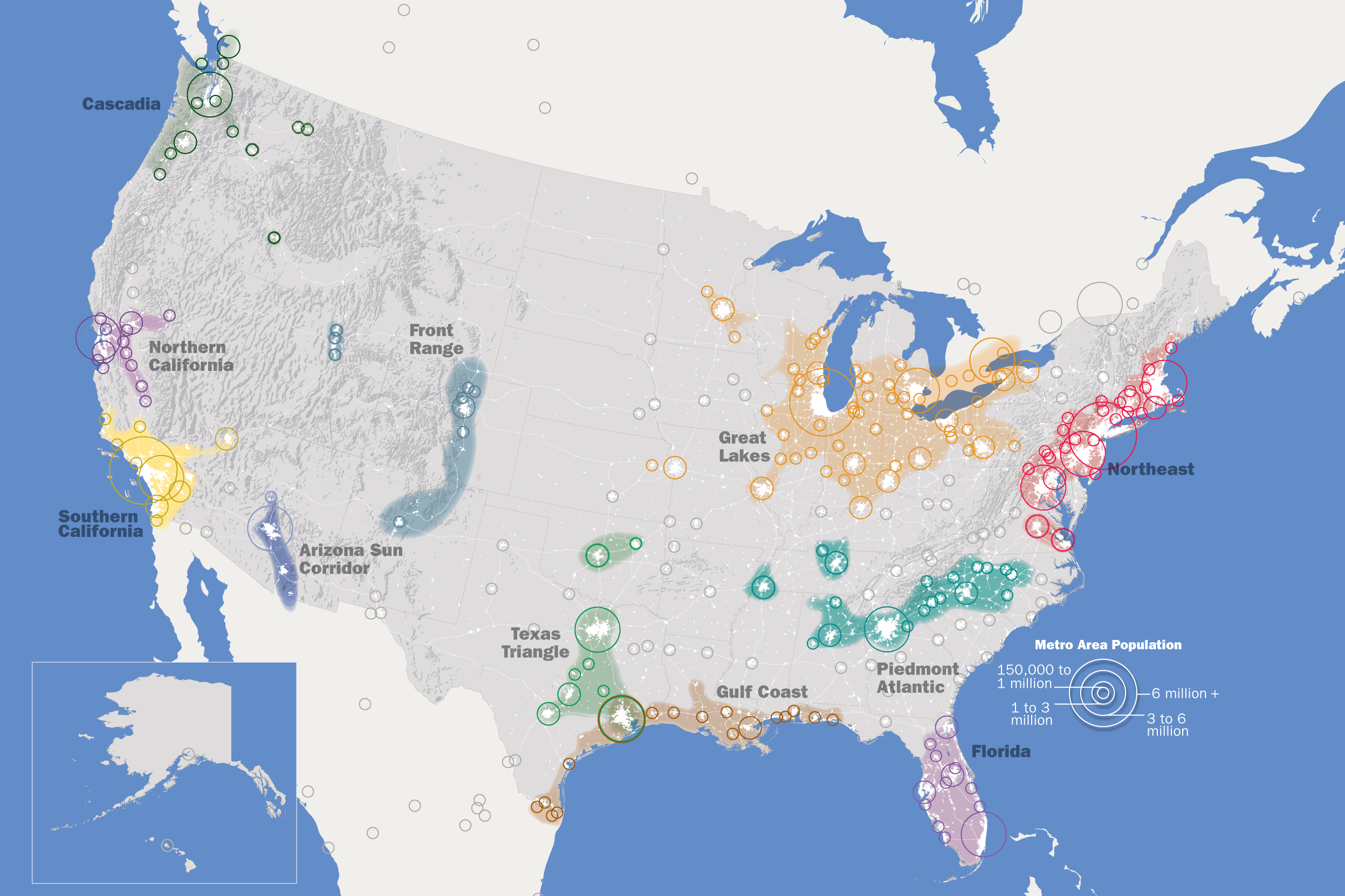
Primarily a project of think tanks with funding by large foundations, the Sun Corridor is one of several "megapolitans" in the US which were defined only about ten years ago based on projected population, proximity between two or more urban areas, an economic integration across boundaries, and their importance in global trade. In some ways it is a prediction based on a trajectory, but mostly it is an agenda for profit-seekers. The Sun Corridor concept is by no means homegrown. Some local officials adopted it after being informed by consultants of the “benefits” of the global competitiveness it would bring, or by the institutions pushing public-private partnerships or state trust land reforms for more developments or infrastructure.
Megaregions, Global-City Regions, Mega-Cities, etc. as trade hubs that surpass the metropolitan scale are not at all specific to the US, nor are they new. These and the accompanying finance, infrastructure and governance projects arose out of free-market-oriented models across the world, largely promoted and pushed by the World Bank specifically through structural adjustment programs and development over the last couple decades. The economic integration mirrors that of arrangements such as NAFTA paired with infrastructure like CANAMEX/I-11, or the the European Union with their passenger rail system. The Sun Corridor is part of a much broader shift towards large private companies attempting to gain access to decision-making and tax dollars to carve their design into the land in effort to increase economic competitiveness.
Profit-making opportunities abound for the few who are in a position to take advantage if the Sun Corridor comes to fruition. First, a megapolitan is seen as an important node in global trade, a way for the region to become economically competitive, or at least this is the justification used for promoting growth. It is also an opportunity for companies to win infrastructure deals, since pushing the megapolitan concept brings along "necessity" for infrastructure like roads and rail. It may allow for changes to laws regarding state trust land, which would enable transportation projects and new development projects. Megapolitans, along with other megaregions, span municipal and sometimes state or even international lines and render the area vulnerable to imposition of new methods of organization and governance, with the full intention of providing private interests access to decision-making and new "partnerships." An arrangement called a public-private partnership (P3) is an integral part of the megapolitan plan.
Financial Interests
Big banks, consultants, engineering and construction companies, and real estate developers all have interests in these new projects, even if they're not quite all on the same page. Those with the most power and influence are the large financial institutions with their relationships to think tanks, foundations, and academia.
Despite the high degree of interest in the construction of new roads and such, the the overarching motivation mustn't be overlooked. As explained in More than Bricks and Mortar, the primary incentive is likely a growing effort on the part of financial institutions and those who see common interests to find more profit-making opportunities.
 |
| Arizona Sun Corridor Partnership |
"... 'infrastructure' is less about financing development (which is at best a sideshow) than about developing finance..." "what is being constructed are the subsidies, fiscal incentives, capital markets, regulatory regimes and other support systems necessary to transform 'infrastructure' into an asset class that should yield above average profits."Public-private partnership (P3), a variation on privatization, is the increasingly preferred “innovative financing solution” used to accomplish arrangements for transportation projects, sometimes involving toll roads for example, but often instead, companies get paid through taxes. P3s may be somewhat new to the US, but they're not new to the world. Since the 1980's, investment banks have developed new ways of making sure they receive full repayment for loans to countries across the world, rather than accepting when they've made bad investments. Repayment was ensured through the International Monetary Fund (IMF) and the World Bank, which saw major neoliberal influence in the early 80's, with a major role played by the Rockefeller Foundation, whose sway did not stop there. Indebted countries were then required to make institutional reforms called "structural adjustment programs" which cut back on social welfare programs and opened the country up to privatization and further foreign investment. Increasingly, investment banks and others have sought opportunities for profit-making in various developing countries, but also in Europe and North America through P3s for infrastructure projects. While structural adjustment programs had largely functioned as austerity measures and accepted only as conditions for accessing loans (with little to no choice), P3s in the US are portrayed as smart options for building roads and such.
In the early 2000s, financial institutions began to arrange for public-private partnerships (including the reform of state laws to enable P3s) to fund infrastructure projects in the US. These ranged from preservation and repair of old transportation infrastructure to development of new infrastructure, specifically trade corridors and transportation that would facilitate conurbation, such as intercity passenger rail. The relationships between the World Bank, Rockefeller Foundation (and other Rockefeller institutions and individuals), JP Morgan Chase, the Brookings Institution, and beyond is integral to this direction. The projects that get completed will have more and more to do with what these elite institutions decide to arrange financing for.
 The "Megapolitan" in particular was conceptualized in
the mid-2000s. It largely arose out of a graduate urban planning
studio at University of Pennsylvania School of Design in 2004 called "Plan for America" involving the Regional
Planning Association (RPA) and the Lincoln Institute of Land Policy
(with connections to the World Bank and close ties to the Brookings Institution). RPA and the Lincoln
Institute, sometimes along with the Rockefeller Brothers Fund, Rockefeller Foundation, and/or the Ford Foundation
sponsored several more forums, conferences, studies and documents. Out of this came
America 2050 (funded by the Rockefeller Foundation through RPA, as well as the Ford Foundation), which is
a primary proponent of the megapolitan concept, along with high-speed
passenger rail.
The "Megapolitan" in particular was conceptualized in
the mid-2000s. It largely arose out of a graduate urban planning
studio at University of Pennsylvania School of Design in 2004 called "Plan for America" involving the Regional
Planning Association (RPA) and the Lincoln Institute of Land Policy
(with connections to the World Bank and close ties to the Brookings Institution). RPA and the Lincoln
Institute, sometimes along with the Rockefeller Brothers Fund, Rockefeller Foundation, and/or the Ford Foundation
sponsored several more forums, conferences, studies and documents. Out of this came
America 2050 (funded by the Rockefeller Foundation through RPA, as well as the Ford Foundation), which is
a primary proponent of the megapolitan concept, along with high-speed
passenger rail.Central to the definition and promotion of megapolitans and the Sun Corridor is Robert E. Lang, originally of Virginia Tech, with fellowships through the Lincoln Institute of Land Policy and the Brookings Institution and involvement in America 2050. He co-authored numerous papers on US megapolitans, as well as the book Megapolitan America. Making the "Sun Corridor" a much more recognizable name, he worked with the Morrison Institute (with Grady Gammage Jr.) on the Megapolitan: Arizona's Sun Corridor while a visiting professor at Arizona State University. Lang became a spokesperson for the concept.
In 2008 when this Morrison report came out, the Arizona Republic printed an article in which Lang (with John Stuart Hall) revealed some of the primary reasons for interest in the Sun Corridor:
Mega regions will be closely watched because of the importance of more people to federal funding formulas (such as with transportation), marketing targets and venture-capital options.
The Sun Corridor also has unique challenges. For example, how state trust land will be developed is a critical wild card since more than a quarter of the Sun Corridor is managed by the State Land Department.State Trust Land
In the context of a major drought, imagine a whole new city of another million residents being planned south-east of Phoenix. The Lincoln Institute of Land Policy has been particularly interested in state trust land reforms, notably in Arizona for this project called the Superstition Vistas.
State trust land was provided to various states by the United States Congress for each state to lease or sell as a way to generate revenue to benefit public institutions such as schools. Currently, Arizona state law requires that parcels of land are sold at auction to the highest bidder, making it nearly impossible for such a large section of land to be purchased with one central plan in mind. Most of the planning for Superstition Vistas dropped off due to the recession, but the land, or some of it, will likely be up for auction soon. The planning has taken place with the hopes that legal obstacles can be overcome.

Prior to the Sun Corridor report, the Morrison Institute (with Lang and Gammage) was commissioned by the Superstition Vistas steering committee for a study on the development of the land which they published in 2006 (The Treasure of the Superstitions). The steering committee also brought in the Lincoln Institute of Land Policy and the so-called conservation group, the Sonoran Institute based out of Tucson, around which time, the two groups created a joint venture.
Interest in this project and the involvement of Lang and the Lincoln Institute seems to have been integral to the advancement of the megapolitan concept and the Sun Corridor in particular. Characterizing the area as a megapolitan region could be used to justify a development project like the Superstition Vistas and the necessary state trust land reforms, and accommodate cross-boundary governance which could more easily bring in private interests. Changes to the state trust land laws in Arizona would facilitate other development and transportation infrastructure projects, such as Interstate 11 connecting Las Vegas with Phoenix and potentially beyond. According to Megapolitan: Arizona's Sun Corridor, "...this effort could become a model for mega-scale thinking about state trust land and its role in the future of Arizona."
To recap and add
some context, Robert Lang and the Lincoln Institute got involved in
the Superstition Vistas project around the time that Lang (with his
fellowship from the Lincoln Institute) was working on the megapolitan
concept. The Morrison Institute Sun Corridor report was published two
years after the Superstition Vistas report.
Also significant may be that in 2005, the Lincoln Institute hired a
new president, Gregory Ingram, who had worked for the World Bank and
International Finance Corporation (the World Bank's private arm that
is heavily involved in infrastructure investment). Ingram remained
president until 2012 and may have had influence on the direction of
the Institute in favor of the megapolitan concept. Also
significant is that the Arizona state land department Commissioner as
of 2012, Vanessa Hickman, sees importance in the success of
Superstition Vistas and is now also on Arizona's Transportation and
Trade
Corridor Alliance (TTCA), a public/private entity that promotes the
importance of "key commerce corridors"--essentially trade
infrastructure.
The Morrison
Institute reiterates
the importance of this land in their 2012 report. "The 2.4
million acres of State Trust Land that make up 18% of the total Sun
Corridor area will be critical to the future growth of the area."
Additionally, they emphasize the role of this land for high speed
rail. "It is possible to site a high speed rail line between Phoenix
and Tucson largely on state trust land. While there are considerable
legal challenges to this, the rewards would be substantial."
Freeways and High Speed Passenger Rail
The importance of high speed rail (HSR) to the megapolitan and megaregion concepts can not be overstated. It is difficult to determine whether rail-builders' interest was what boosted the megapolitan idea, or if it is the megapolitan concept that requires the intercity rail. What is clear is that HSR would play a very important role in tying the urban areas together.
Private-Sector Imposition
Most likely any high speed rail project in Arizona, if it gets built, will be a public-private partnership (P3), like many are in Europe. The way things are going, the same could be said for roads as well. P3s can involve concession such as rail fares or tolls on roads, but can in some cases allow for an arrangement in which private companies can access financing that they couldn't otherwise, in the form of low-interest federal loans, tax-free bonds, and payments from tax-payers via local government. P3s are more attractive to governments because the arrangements allow for getting transportation projects finished without relying on the minimal government funding, although they often don’t work out in the public’s favor. The companies themselves are interested in profit, and on a larger scale, financial institutions are able to make money as well.
As described in More
than Bricks and Mortar, "Under PPPs, the private sector builds,
finances and manages a
project in return for the government guaranteeing a revenue stream
from the project’s users (in the case of a toll road, for instance,
the government undertakes to pay should usage fall below a minimum
number of cars per day) and giving other contractual undertakings." The
report explains that the situation has been described as a “'build now,
pay later' scheme that
is 'no different from the credit card consumerism boom that
contributed to the global financial crisis.'" An illusion is created in
which it seems that financing is coming from a private source, but in
the end, taxpayers or service users are making the payments. Elsewhere,
P3s are often compared to mortgages, and we've seen how well we can
trust banks and the government to keep these debt-based transactions
from impacting the broader economy.The importance of high speed rail (HSR) to the megapolitan and megaregion concepts can not be overstated. It is difficult to determine whether rail-builders' interest was what boosted the megapolitan idea, or if it is the megapolitan concept that requires the intercity rail. What is clear is that HSR would play a very important role in tying the urban areas together.
The Arizona Department of Transportation has a study in the works for a
high speed passenger rail between Phoenix and Tucson. Of the three
routes they’ve narrowed it down to, the eastern-most (orange)
alternative runs right through the area some planners still hope will be
the Superstition Vistas. The central (yellow) route could also serve
this area.


The first of five objectives of the Sonoran Institute, one of the main
promoters of the Superstition Vistas project, was to “promote a commuter
rail system linking Phoenix and Tucson," according to their 2010
publication “Riding the Rails to Sustainability,” as part of their Sun Corridor Legacy Program.
While the best selling point for megapolitan development is high speed passenger rail as an alternative to driving, it is not as incompatible with new highways as it's made to seem. Certain environmental non-profit organizations citing research on megapolitans and population are promoting studies that show a decreasing number of drivers and therefore less need for new highways, and yet the megapolitan vision requires new roads as well, particularly the important trade corridors. Specifically, USPIRG and AZPIRG are funded by the Rockefeller Foundation for their HSR projects, and their publications reference America 2050, the primary promoter of the megapolitan concept, which is also funded by the same foundation. Aside from America 2050, most of the promoters of pairing the megapolitan concept with passenger rail also see CANAMEX or trade corridors in general as necessary endeavors.
While the best selling point for megapolitan development is high speed passenger rail as an alternative to driving, it is not as incompatible with new highways as it's made to seem. Certain environmental non-profit organizations citing research on megapolitans and population are promoting studies that show a decreasing number of drivers and therefore less need for new highways, and yet the megapolitan vision requires new roads as well, particularly the important trade corridors. Specifically, USPIRG and AZPIRG are funded by the Rockefeller Foundation for their HSR projects, and their publications reference America 2050, the primary promoter of the megapolitan concept, which is also funded by the same foundation. Aside from America 2050, most of the promoters of pairing the megapolitan concept with passenger rail also see CANAMEX or trade corridors in general as necessary endeavors.
While AZPIRG has solicited support for
their HSR campaign from groups opposing Interstate 11 and
the South Mountain Freeway, they likely will not join the opposition to these roads
themselves, other than releasing a report naming the I-11 as one of several money-wasting “boondoggles.” It may be lost on them that the Sun Corridor concept
justifies and even requires the trade corridor that I-11 would
become, and the truck bypass that the South Mountain Freeway/Loop 202
extension would provide. The megapolitan is nearly always portrayed
as an international trade hub, which requires massive multi-lane
roads for freight trucks. "A successful Interstate 11 will be a smartly designed multi-modal trade
corridor that yields multiple benefits for rural and underserved
communities on both sides of the U.S.-Mexico border," is the opinion of the Sonoran Institute, or at least its Sun Corridor program director, who recently wrote in favor of the I-11. Dowdy lists rail specifically in an October 8th pro-I-11 commentary.
This is not the only mention of I-11 having multiple modes for transportation (and possibly for energy and even water). Potentially, the excitement for HSR could inadvertently be used to facilitate an acceptance of I-11, even despite PIRG's portrayal of I-11 as a boondoggle in their vaguely pro-HSR report (the report is largely based on their Rockefeller Foundation-funded research by both PIRG and the Frontier Group including the more blatantly pro-HSR "A Track Record of Success"). In a September 29th letter to the editor from AZPIRG, the director wrote, "We agree that 'this isn't about cars vs. transit' and that there should be a larger vision for an Intermountain West multi-modal corridor." The AECOM Sun Corridor report states that there's a potential to share right-of-way between rail and highway. Additionally, ADOT's 2011 Rail Plan (prepared in part by AECOM as a consultant, including Mike Kies and John McNamara who are involved in the I-11 Study) stated, "The proposed Interstate [11] route may be developed as a multimodal corridor, including freight rail, and is part of the Canamex high priority corridor, which is envisioned to include intercity or high-speed passenger rail service." Again, even if the I-11 is not justified by pairing it with HSR, there is demand for trade corridors with or without HSR.
This is not the only mention of I-11 having multiple modes for transportation (and possibly for energy and even water). Potentially, the excitement for HSR could inadvertently be used to facilitate an acceptance of I-11, even despite PIRG's portrayal of I-11 as a boondoggle in their vaguely pro-HSR report (the report is largely based on their Rockefeller Foundation-funded research by both PIRG and the Frontier Group including the more blatantly pro-HSR "A Track Record of Success"). In a September 29th letter to the editor from AZPIRG, the director wrote, "We agree that 'this isn't about cars vs. transit' and that there should be a larger vision for an Intermountain West multi-modal corridor." The AECOM Sun Corridor report states that there's a potential to share right-of-way between rail and highway. Additionally, ADOT's 2011 Rail Plan (prepared in part by AECOM as a consultant, including Mike Kies and John McNamara who are involved in the I-11 Study) stated, "The proposed Interstate [11] route may be developed as a multimodal corridor, including freight rail, and is part of the Canamex high priority corridor, which is envisioned to include intercity or high-speed passenger rail service." Again, even if the I-11 is not justified by pairing it with HSR, there is demand for trade corridors with or without HSR.
Due to issues with increased development contributing to pollution, the
urban heat island effect, increased water usage, impacts to wildlife,
displacement of people, and damage to South Mountain in the case of
the Loop 202 extension, the Sun Corridor's architects know that this
megapolitan idea will only be accepted if it can be portrayed as
“green”--as environmentally sustainable and responsible. But
there are many ways of making something appear green that really
isn't, such as can be seen with market-based mechanisms which
involve turning things into commodities such as carbon for trade.
Greenwashing is a term used to refer to the "unjustified
appropriation of environmental virtue by a company, an industry, a
government, a politician or even a non-government organization to
create a pro-environmental image, sell a product or a policy,"
according to SourceWatch.
This is not to imply that the benefits of HSR are enough to greenwash
trade corridor infrastructure. HSR also requires a certain amount of
greenwashing to justify itself. And this is not the only way that
paving over the land to make space for transportation will be
greenwashed.
High speed rail would not only be used to make the megapolitan or trade
corridors acceptable. It supports the concept of the megapolitan as a
node in international trade, it is meant to facilitate regional identity
and economic integration, it is another piece of infrastructure that
provides finance opportunities, and would contribute to the destruction
caused by increased development. It is true that HSR makes sense to many
in an era of diminishing oil. But the political and economic stability
sought by having alternatives to oil-based transportation is meant to
support commercial and financial productivity, not to save the planet.
That which primarily inspired early
proponents of HSR including Robert Lang to promote US megapolitans
paired with HSR is the European model of regionalism and the ways
HSR facilitated economic integration (the EU) and regional identity.
Lang and a couple of RPA/Lincoln Institute colleagues promoted HSR as
early as 2005, while most others (Brookings Institution, AECOM, PIRG,
and even Lincoln Institute as a whole) didn't pick up on it in any
significant way until 2009 when Obama promised billions of dollars in federal funds for HSR,
at which point the HSR lobby grew exponentially. State officials, but
especially the private sector, have gathered that alternative modes
of transportation are necessary and desired, yet profit is the underlying motivation. Legislation continues to be introduced to facilitate more HSR in the US. Rockefeller Foundation/America 2050's U.S.
High-Speed Intercity Passenger Rail Program has made investments of
$10.1 billion in high-speed and conventional passenger rail corridors
across the country, according to a 2011
report. How much money would their associates (board members even?) stand to make from these projects?  |
| HSR map overlaying Megapolitan map from USHSR |
Private-Sector Imposition
Most likely any high speed rail project in Arizona, if it gets built, will be a public-private partnership (P3), like many are in Europe. The way things are going, the same could be said for roads as well. P3s can involve concession such as rail fares or tolls on roads, but can in some cases allow for an arrangement in which private companies can access financing that they couldn't otherwise, in the form of low-interest federal loans, tax-free bonds, and payments from tax-payers via local government. P3s are more attractive to governments because the arrangements allow for getting transportation projects finished without relying on the minimal government funding, although they often don’t work out in the public’s favor. The companies themselves are interested in profit, and on a larger scale, financial institutions are able to make money as well.
Nearly any document promoting megapolitans and/or trade corridors also touts P3s for their indispensable benefits, even including the early megapolitan-related 2004 City Planning Studio/Lincoln Institute document, Toward an American Spatial Development Perspective. The Brookings Institute in particular has been producing documents and policy recommendations for P3s for years. The primary Brookings document related to the Sun Corridor is by Robert Lang called Mountain Megas (2008).
Also
check out Plans
for Privatization of I-11
Other publications that advanced the Sun Corridor concept, trade corridors, P3s and megapolitans include North America Next: North American Opportunities and the Sun Corridor (2009) prepared by the North American Center for Transborder Studies (NACTS) at ASU (now defunct); and the Sun Corridor, Future Corridor report (2010) by AECOM Global Cities Institute.
As with many neoliberal-leaning institutions, the view is that the federal government's role is to facilitate free-market policies such as free trade. In chapter five of Brookings' Mountain Megas document, entitled "Forging a New Federal-Mega Agenda for the Intermountain West" which highlights the Sun Corridor, the authors emphasize CANAMEX/I-11 and high speed passenger rail along with P3s.
Brookings and other think tanks have had success in moving the federal government in the direction of P3s. The megapolitan/P3 project has increasingly been taken on by the federal government as shown by tax-breaks and other forms of corporate welfare, as well as providing resources for local governments to implement policy changes. Case in point is the September 9, 2014 announcement of the federal government’s Build America Investment Initiative, although this is not the first effort to promote P3s. According to Chadbourne.com,
The part of the President’s new initiative that could provide the most immediate benefit is creation of a new office within the US Department of Transportation called the Build America transportation investment center. The center will open by November 14. The President said it will serve as a “one-stop shop for cities and states seeking to use innovative financing and partnerships with the private sector to support transportation infrastructure.”
The center will play an informational role. It will make federal resources more understandable and promote access to federal credit assistance programs to help finance transportation infrastructure.This initiative includes a joint investment between the Rockefeller Foundation and the Ford Foundation of “over $1 million to support innovations in U.S. infrastructure. The new partnership will expand the infrastructure pipeline by incubating innovative public private collaborations, including... Provide seed capital for promising regional collaboration models, including regional infrastructure exchanges, that make it easier for localities to attract private finance…” “Regional” here likely implies megaregions or megapolitans.
It is worth noting that large foundations serve many roles. In addition to acting as tax shelters, foundations often have political agendas relating to the interests of their board members and/or the companies they invest in. For example, there has been a long-standing relationship between the Rockefeller Foundation and JP Morgan Chase. Many think of foundations as simply a provider of charitable donations and grants to non-profits. Tax law requires foundations to spend a minimum of 5% of their taxable assets on grants and administrative expenses, which allows much of the rest to be invested. Foundations such as Ford and Rockefeller are not politically neutral, but instead are particularly interested in proliferating free-market capitalism, managing dissent, maintaining economic and political stability, and strengthening US hegemony. They are part of the power elite. Governance allows for participation not just from the companies that foundations have relationships with, but also from non-governmental organizations (NGO’s) who often do their bidding--all with an appearance of being more democratic.
Another example of obvious involvement of the federal government is the Federal Highway Administration website and their promotion of megaregions such as in their Megaregions Report and literature review prepared by Catherine Ross (member of the National Committee for America 2050) in 2011. This, along with their promotion of P3s, has likely resulted due to lobbying. Although it may appear as a more horizontal governance approach through incentive funding and relaxation of current laws rather than top-down state power, the intention is that private interests will benefit from federal government-given protectionism and subsidies. This is a variation of “actually-existing neoliberalism,” a form that utilizes the state to allow the private sector into decision-making and financing that it previously had little access to. Governance facilitates an entry of the private sector into official decision-making such as for more infrastructure and more P3s. In the case of these types of governance structures, decisions tend to be made behind closed doors.
Brookings also promotes a new method of governance. In their Mountain Megas report, they advocated for tweaking Municipal Planning Organization (MPO) law and creating governance structures such as the Joint Planning Advisory Council (see below), and to incentivize other innovations in governance for megapolitans. This echos Lang's early writings on the megapolitan concept: "...new super MPOs could result from future legislation that directs Megapolitan Areas to plan on a vast new scale."
The junction of megapolitans/megaregions, governance, and P3s is rooted in "new regionalism," as Ross' FHWA report discusses:
...'new regionalism', proposes an institutional shift in regional emphasis from government to governance, and emphasizes public and private-sector partnerships and joint ventures... The new institutional forms require a strong coordination of governments at different scales, and public and private actors...The territorial and functional reorganization of the power of the national government means the changes of its boundaries in terms of roles, emphasizing the coordination of the boundaries between public, private, and other actors.In this same report it was argued that the Sun Corridor "will have to consider a different form of governance, regional cooperation and infrastructure investment that will promote its global perspective and shift the paradigm to solidify it as a new geographic entity."
Described as a milestone in Sun Corridor efforts, a Joint Planning Advisory Council (JPAC) was formed in 2009 by the Maricopa Association of Governments (MAG), the Pima Association of Governments (PAG) and the Central Arizona Association of Governments (CAAG). They are joined by their private “partnering agencies," the Arizona Mexico Commission (a P3 unit that is said by their CANAMEX expert to be the "godfather" of CANAMEX), the CANAMEX Coalition (also a P3 unit), AECOM, and the Morrison Institute.
Trade with Mexico
This same collaboration as initiated with
JPAC is considered highly important according to the NACTS
report, which the authors argued "should be implemented to
take advantage of international opportunities." NACTS, the
now-defunct ASU establishment, was an extension of the Security and
Prosperity Partnership via the Council of the Americas. They have been
a major proponent of NAFTA and the CANAMEX Trade Corridor and they
conceptualized the Sun Corridor as a multi-modal inland port.
Also
check out Filling
in the I-11/CANAMEX Gaps
CANAMEX
is a NAFTA trade corridor stretching from the western Mexican port of
Guaymas up through five US states to Alberta, Canada. Interstate 11 is
needed to create a better truck route between Las Vegas and Phoenix, but
is intended to extend the length of the CANAMEX corridor or some
variation on it
called the Intermountain West Corridor, therefore going through or near
Tucson to Mexico (read more on the I-11 confusion at Filling in the I-11/CANAMEX Gaps). AECOM defines the Sun Corridor as a
piece of the CANAMEX Corridor and envisions the Sun Corridor as an inland port
with a strong trade relationship with Mexico. Their Sun
Corridor, Future Corridor report (2010) was written by AECOM
Global Cities Institute. One author was AECOM's John McNamara who is
now instrumental in the Interstate 11 Study and was involved in the
Arizona
Trade Corridor Study, an early CANAMEX document of 1993.
AECOM, which is one of the private
partners within JPAC, seems to have entered the megapolitan game when
they got a board member on RPA in 2006 (Kevin S. Corbett, DMJM
Harris). They are involved in various types of transportation
infrastructure and P3s, including high speed passenger rail and roads,
the I-11 Study being only one of them. Just like
the Brookings Institution's Mountain Megas report, both AECOM in their Sun
Corridor, Future Corridor report (2010), and the Central Arizona Association of Governments (2011) prioritized
I-11/CANAMEX and high speed rail as central to the Sun Corridor
project.
The Sun Corridor and its position within the CANAMEX Corridor claim to provide business opportunities such as for the Casa Grande-based PhoenixMart, a massive wholesale trade center involving a foreign trade zone. Casa Grande is planning an "inland port" involving proximity to one or more Foreign Trade Zones (FTZ) and increased rail infrastructure. FTZs and other such zones are being increasingly created to provide incentives to big companies to do business in those areas, allowing them to avoid paying certain taxes and fees. Last year, in "PhoenixMart seen as catalyst" Melissa St. Aude wrote (likely confusing the term megapolitan with megalopolis):
Casa Grande could someday be the epicenter of a sprawling Sun Corridor megalopolis, spanning from Tucson to Phoenix. That was the vision given Friday by PhoenixMart Chief Executive Officer Steve Betts and AZ Sourcing President Jeremy Schoenfelder...
At the center of the megalopolis would be PhoenixMart, a nearly 2-million-square-foot sourcing center with 1,750 manufacturer showroom suites, attracting wholesale buyers from around the world and triggering development of various spin-off businesses ranging from hotels, restaurants and warehouses to other services.The promise of Arizona's economic growth has everything to do with trade with Mexico. As Albert Lannon of the Avra Valley Coalition pointed out, the I-11 Corridor Justification report use of certain projections to explain the benefits of the Interstate is telling.
The key words in the projections are “nearshoring” and “integrative manufacturing.” The planners predict that, as Chinese wages rise, Mexico will become more attractive to corporations. With U.S. manufacturing labor costs at 100 on an ADOT index, China is 5 and Mexico 12. As “trade with Mexico expands,” the report argues, so will “the current trend of moving manufactured goods production … to Mexico. ... Mexico was the most popular choice for nearshoring, where hourly compensation costs are nearly as low as China.”
The report suggests “industry clusters” and “integrative manufacturing” to house the making of parts in the U.S., with assembly in Mexico. Kies told the stakeholders, “Mexico is happening!”
The report discusses planned improvements at the Mexican port of Guaymas for container traffic. That impacts high-paying jobs in the West Coast stevedoring, trucking and warehouse industries. The report discusses receiving even more goods from Asia as another “alternative future scenario.
In their discussion of marketing I-11 to the public, the pitch is “enhancing economic vitality” and “commercial opportunities.” I-11 is being sold as a way for corporations to make more money. Period. There is no expressed interest in workers except as cheap labor across the border.

The Megaregion/megapolitan, due to its alleged promise of prosperity, is popping up everywhere, with different interests promoting varying concepts with a lack of coordination. Arizona and Sonoran government officials recently signed a partnering agreement called the Arizona Sonora Binational Megaregion. One of their listed guiding principles is to "Use the megaregion as a framework to further enable the development of local relationships to advance projects/initiatives of regional significance on both sides of the border in areas such as transportation and infrastructure, education, economic development, border security and public safety, trade area promotion, commerce and tourism."
And there's also the Southwest Triangle
Megaregion, seemingly having everything to do with I-11. This specific megaregion is a new concept notably used in
the I-11 Study documents by AECOM and CH2MHill. The triangle
connects the Sun Corridor, Southern California Megapolitan, and Las
Vegas. Older plans for high-speed passenger rail making this same triangular connection
likely play a part in the creation of this megaregional
conceptualization. Additionally, some other people came up with the nearby Cali-Baja Binational Megaregion. Perhaps all of this will turn into the Southwest-Sonoran Trapezoid Mega-mega-region.
Somehow the logic of globalization does
not acknowledge the absurdity that the population growth in the Sun
Corridor is used to justify the area's role in global trade,
specifically NAFTA, even though it is policies like NAFTA that
have caused the displacement south of the border, leading to
migration and population growth in Arizona. The population projections
for
the Sun Corridor are based on the growth of the region leading up to
the primary studies on the concept around the mid-2000's. More recent
estimates show lower numbers but still project a few more million in the
area by
2050. Pro-NAFTA institutions such as the Rockefeller Foundation,
Brookings Institution, NACTS, etc, would have us believe that we can
still expect trickle-down benefits from these sorts of trade
arrangements. We are to accept the idea that this the Sun Corridor
should be a trade-hub, with its accompanying foreign trade zones
allowing tax- and duty-free transactions for corporations.
Migration from
south of the border is a primary factor in local population growth and
encouraging or embracing that growth through Megapolitan development
would seem to hasten the likelihood that white people will become the
minority, a rather silly concern. Nonetheless, Robert Lang dedicated a
portion of his book, “Megapolitan America”
to easing the fears of white people about getting out-numbered. He
reasoned that the definition of whiteness is fluid and will be
expanded. There are a number of environmentalists who also concern
themselves with the ethnic and racial composition of population growth.

Recent history has shown us that racists and xenophobes use environmental concerns to try to push their population control policies, ranging from border security to sterilization (not to mention the Rockefeller Foundation's role in population control campaigns across the world). The real problem with megapolitans in the context of environmentalism is that they don't just accommodate population growth, they encourage expansion and consumption on a mega scale. The infrastructure and accompanying resource extraction are the much bigger problems.
Environmental Sustainability
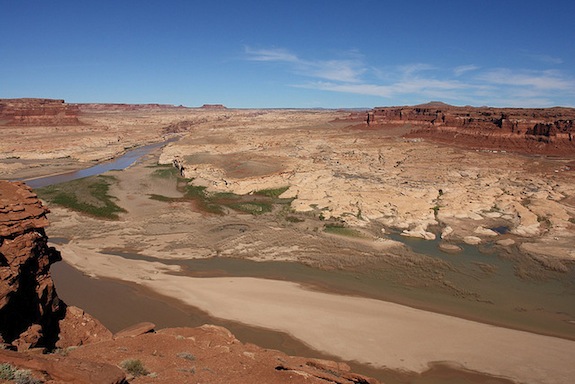
A new study shows that Arizona may be amidst a mega-drought, depending on how the next couple decades go. Yet the Morrison Institute's 2012 Sun Corridor report describes the Sun Corridor as natural and organic. While they may see the ways that a tendency towards conurbation has occurred without much private or state intervention, a glaring omission of perspective is the basis upon which the settlement and urbanization occurred in the first place.
What isn't acknowledged is, for
example, "a coalition of lawyers,
businessmen, and politicians engaged in 'legal theft' to turn this
high desert, called Black Mesa, into one of America’s largest strip
mines. The energy from that coal would power the excesses of Las
Vegas and pump the Colorado River over three mountain ranges to
Phoenix as part of the Central Arizona Project, the world’s most
expensive water system," as described in a review
of Judith Nies new book "Unreal City." Also ignored is that Tucson as a settler city was able to survive and grow
due to the pumping of groundwater from the Tohono O'odham San Xavier
reservation, that O'odham water rights have been undermined, and that
their access to Central Arizona Project water was contingent on not
having the power to prevent more pumping and pollution (e.g. from
mining) of their groundwater.
The Morrison Institute
report, Watering the Sun Corridor, a follow-up to the original Sun Corridor document, contains concluding remarks that are
rather myopic, and pretty much racist, with this in mind. They write, "The Sun Corridor
exists only because past Arizonans worked together tirelessly to
build a vast, complex plumbing system. Using the power of government
to do this represented the clearest consensus imaginable about
serving the needs of society through collective action" (my emphasis).
This
report is also laden with admissions of the limitations regarding
knowledge about whether the Sun Corridor area has enough water to
sustain it. Overall, it recommends proceeding with caution, and
attempts to legitimize the development even if it takes more drastic
infrastructural changes to accommodate it, along with a few less
swimming pools.
 The impact of settler infrastructure projects on indigenous communities
is not a thing of the past, but continues, for example in the building
of roads like the South Mountain Freeway, which would be central to the
junction of the Sun Corridor and the I-11 Las Vegas-Phoenix Corridor.
Its function as a truck bypass would cut through the mountain sacred to
the O'odham and cause damage to the environment and to health.
The impact of settler infrastructure projects on indigenous communities
is not a thing of the past, but continues, for example in the building
of roads like the South Mountain Freeway, which would be central to the
junction of the Sun Corridor and the I-11 Las Vegas-Phoenix Corridor.
Its function as a truck bypass would cut through the mountain sacred to
the O'odham and cause damage to the environment and to health.
In addition to the impacts of global warming, the urban heat island effect, largely due to roads, will raise
temperatures. In one
study,
the researchers show "the intensification of observationally
based urban-induced phenomena and demonstrate that the direct
summer-time climate effects of the most rapidly expanding megapolitan
region in the USA—Arizona’s Sun Corridor—are considerable."
Can't we just paint all the roofs white to reduce the impact of the
heat island effect? Well, that might be nice if it didn't also
decrease rainfall by as much as an additional 4% on top of the 12%
from Sun Corridor growth as discussed in "Researchers
emphasize need for evaluation of tradeoffs in battling urban heat
islands."
Just like the impact of coal mining in northern Arizona has been overlooked, so too have repercussions of copper mining. Freeport McMoran, the largest copper producer, with various mines in Arizona (and elsewhere) and an office in downtown Phoenix, has interests in state trust lands; they're buying up farmland for water rights; and they're scheming to gain access to more tribal water rights across Arizona. With one of the highest paid CEOs in the world, Freeport has finagled Arizona water legislation to allow them to pollute ground water (not to mention what they've done in New Mexico). In January, Freeport hired the previous director of the Arizona Department of Water Resources as their director of water strategy. Freeport is a major participant and sponsor of the Arizona-Mexico Commission--self-identified as the god-father of the CANAMEX Corridor--most likely because of their interest in the Port of Guaymas. Mining requires an exorbitant amount of water, yet individual residents will be made to feel guilty about how long they shower.
"Follow the money" is more than a cliché. The infastructural projects are clearly a means to make a few people money. Furthermore, the Sun Corridor is a fantasy at best, a heat- and drought-ridden, abandoned and perhaps apocalyptic scene at worst. Or there is no Sun Corridor. Growth, development, resource/energy extraction, can all be slowed or stopped with enough effort.
Published with the permission of the Stop CANAMEX blog